AFD · SAXONY-ANHALT
43%
DECLARED DONATION
€40K
SPD MEMBERS · 2025
348K
YOUTH FEEL HEARD
20%
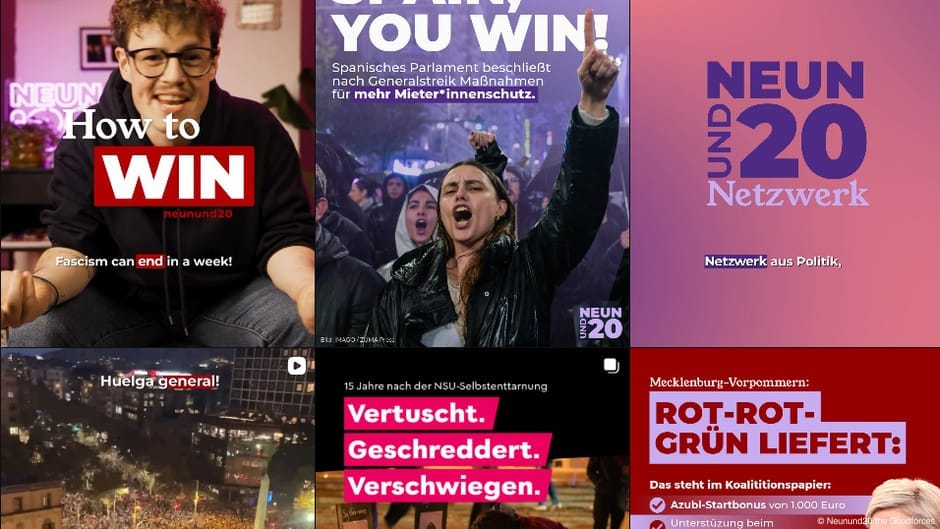
A Berlin agency called the Goodforces is attempting something genuinely new in German politics: building a Super PAC-equivalent campaign infrastructure for the left, four years ahead of the 2029 federal elections. Co-founded by Patrick Haermeyer, a former online organizer for Bernie Sanders' 2016 US primary campaign, the agency operates outside party structures entirely, running social media content campaigns, tactical voting apps, and grassroots networking under the banner neunund20 (twenty-nine).
Extraction Map
The model borrows from multiple American sources. The content-sharing architecture is modeled on New York left-wing mayor Zohran Mamdani's campaign. The organizational philosophy echoes Sanders' 'not me, us' distributed mobilization. The legal structure mimics US Super PACs — entities that spend on campaigns without directly coordinating with candidates or parties. In Germany, where party funding comes partly from taxpayers and membership fees, and where donations are capped, this kind of outside player is essentially unprecedented. The agency's first measurable test came in Saxony-Anhalt's September elections, where it ran a tactical voting app recommending the SPD and Greens to prevent an AfD absolute majority. Both parties cleared the 5% parliamentary threshold, and each declared the help as a €40,000 donation. The AfD still won 43% of the vote and may produce Germany's first far-right state premier since the Nazi era — a result that simultaneously validates the agency's threat assessment and underscores the limits of tactical voting against a dominant force. The political response has been hostile from multiple directions. The BSW called the Saxony-Anhalt intervention 'infantilizing and perhaps even antidemocratic.' The FDP called the tactical voting tool 'wrong and intentionally misleading.' Both parties had reason to object — the FDP failed to clear the threshold, and the BSW barely squeaked in. But the criticism raises a real structural question: when an outside entity directs voters toward specific parties using algorithmic recommendations, who is accountable for the information quality? Political scientist Christoph Bieber of the University of Duisburg-Essen identifies the core tension: Germany has strict donor disclosure rules for Super PACs' American equivalents that simply do not exist here. The Goodforces funds itself through commissions and small donations of $20-$50, but no German regulatory framework governs transparency for this kind of entity. Bieber sees the agency as compensating for decades of party decline — SPD membership has dropped from 943,000 in 1990 to 348,000 in 2025, CDU from 750,000 to under 357,000 — but warns the model could 'further devalue parties and their structures.' The deeper dynamic is one of institutional decay creating a vacuum. Only 20% of young Germans felt their concerns were taken seriously in the 2025 elections. Centrist parties have hemorrhaged members for decades and failed to build digital campaign infrastructure competitive with the AfD, which was born in the social media era. The Goodforces is filling a gap that established parties created through their own inertia — but filling it with a structure that has no democratic accountability mechanisms built in. The twenty-year question is not whether this particular agency succeeds but whether it establishes a template. If outside-spending campaign infrastructure works for the German left, the right will build its own version — likely with deeper pockets and fewer scruples about donor transparency. Germany is importing an American political technology without importing the (already inadequate) American disclosure rules that nominally constrain it. The parties complaining about this today are the same ones whose institutional rot made it possible.
Worth reading?
OPTIONAL
Score
56
/100
Mixed — the agency addresses a real democratic deficit (party decline, digital gap against far-right) but introduces an unregulated influence channel that could easily become extractive once copied by better-funded actors.
What Is GRIN?
GRIN stands for Generativity, Resilience, Innovation efficiency, and Novelty openness. These four dimensions capture the essential characteristics of any memetic intelligence — whether a nation, a corporation, a religion, or a movement.
About GRINGenerativity
2/5
Resilience
2/5
Efficiency
3/5
Novelty
4/5
Extractive
2/5
Inverted
Does this create new capability or just redistribute existing value?
Modest new capability: fills a digital mobilization gap centrist parties failed to build. But redistributes existing voters via tactical apps rather than expanding political participation or building durable institutions.
Verified Facts (10)
Co-founder Patrick Haermeyer worked as an online organizer for the election team of Bernie Sanders in the US Democratic presidential primaries in 2016.
The AfD gained 43% of the vote in Saxony-Anhalt and its candidate may soon become Germany's first far-right state premier since the Nazi era.
The Greens and the SPD made it over the 5% hurdle; each party declared the help in the form of a €40,000 ($43,900) donation.
Membership of the SPD dropped from 943,000 in 1990 to some 348,000 at the end of 2025.
The CDU has seen a fall from 750,000 to under 357,000 members.
Only 20% of young people felt their concerns were taken seriously in the 2025 German elections.
The BSW called the intervention 'infantilizing, and perhaps even antidemocratic.'
The FDP called the tool 'wrong and intentionally misleading.'
Haermeyer says contributions generally range from $20 to $50.
Haermeyer and Peter Jelinek previously worked for Green Party European Parliament member Michael Bloss.
More latest news
Read all