ANNUAL ADAPT GAP
$300B
THRESHOLD BREACHED
1.5°C
ELECTRIFICATION SIGNERS
~75
ELECTRICITY TARGET 2035
20→35%
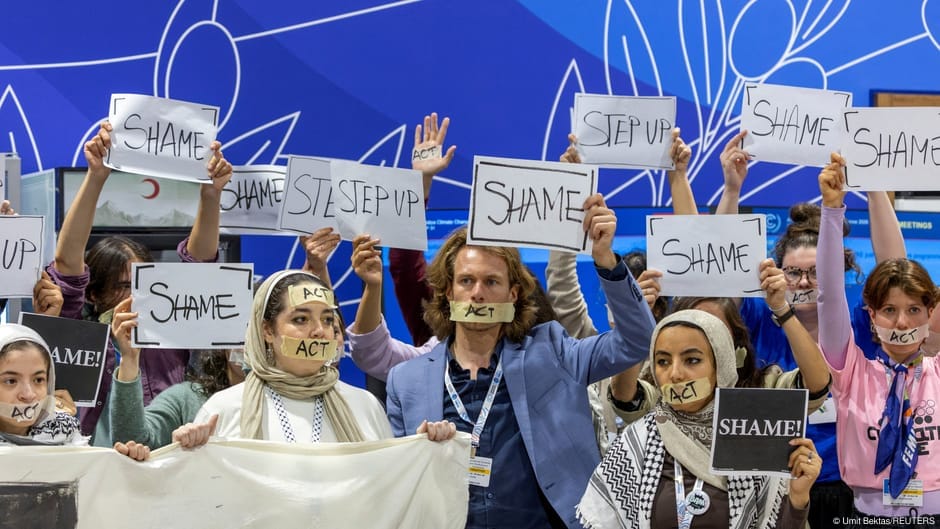
COP31 in Antalya ended almost two days past its deadline with no consensus — a collapse that exposes the fundamental deadlock at the heart of global climate governance. The EU, led by Irish climate minister Darragh O'Brien, rejected the proposed Antalya Pact because it omitted any mention of fossil fuels, calling it 'unconscionable.' Panama and the Marshall Islands joined, with the latter declaring it would 'not compromise our future to benefit fossil fuel interests.' Russia backed the omission, insisting each country should chart its own emissions path.
Extraction Map
The finance fight was equally intractable. Developing states blamed the EU and other wealthy nations for refusing to scale up adaptation finance, even as climate-linked disasters — deadly European heatwaves, a Nepali glacier collapse that killed over 1,400 — provided the backdrop to talks. The draft decision referenced $300 billion annually in developing-country adaptation needs through 2035 but proposed only 'further discussions' on tripling adaptation finance, without committing a figure. Harjeet Singh of Fill the Fund summarized the impasse: 'You can't ask developing countries to transform their economies while they're drowning in disasters and debt.' The rejected cover decision did contain some forward-looking language. It recognized electrification as a pathway to emissions reductions, calling for electricity's share of final energy demand to rise from 20% to 35% by 2035 — a proposal backed by co-host Turkey and adopted as a non-binding pledge by roughly 75 countries including China. Critics noted the pledge does not specify clean electricity, leaving the door open for fossil-fuel-generated power to fill the gap. Carbon capture and storage emerged as another fault line. The draft called for reaching 'gigaton scale' CCS by 2035. Vanuatu's climate minister Ralph Regenvanu objected that the technology 'had been singled out for special attention that it doesn't deserve,' echoing scientists who warn that CCS remains unproven at scale and expensive, while potentially giving polluters cover to continue burning fossil fuels. Outside the formal talks, the Transition Away from Fossil Fuels (TAFF) initiative gained traction. Tuvalu's climate minister Maina Talia framed it as moving 'beyond debating whether fossil fuels are simply mentioned in a text, to creating detailed plans for a global transformation.' Several European states including Ireland, Denmark, the Netherlands, France, Germany, and Finland have completed or are developing national fossil fuel exit roadmaps. But ActionAid USA's Brandon Wu dismissed these as 'nothing more than restatements of inadequate existing policy,' calling COP31 'one of the worst COPs ever.' This was the first COP held with explicit knowledge that the 1.5°C Paris threshold will be breached. The draft acknowledged the need for 'deep, rapid and sustained' emissions cuts and action on methane, while calling on states to 'limit overshoot.' But acknowledgment without binding mechanism is just atmosphere. Pakistan and Ghana defended the failed pact as necessary compromise; the EU and island states rejected it as regression. The core structural problem — who pays for the transition, and who controls the pace — remains exactly where it was. Ethiopia's foreign minister Gedion Timothewos, who will preside over COP32 in Addis Ababa in 2027, pledged to 'restore hope, rebuild trust and mobilize collective action.' The question is whether the architecture of COP itself can produce outcomes when the consensus requirement hands veto power to the parties with the least incentive to move.
Worth reading?
SKIP
Score
8
/100
Extractive — the COP31 failure preserves incumbent fossil fuel interests and defers costs to the most vulnerable nations and future generations, while producing no new binding capability or finance mechanism.
What Is GRIN?
GRIN stands for Generativity, Resilience, Innovation efficiency, and Novelty openness. These four dimensions capture the essential characteristics of any memetic intelligence — whether a nation, a corporation, a religion, or a movement.
About GRINGenerativity
0/5
Resilience
1/5
Efficiency
0/5
Novelty
1/5
Extractive
5/5
Inverted
Does this create new capability or just redistribute existing value?
Zero new capability created. No binding commitments, no finance mechanism, no fossil fuel language. The process consumed two weeks and produced less than what existed before COP28's Dubai consensus.
Verified Facts (11)
Irish climate minister Darragh O'Brien said on behalf of the EU: 'We will not endorse a cover decision that does not even mention fossil fuels, the driver of climate change.'
Panama rejected the deal, describing it as a step backwards, adding any decision must acknowledge 'the truth about the collective failure on 1.5 degrees Celsius.'
The Marshall Islands formally objected, saying 'we will not compromise our future to benefit fossil fuel interests.'
Russia supported leaving out wording on accelerating a phaseout of fossil fuels, arguing they are still a necessary power source.
The final cover decision proposed 'an implementation pathway for tripling adaptation finance by 2035' without mentioning a figure.
Developing countries need some $300 billion annually for adaptation until 2035.
The cover decision included a call to increase electricity's share of final energy demand from around 20% now to 35% by 2035.
About 75 countries, including China, adopted the electrification pledge outside formal negotiations.
The draft called for reaching 'gigaton scale' carbon capture and storage by 2035.
A glacier collapse in Nepal killed more than 1,400 people.
COP32 will be held in 2027 in the Ethiopian capital Addis Ababa.
More latest news
Read all