YEARS · TOP DISINFO TARGET
11
ACTUAL US TROOPS · TAIWAN
45
FABRICATED WITHDRAWAL CLAIM
500
CHINA-BASED AD BUYERS TRACED
2
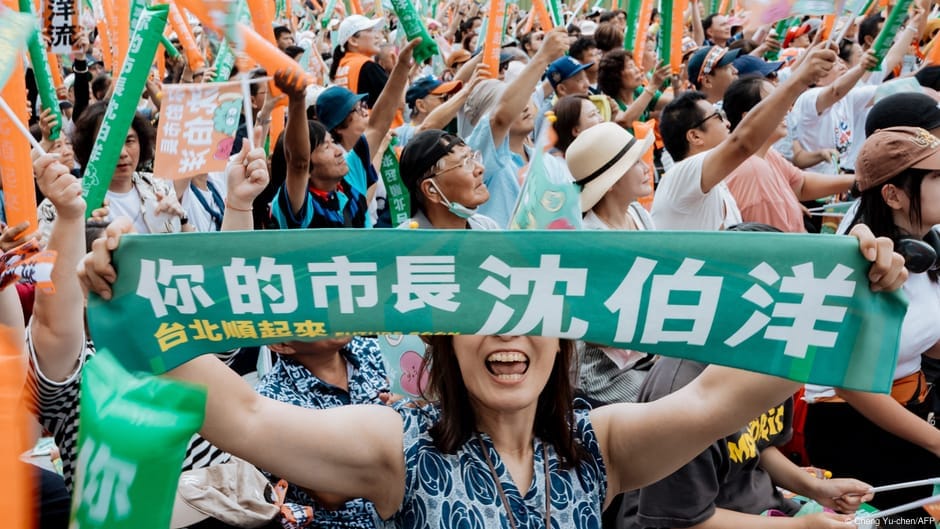
Taiwan goes to the polls on November 28 for local elections that will test the balance of power between the sovereignty-leaning Democratic Progressive Party and the Beijing-friendly Kuomintang. The Taipei mayoral race — DPP's Puma Shen against KMT's Chiang Wan-an — is the marquee contest, with polls showing a dead heat. The stakes extend well beyond city governance: the outcome will signal Taiwan's posture toward China and the durability of its relationship with Washington.
Extraction Map
The information warfare campaign is specific and traceable. AI-generated audio posted to Facebook on October 29 purports to show Shen admitting to receiving kickbacks from US arms deals. Deepfake detection platforms flagged the recording as synthetic. The Facebook account that posted it was created the same day, with followers primarily using English, Arabic, and Thai — a bot-network signature. A separate account, created in March 2026, posted an AI-generated image of Shen using drugs. Taiwanese independent media platform Watchout traced the account's advertising activity to two individuals — Peng Zhiwei and Guo Yang — both based in China. The second vector is a coordinated narrative campaign claiming US forces are withdrawing from Taiwan. Identical headlines appeared as articles and videos on Chinese clickbait platforms NetEase and Sohu, claiming 500 US troops were being urgently pulled out. The actual number of American military personnel stationed in Taiwan is 45, according to the US Defense Manpower Data Center as of March 2026. The 500 figure appears to originate from a May 2025 statement by retired Rear Admiral Mark Montgomery about training personnel — a different category entirely, deliberately conflated. A TikTok video further distorted a May 16 Fox News interview with Donald Trump, claiming the US president said America was abandoning Taiwan. Trump said no such thing. He stated his Taiwan policy "has not changed," called for maintaining the status quo, and said he did not want Taiwan to become independent or for war to break out. Washington's longstanding policy of strategic ambiguity — neither guaranteeing Taiwan's defense nor ruling it out — remains intact. The distortion is surgical: take an ambiguous signal and amplify it into an abandonment narrative. The V-Dem Institute at the University of Gothenburg has ranked Taiwan the country most severely targeted by foreign disinformation for eleven consecutive years, from 2014 to 2024. Taiwan's Ministry of the Interior has documented escalating foreign interference methods: manipulating election betting, inviting citizens to China, channeling donations through Taiwanese business people, and leveraging temple and religious activities for political mobilization. This is not a new phenomenon — it is an industrialized one. The operational pattern is clear: degrade the DPP candidate personally through deepfakes, then undermine the strategic logic of Taiwan's US alignment through fabricated withdrawal narratives. Both vectors serve the same objective — making the pro-sovereignty position appear both corrupt and strategically foolish. The targets are not random; they are load-bearing pillars of Taiwan's democratic self-determination and its security relationship with Washington. What makes this cycle different is the AI tooling. Synthetic audio with masking background noise, AI-generated images with traceable Chinese advertising money behind them, and cross-platform narrative coordination across NetEase, Sohu, Facebook, and TikTok represent an escalation in capability. The cost of producing convincing fakes has dropped while the cost of debunking them remains high. Taiwan's democratic infrastructure is being stress-tested by an adversary that has refined its playbook over more than a decade.
Worth reading?
SKIP
Score
12
/100
Extractive. Foreign state-linked actors are destroying democratic trust and alliance credibility at scale while generating zero public value — pure value destruction targeting Taiwan's sovereignty and security architecture.
What Is GRIN?
GRIN stands for Generativity, Resilience, Innovation efficiency, and Novelty openness. These four dimensions capture the essential characteristics of any memetic intelligence — whether a nation, a corporation, a religion, or a movement.
About GRINGenerativity
0/5
Resilience
1/5
Efficiency
1/5
Novelty
1/5
Extractive
5/5
Inverted
Does this create new capability or just redistribute existing value?
Purely destructive. Deepfakes and fabricated narratives create no new capability — they degrade the information commons and corrode the trust infrastructure that democratic elections require to function.
Verified Facts (8)
V-Dem Institute at the University of Gothenburg ranked Taiwan 'the country most severely targeted' by foreign disinformation for eleven consecutive years — from 2014 to 2024
According to a March 2026 report by the US government's Defense Manpower Data Center, 45 American military personnel are currently stationed in Taiwan
Retired US Navy Rear Admiral Mark Montgomery stated during a hearing in May 2025 that 500 American military personnel were providing training in Taiwan
Trump stated his policy toward Taiwan 'has not changed' in a May 16 Fox News interview
Taiwanese independent media platform Watchout identified advertisers Peng Zhiwei and Guo Yang, both based in China, behind the Facebook account posting AI-generated content
The Facebook account that posted the deepfake audio was created on October 29, 2026 — the same date the audio was published
Multiple deepfake detection platforms, including Is this AI and Undetectable, flagged the audio as likely AI-generated
Washington has long maintained a policy of strategic ambiguity toward Taiwan — neither explicitly guaranteeing the island's defense nor ruling out the possibility of doing so
More latest news
Read all