GLOBAL YOUTH · LOWER SEC
78%
UNDER-30 MPS · WORLDWIDE
2.6%
PEOPLE SURVEYED · 73 COUNTRIES
109K
GERMAN CITIES · PROTESTS
73
A new UN Population Fund report surveying 109,000 people across 73 countries confirms what German youth already feel viscerally: being the most educated generation in history does not translate into economic security or political power. Seventy-eight percent of adolescents globally now complete at least lower secondary education, yet the labor market absorbs them into informal, precarious, and underpaid work at rising rates. Financial independence now stretches into the mid-to-late twenties; stable partnerships and parenthood into the early-to-mid thirties. The demographic conveyor belt that once carried German graduates from university into apartments, careers, and families has seized up.
Extraction Map
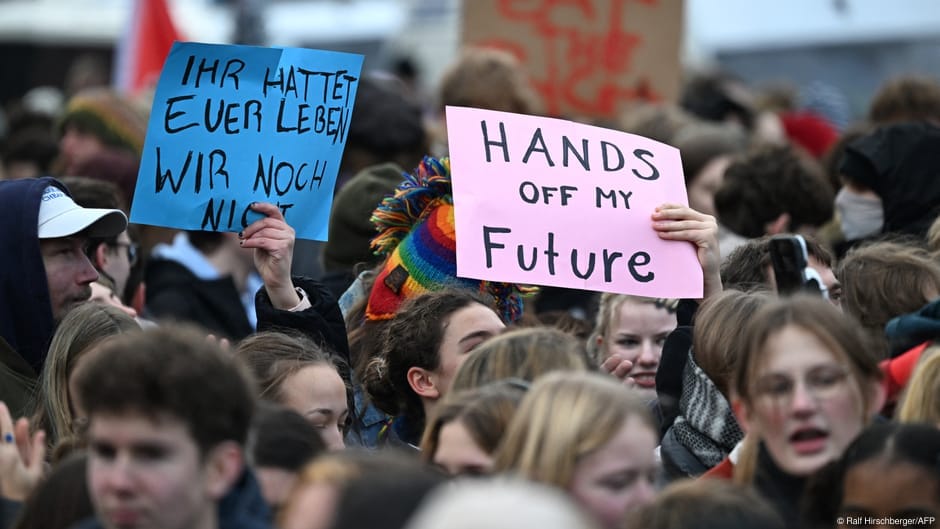
The political dimension is equally stark. Nearly half the world's population is under 30, yet only 2.6% of parliamentarians worldwide fall into that age bracket. In Germany, the gap manifests as performative inclusion: youth delegates like Florian Brod and Erik Sczygiol are invited to UN conferences and federal panels, only to discover that legislative texts have already been through seventeen drafts by the time they sit down. As Sczygiol puts it, the Federal Youth Conference often functions as a photo opportunity, not a legislative input channel. Brod notes that without substantive briefings, preliminary negotiation access, or working documents, attendance is decorative. Medical student Amelie Belosevic, Germany's youth delegate at the World Health Assembly in Geneva, adds a global equity layer. Twenty-five countries sent youth representatives, but ninety percent of the world's 1.8 billion young people live in the Global South — a region represented by just eight delegates. The optics of inclusion without structural access repeat at every institutional level. Frustration has predictable outlets. On World Children's Day, Fridays for Future-style protests took place in 73 German towns and cities. The response from incumbents followed a familiar script: the CDU/CSU youth wing in Berlin-Mitte floated deploying the Bundeswehr against demonstrations, and Bild ran a headline framing young male protesters as police-known rioters before events had even occurred. Media coverage devoted one paragraph to demands and the rest to security theater. The protests themselves become the story; the causes behind them disappear. The underlying economics are generational extraction in its purest form. Germany's housing market, pension obligations, and labor-market protections were designed for and by incumbents. Older cohorts hold property, benefit from pension systems funded by younger workers, and occupy the parliamentary seats that set the rules. Gen Z pays into systems whose returns they increasingly doubt they will see. As Belosevic observes, the promise that each generation's children will live better than their parents no longer holds — and the people with the most future ahead of them bear the most anxiety about it. The report's framing — 'Succeeding Generations: Empowering young people to chart the future' — is itself a tell. Empowerment language substitutes for structural reform. Without binding mechanisms that give youth cohorts actual veto points or legislative weight — lowered voting ages, reserved seats, mandatory youth-impact assessments on legislation — the pattern will reproduce itself. Germany is not unique here; the report covers 73 countries. But Germany's combination of credential inflation, rigid housing markets, and an aging parliament makes it a particularly clear case study. The twenty-year trajectory is not mysterious. If the credential-to-opportunity pipeline continues to degrade while political representation stays frozen, Germany gets a generation that is simultaneously overqualified and underemployed, locked out of housing wealth, and politically disengaged or radicalized. The CDU/CSU youth wing's instinct to reach for the Bundeswehr is a symptom, not an outlier — it reflects a political class that treats youth mobilization as a security problem rather than a legitimacy signal.
Worth reading?
SKIP
Score
20
/100
Extractive — Germany invests in educating Gen Z, then denies them the jobs, housing, and political power needed to convert that education into productive lives. Value flows upward to incumbent property holders, pensioners, and established political actors.
What Is GRIN?
GRIN stands for Generativity, Resilience, Innovation efficiency, and Novelty openness. These four dimensions capture the essential characteristics of any memetic intelligence — whether a nation, a corporation, a religion, or a movement.
About GRINGenerativity
1/5
Resilience
1/5
Efficiency
1/5
Novelty
1/5
Extractive
4/5
Inverted
Does this create new capability or just redistribute existing value?
Credential output is high but conversion to productive careers is collapsing. Education without labor-market access is sunk cost, not generativity. Informal employment rises as formal pathways narrow.
Verified Facts (10)
UN researchers surveyed 109,000 people across 73 countries for the report
78% of adolescents across the globe completing at least lower secondary education
Only 2.6% of parliamentarians worldwide are under 30
Gen Z protests took place in 73 towns and cities in Germany
CDU/CSU youth wing in Berlin-Mitte suggested deploying the German army against demonstrations
90% of the world's 1.8 billion young people live in the Global South, represented by only eight delegates
Twenty-five countries sent youth representatives to the World Health Assembly
Erik Sczygiol is 18 years old and was deputy secretary-general of the Federal Conference of Student Representatives
Florian Brod, 25, has served as a Youth Delegate for Sustainable Development for almost two years
Report title: 'Succeeding Generations: Empowering young people to chart the future'
More latest news
Read all