PROPERTY LOSSES
$150B
STRUCTURES DESTROYED
6,800
DEAD · PALISADES
12
MAX SENTENCE
40 yrs
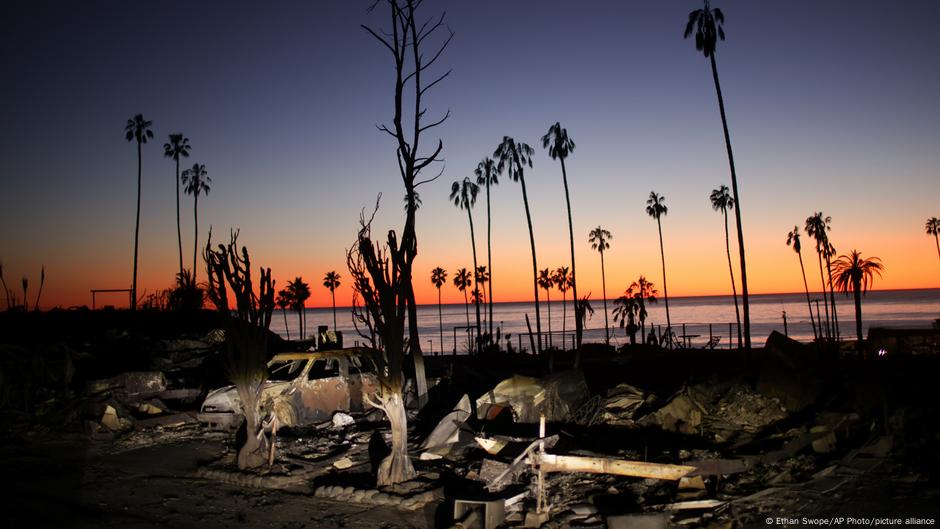
A federal jury in Los Angeles has convicted a US-French man of arson charges for starting the brush fire on January 1, 2025, that became the catastrophic Palisades Fire. The blaze killed 12 people, destroyed approximately 6,800 homes and structures, and caused an estimated $150 billion in property losses — making it one of the costliest disasters in American history. The defendant faces up to 40 years in prison, with sentencing set for March 17.
Extraction Map
The prosecution's case rested on security camera footage and cellphone location data placing the defendant as the only person near the ignition point in the Santa Monica Mountains National Recreation Area. Prosecutors characterized him as a former Uber driver and loner who harbored deep resentment against society, particularly the wealthy — a profile that maps neatly onto the affluent Pacific Palisades neighborhood that bore the brunt of the destruction. The defense argued fireworks could have caused the blaze; prosecutors said there was no evidence of fireworks in the area. This was the second trial. The first ended in a hung jury five months earlier, forcing prosecutors to retry under modified charges. The defendant denied in a court declaration that he had willfully started any fire but declined to testify at either trial. The conviction closes a legal chapter, but raises a more uncomfortable structural question: how did a single brush fire, initially suppressed on January 1, smolder underground and reignite days later to become a $150 billion disaster? The answer lies in the fierce Santa Ana winds that turned a contained brushfire into an uncontrollable inferno. This is the fragility at the core of the story. One person with a match — or a firework, or a downed power line — can trigger losses that dwarf the GDP of small nations, because Los Angeles has built extraordinarily expensive housing stock in fire-prone wildland-urban interface zones with inadequate redundancy in suppression capacity. The Palisades fire erupted nearly simultaneously with the Eaton Canyon fire approximately 30 miles east, believed to have been sparked by an electrical transmission tower. That blaze killed 19 people and devastated Altadena. Together, the two fires constitute the deadliest wildfire disaster in Los Angeles County history — 31 dead, tens of thousands displaced, and losses that will reshape California's insurance market for a generation. The conviction delivers individual accountability. What it cannot deliver is systemic accountability for a land-use and infrastructure model that concentrates billions in property value in landscapes that burn regularly, then treats each fire as an aberration rather than a statistical certainty. The defendant may serve decades in prison. The conditions that turned his act into a $150 billion catastrophe will be waiting for the next ignition source. The Eaton Canyon fire — caused not by a loner with a grudge but by aging electrical infrastructure — killed more people. The structural lesson is that the ignition source matters far less than the system's ability to absorb the shock. On that metric, Los Angeles failed catastrophically, and no criminal conviction changes the underlying math.
Worth reading?
SKIP
Score
16
/100
Extractive — the disaster concentrated costs on homeowners, taxpayers, and insurers while the underlying land-use model that created the exposure remains intact, protecting development interests and deferring systemic reform.
What Is GRIN?
GRIN stands for Generativity, Resilience, Innovation efficiency, and Novelty openness. These four dimensions capture the essential characteristics of any memetic intelligence — whether a nation, a corporation, a religion, or a movement.
About GRINGenerativity
0/5
Resilience
1/5
Efficiency
1/5
Novelty
1/5
Extractive
4/5
Inverted
Does this create new capability or just redistribute existing value?
Zero generative value. A criminal act destroyed $150B in housing, displaced thousands, and created no new capability. The conviction restores some rule-of-law credibility but generates nothing.
Verified Facts (12)
A US-French man has been convicted on federal arson charges connected with the 2025 Palisades fire in Los Angeles
The weeks-long blaze destroyed some 6,800 homes and other structures, causing estimated property losses of $150 billion (€136.7 billion)
The fire killed 12 people
The man is set to be sentenced on March 17 and could face up to 40 years in prison
The man was arrested in October 2025 and already faced one trial that ended with a hung jury
The judge declared a mistrial in June, prompting federal prosecutors to retry the case under modified charges
Security camera footage and location data from the defendant's cellphone showed he was the only person nearby when the January 1 blaze began
The fire began in the Santa Monica Mountains National Recreation Area
The initial blaze was initially suppressed but continued smoldering underground and reignited days later amid fierce winds
The Eaton Canyon fire broke out some 30 miles to the east, believed to have been ignited by sparks from an electrical transmission tower
The Eaton Canyon fire killed 19 people and devastated the Los Angeles suburb of Altadena
Together, the two blazes rank as the deadliest wildfire disaster ever seen in Los Angeles County
More latest news
Read all