PROJECTED DEATHS · 25YR
39M
WHO MORTALITY TARGET · 2030
10%
EU FEED BAN · ONLY MAJOR MOVE
2006
ON TRACK TO TARGET
0%
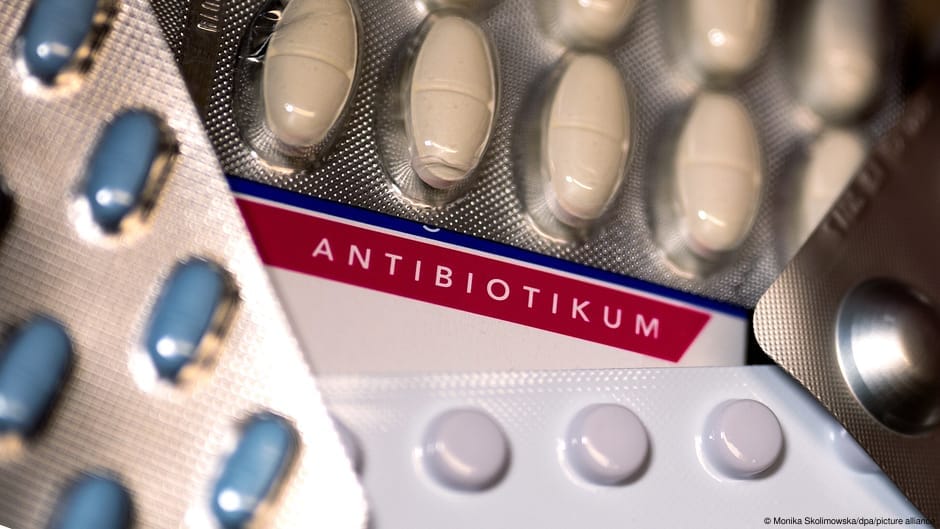
The World Health Organization now projects 39 million deaths directly attributable to antimicrobial resistance over the next 25 years. Jean Pierre Nyemazi, acting director of the WHO's AMR department, was blunt at a recent press conference: member states set a goal of reducing AMR mortality by 10% by 2030, and "we don't think we are on the right track." The gap between what's known and what's done is the entire story.
Extraction Map
The mechanics are well understood. Antibiotics prescribed against viral infections — common in Germany for respiratory and urinary tract conditions — do nothing to the virus but devastate the gut microbiome, allowing resistant bacteria to colonize. Those carriers then shed resistant pathogens into their environment via wastewater. Katharina Schaufler, a veterinarian and microbiologist at the Helmholtz Institute for One Health, traced this pathway from hospital toilets through wastewater treatment into the Baltic Sea, where wild birds ingest and spread the bacteria. Factory farming is the accelerant. The EU banned antibiotics as growth promoters in animal feed in 2006, but the conditions of industrial livestock production make therapeutic antibiotic use a permanent necessity. Confined spaces, boredom-induced injuries, and high bacterial loads mean infections spread fast and treatment is constant. Through fertilizers, resistant pathogens enter the food chain — Schaufler notes that resistant bacteria have been found on lettuce heads and meat alike. The One Health framework, adopted in 2004, recognizes that human, animal, and environmental health are inseparable. Can Imirzalioglu, director of the Institute of Medical Microbiology at Justus Liebig University Giessen and an advisor to the EU's Antimicrobial Resistance One Health Network, works on the Guardian project monitoring wastewater in the German state of Hesse for resistant bacteria outbreaks. But he reports a familiar pattern: "The experts and working groups have great ideas, and then these are often scaled back or stifled during the initial stages." The global dimension makes national action insufficient. Many countries still permit antibiotics as routine feed additives and sell them over the counter without prescriptions. This creates a commons problem — resistant bacteria respect no borders. A country that invests heavily in stewardship still imports resistance through trade, travel, and environmental flows. The WHO's response amounts to individual-level advice: hygiene, vaccinations, following prescriptions. This is not wrong, but it sidesteps the structural drivers — industrial agriculture's dependence on prophylactic antibiotics, weak international regulatory harmonization, and chronic underfunding of diagnostic innovation that could reduce unnecessary prescribing. The science has been clear for decades. The extraction continues because the costs are diffuse, delayed, and borne by the public while the benefits of cheap antibiotics flow to concentrated interests. Faster diagnostics that distinguish bacterial from viral infections at the point of care could cut unnecessary prescribing dramatically. But the investment case depends on political will that Imirzalioglu and Schaufler both describe as absent. The 39-million-death projection is not a prediction of the unknowable — it is the arithmetic of continuing to do what we are doing now.
Worth reading?
SKIP
Score
24
/100
Extractive. Industrial agriculture and pharmaceutical convenience extract short-term profits while externalizing the destruction of antibiotic efficacy — a shared global resource — onto future patients and public health systems.
What Is GRIN?
GRIN stands for Generativity, Resilience, Innovation efficiency, and Novelty openness. These four dimensions capture the essential characteristics of any memetic intelligence — whether a nation, a corporation, a religion, or a movement.
About GRINGenerativity
1/5
Resilience
1/5
Efficiency
1/5
Novelty
2/5
Extractive
4/5
Inverted
Does this create new capability or just redistribute existing value?
Net destruction. Antibiotic efficacy is a finite shared resource being depleted without replacement. New diagnostic tools and alternative therapies remain chronically underfunded relative to the scale of the threat.
Verified Facts (8)
An estimated cumulative number of 39 million deaths directly attributable to AMR would occur in the next 25 years — Jean Pierre Nyemazi, WHO
WHO member states goal to reduce AMR mortality rate by 10% until 2030
In 2006, an EU-wide ban on the use of antibiotics as growth promoters in animal feed came into effect
One Health concept adopted in 2004 by experts in human medicine, veterinary medicine and nature conservation
Katharina Schaufler, veterinarian and microbiologist at the Helmholtz Institute for One Health, traced resistant pathogen pathway from hospitals through wastewater to the Baltic Sea and wild birds
Can Imirzalioglu, director of the Institute of Medical Microbiology at Justus Liebig University Giessen, works at Guardian project funded by the German Federal Ministry of Research, Technology and Space
Resistant bacteria can still be found on lettuce heads — Schaufler
The experts and working groups have great ideas, and then these are often scaled back or stifled during the initial stages — Imirzalioglu
More latest news
Read all