ANNUAL SALARY
€30M
CONTRACT EXPIRES
2030
EXECS ON RECORD
3
MEMBER STAKE (50+1)
70%
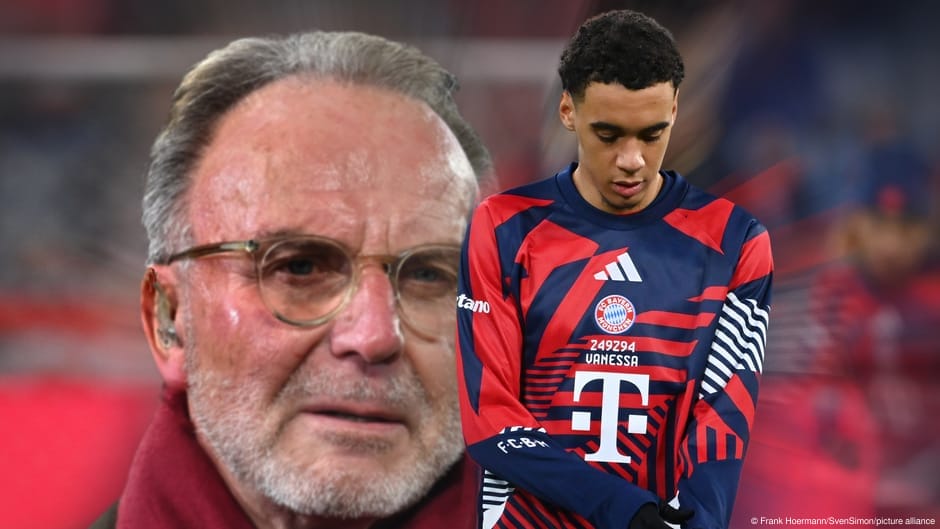
In the span of a week, three of Bayern Munich's most powerful figures — supervisory board member Karl-Heinz Rummenigge, former president Uli Hoeness, and chief executive Jan-Christian Dreesen — made separate public statements questioning whether Jamal Musiala's contract remains "justifiable" while the 23-year-old battles a fractured fibula, a broken ankle sustained at the Club World Cup in July 2025, and a neurological condition diagnosed as absence seizures that has caused him to collapse on the pitch twice during pre-season.
Extraction Map
The sequencing is difficult to read as anything other than deliberate. Hoeness went first, telling Bayrischer Rundfunk that Musiala's situation was a "dilemma" and questioning whether he would ever regain his former ability while noting "he continues to receive money." Dreesen followed in the Abendzeitung, introducing conditional language about "the old Jamal" returning. Then Rummenigge delivered the sharpest blow on Sky after the 1-1 draw with Cologne, declaring the contract sums "no longer justifiable" and calling Musiala's condition a "problem" because no other club would buy him out of a deal running to 2030 at a reported €30 million per year. The global players' union FIFPRO named the pattern explicitly: "a coordinated strategy to put pressure on Musiala and his representatives ahead of any negotiations." The union emphasized Bayern's duty of care and the basic principle that contracts exist to be honored — an injury or dip in form provides no grounds to reopen terms. Former Bayern and Germany defender Lothar Matthäus, speaking as a Sky pundit, said he had been "shocked" and that Rummenigge "chose those statements very deliberately." The timing also coincided with Bayern's annual general meeting on Saturday, where club members — who hold a majority 70% stake under Germany's 50+1 ownership rule — directly challenged the hierarchy. Jonatan Hoffmann, a professional neurologist and club member, told executives that patients with absence seizures require support, not public financial audits, and said the boardroom comments had "little to do with the much talked about Bayern Munich family." His remarks drew considerable applause. Bayern president Herbert Hainer and Dreesen attempted damage control, with Hainer insisting Musiala would "receive all the support and time he needs" and Dreesen claiming there was no intent to pressure the player. Hainer also dismissed the suggestion that Musiala's agents had concealed the neurological condition prior to his contract extension in January 2025. But the walkback landed against a wall of criticism: Kicker called the approach "irresponsible," and 11Freunde described the episode as "a glimpse into the abyss of professional football" where "the value of a person is measured only by their ability to perform." Meanwhile, the football kept moving. Borussia Dortmund overtook Bayern atop the Bundesliga. Harry Kane underwent surgery on a torn ankle ligament and will miss the Champions League trip to Lille. And Musiala — who made a 20-minute substitute appearance against Cologne on Friday, the same day Rummenigge questioned his worth — continues to manage seizures triggered by medication adjustments, the most recent occurring just last Monday. What Bayern's executives revealed is not an aberration but a structural feature: when a player's body fails to generate the return on investment a club expected, the institution's first instinct is to reframe the contractual obligation as a burden rather than a commitment. The 50+1 membership structure provided the corrective — ordinary members, not market logic, pushed back. Whether that corrective holds is the question that matters.
Worth reading?
SKIP
Score
20
/100
Extractive. Bayern's boardroom is attempting to renegotiate downward a binding contract by weaponizing a player's medical condition in public, shifting financial risk onto the most vulnerable party.
What Is GRIN?
GRIN stands for Generativity, Resilience, Innovation efficiency, and Novelty openness. These four dimensions capture the essential characteristics of any memetic intelligence — whether a nation, a corporation, a religion, or a movement.
About GRINGenerativity
1/5
Resilience
1/5
Efficiency
1/5
Novelty
1/5
Extractive
4/5
Inverted
Does this create new capability or just redistribute existing value?
Purely destructive. No new capability is created; the club seeks to claw back value from a sick employee. The only generative signal is the 50+1 membership pushback.
Verified Facts (15)
Musiala suffered a fractured fibula and a broken ankle at the Club World Cup in July 2025
Musiala diagnosed with 'absence seizures' — a debilitating neurological condition
Musiala collapsed on the pitch in two consecutive pre-season games in August
Contract extension signed in January 2025; reportedly €30 million per year, running until 2030
Musiala suffered another seizure as recently as last Monday, believed to be a result of an adjustment to his medication
Rummenigge told Sky: 'such sums are, with respect, no longer justifiable'
Hoeness told Bayrischer Rundfunk: 'He has an illness which cannot be cured but which can be somewhat controlled through medication'
FIFPRO called it 'a coordinated strategy to put pressure on Musiala and his representatives ahead of any negotiations'
Club member Jonatan Hoffmann, a professional neurologist, criticized the executives at the AGM
German football's 50+1 ownership rule gives club members a majority 70% stake
Borussia Dortmund went top of the Bundesliga with a 1-0 win at Borussia Mönchengladbach
Harry Kane underwent an operation on a torn ankle ligament and will be out until the new year
Bayern drew 1-1 with FC Cologne; Musiala made a 20-minute substitute appearance
11Freunde described the case as 'a glimpse into the abyss of professional football'
Kicker editor-in-chief Matthias Dersch called the approach 'irresponsible'
More latest news
Read all