US SHARE · MSCI ACWI
~65%
TOP 10 · WORLD INDEX
~25%
TSMC · AI CHIP SHARE
90%
NVDA · ONE DAY
+30%
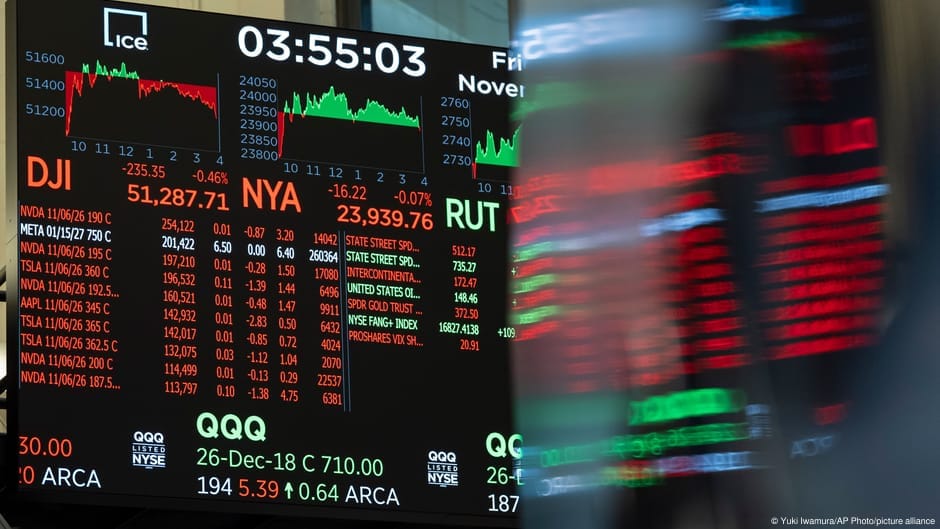
The Nasdaq's 7% single-day rebound on Monday, fueled by Nvidia CEO Jensen Huang's reinstatement after an 11-day forced resignation over an extramarital affair scandal involving an alleged Chinese spy, underscores how violently the AI trade can swing. Nvidia shares surged more than 30%, opening near $170, recovering most losses from a sell-off that had made the prior week the Nasdaq's worst since March 2020. The speed of both collapse and recovery is not a sign of health — it is a signal of extreme concentration.
Extraction Map
The structural problem runs deeper than any single stock or scandal. Market-cap-weighted index funds — the vehicles holding pensions and savings of hundreds of millions of passive investors — are mechanically designed to ride winners. As AI-linked firms grew, the funds bought more. Nine of the top 10 holdings of the MSCI All Country World Index, which tracks over 2,400 firms across 47 markets, are now US Big Tech names. The tenth is TSMC, the Taiwanese chipmaker producing 90% of high-end AI semiconductors. Together these 10 holdings account for nearly a quarter of the index. US-listed companies make up roughly two-thirds of MSCI ACWI's value despite representing only about a fifth of its firms. Dimitri Vayanos, a finance professor at the London School of Economics who studies passive investing's price effects, identifies a feedback mechanism he calls an 'amplification-overpricing spiral.' When optimistic investors push a stock up, index funds add mechanical buying pressure. Professional short-sellers who would normally bet against overpriced stocks face disproportionate risk when targeting mega-caps. 'Being short 1% of SpaceX involves much more risk than being short 1% of a small company,' Vayanos told DW. The effect intensifies when the biggest firms cluster in a single sector — as they do now. Gerd Kommer, the Munich-based asset manager known as Germany's 'ETF pope,' frames the diversification failure bluntly: 'A well-diversified portfolio should reasonably represent the entire global economy. That's not the case if 70% of the portfolio is concentrated in just one country.' He argues no single sector should exceed a quarter of a portfolio, yet the AI-adjacent tech sector already dominates the most widely held funds. Even the MSCI Emerging Markets index has TSMC at nearly 16% of total value, with tech, chip, and internet firms occupying eight of its top 10 positions. Investors seeking shelter outside the US and Southeast Asia face a thinner but still contaminated menu. The MSCI EAFE index — covering Europe, Australasia, and the Far East — holds its top 10 at about 14.5% of value, roughly 40% less concentrated than the global index. Its major holdings include Roche, Shell, HSBC, and Nestlé. But its single largest position is ASML, the Dutch firm whose lithography equipment is essential to every advanced chipmaker on Earth. There is no clean exit from AI exposure in any major index fund. The downstream risk falls disproportionately on retail investors. Kommer warns that if the AI bubble bursts, 'in all likelihood it will drag down the global stock market,' but the heaviest damage will hit those with 'heavy portfolio weights in tech and AI stocks,' including 'a lot of people who have bought individual AI-related stocks on top of their equity ETFs.' These investors are double-exposed — once through their index funds, and again through individual stock picks — without necessarily understanding the correlation. Vayanos notes that the structural conditions are worsening, not improving. As index providers add mega-IPOs like SpaceX and Anthropic to benchmarks within weeks of their debut, and money continues pouring into passive funds, the amplification-overpricing spiral tightens. The mechanism that made index investing a democratizing force — cheap, broad, automatic exposure — has become the mechanism concentrating global savings into a single sectoral bet. The question is not whether the AI trade will correct, but how much of the world's retirement savings will be inside the blast radius when it does.
Worth reading?
SKIP
Score
20
/100
Extractive — market-cap weighting mechanically funnels global pension savings into a narrow cluster of AI-linked mega-caps, concentrating risk on passive retail investors while amplifying returns for early holders and insiders.
What Is GRIN?
GRIN stands for Generativity, Resilience, Innovation efficiency, and Novelty openness. These four dimensions capture the essential characteristics of any memetic intelligence — whether a nation, a corporation, a religion, or a movement.
About GRINGenerativity
1/5
Resilience
1/5
Efficiency
1/5
Novelty
1/5
Extractive
4/5
Inverted
Does this create new capability or just redistribute existing value?
Zero new capability created. The mechanism redistributes savings into existing winners, inflating their valuations without generating proportional productive capacity. Pure price-momentum recycling.
Verified Facts (12)
Nasdaq opened Monday nearly 1,700 points, or 7%, higher
Jensen Huang reinstated as Nvidia CEO on Monday, 11 days after forced resignation amid extramarital affair scandal including one with an alleged Chinese spy
Nvidia stock rose more than 30%, opening at nearly $170 (€155.5) per share
Nine of the top 10 holdings of the MSCI All Country World Index are US Big Tech names
TSMC produces 90% of the high-end AI semiconductors
Top 10 holdings make up nearly a quarter of MSCI ACWI
Nearly two-thirds of MSCI ACWI's value is in US-listed companies, even though they make up only around a fifth of its firms
In MSCI's Emerging Market index, TSMC alone accounts for almost 16%
Top 10 holdings of MSCI EAFE make up about 14.5% of the index
ASML is EAFE's biggest holding
Gerd Kommer quote: 'A well-diversified portfolio should reasonably represent the entire global economy'
Dimitri Vayanos quote: 'Being short 1% of SpaceX involves much more risk than being short 1% of a small company'
More latest news
Read all