2027 BUDGET
€170M
CUT FROM 2026
-€20M
ORGS DEMAND
+€50M
BLACK GERMANS AFFECTED
1M+
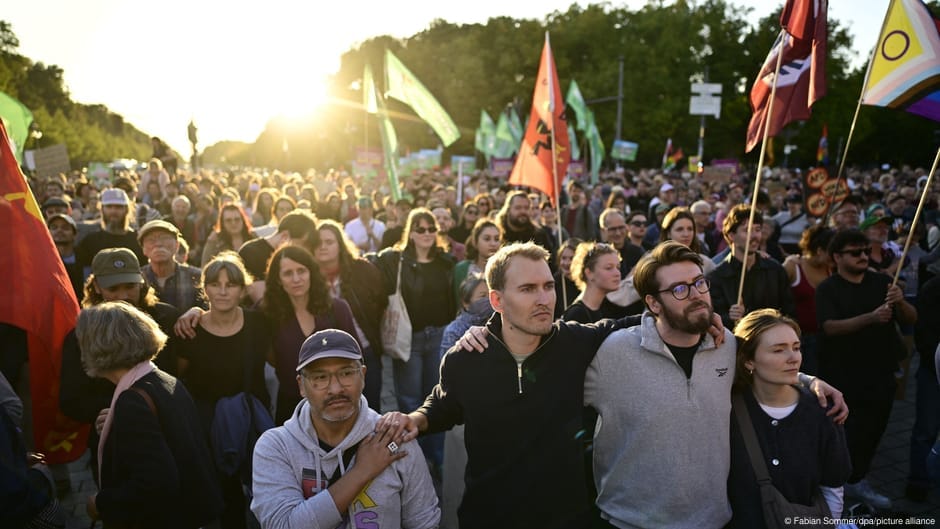
Germany's governing CDU/CSU-SPD coalition has proposed cutting roughly €20 million from the "Living Democracy" (Demokratie Leben) program, reducing the Family Affairs Ministry's flagship civil-society fund to €170 million for 2027. The budget draft faces parliamentary debate this Friday, and the timing has drawn fierce criticism: the cuts arrive as the far-right AfD celebrates its strongest-ever electoral showings, including a record result in Saxony-Anhalt where the party — classified as right-wing extremist in that state — aims to install its first state premier in December.
Extraction Map
The Amadeu Antonio Foundation's Tahera Ameer described the situation in existential terms: "In view of the antisemitic agitation, the open violence and the ever-increasing legitimization of its normalization, it is concerning that the very structures and grants which do something to oppose them are now standing on the verge of collapse." The foundation and allied organizations argue that long-established democratic infrastructure cannot simply be rebuilt once dismantled — these are not taps you turn on and off. The cuts are not limited to anti-racism work. The Central Committee of German Catholics (ZdK) flagged reductions to RIAS (the federal antisemitism reporting network), the OFEK counseling center for victims of antisemitic violence, and CLAIM, the German alliance against Islamophobia. This breadth undercuts the CDU's own framing: CDU politician Marvin Schulz argued in March 2025 that projects against extreme Islamism and antisemitism were "underrepresented," but the actual budget draft cuts those programs too. The AfD's position is blunter: abolish the funding entirely, calling it a "program for the Left to secure power for itself." In Saxony-Anhalt, the party's governing agenda includes eliminating the State Center for Civic Education entirely and cutting state funding from numerous civil-society organizations. The pattern is clear — defund the watchers, then govern without scrutiny. Organizations on the ground describe immediate consequences. Lina Mitschke of EOTO, an education and empowerment organization for people of color, laid it out plainly: "From January, people coming in have nobody to properly speak with; the phone will no longer be picked up; emails will go unanswered, if someone needs support." The needs — discrimination, violence, exclusion affecting more than a million Black Germans — do not shrink because the budget does. The coalition's response has been boilerplate fiscal discipline: a Family Affairs Ministry spokesperson cited the need for "budget consolidation" while promising programs would "reliably continue" and make "the biggest and widest impact possible with the means available." This is the language of managed decline dressed as efficiency. A counter-alliance of organizations is demanding not just reversal of the cuts but a €50 million increase. The structural contradiction is stark. Germany's governing coalition is simultaneously warning about the threat of far-right extremism and defunding the infrastructure designed to counter it. Whether this reflects genuine fiscal constraint, ideological indifference, or a quiet recalibration of priorities, the effect is the same: the organizations fighting the fire lose their water supply while the fire grows.
Worth reading?
SKIP
Score
20
/100
Extractive — the state withdraws investment from democratic infrastructure while the threat that infrastructure addresses intensifies, concentrating risk onto vulnerable populations and underfunded civil society organizations.
What Is GRIN?
GRIN stands for Generativity, Resilience, Innovation efficiency, and Novelty openness. These four dimensions capture the essential characteristics of any memetic intelligence — whether a nation, a corporation, a religion, or a movement.
About GRINGenerativity
1/5
Resilience
1/5
Efficiency
1/5
Novelty
1/5
Extractive
4/5
Inverted
Does this create new capability or just redistribute existing value?
Purely destructive. Cutting proven civil-society networks generates no new capability — it eliminates existing capacity to monitor, report, and counter extremism at the moment of greatest need.
Verified Facts (8)
The 'Living Democracy' (Demokratie Leben) program is set to receive €170 million ($187 million) in the 2027 budget, about €20 million less than the current year's allocation.
The AfD achieved record-high results in several elections in 2026, most notably in the eastern state of Saxony-Anhalt.
The AfD has been classified as right-wing extremist in Saxony-Anhalt.
The AfD wants its lead candidate Ulrich Siegmund to be the first AfD state premier in December.
Lina Mitschke leads 'Each One Teach One' (EOTO), an education and empowerment organization for people of color.
The Central Committee of German Catholics (ZdK) criticized cuts to RIAS, OFEK, and CLAIM.
Organizations are calling for the government to boost the funding pool by €50 million instead of implementing cuts.
CDU politician Marvin Schulz said in a March 2025 federal parliamentary debate: 'We need new areas of focus.'
More latest news
Read all