NATIONS WALKED AWAY
130+
BREACH ACKNOWLEDGED
1.5°C
DECISIONS ADOPTED
0
ELECTRIFICATION PLEDGES
90+
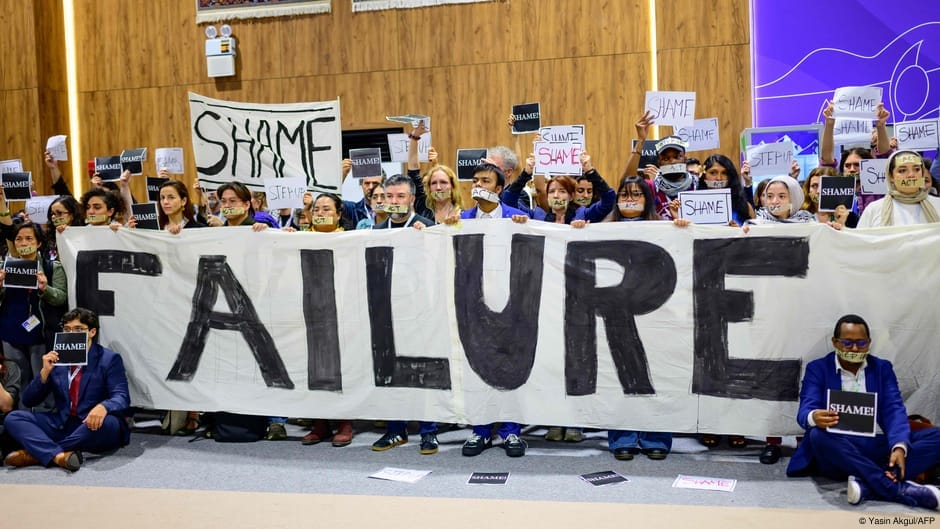
The COP31 climate summit in Antalya, Turkey, ended Sunday without a final agreement — the first outright collapse of a UN climate conference in years. The proximate cause was the phrase 'fossil fuels,' which around 130 parties demanded be reintroduced into the closing text after petrostate delegations, led by Saudi Arabia and Russia, succeeded in having it removed. Turkish COP president Murat Kurum acknowledged the impasse: 'There is no agreement on this text. These decisions have not been adopted.'
Extraction Map
The phrase had entered the UN climate lexicon only three years ago at COP28 in Dubai, with the commitment to 'transitioning away from fossil fuels in energy systems, in just, orderly and equitable manner.' It has been absent from every COP decision since. The pattern is now unmistakable: inclusion was a one-time concession, not a ratchet. Petrostates treat each new COP as a chance to claw back language, and the consensus-based decision structure gives them the lever to do it. Money was the other fracture line. Developing nations — many suffering the worst consequences of climate change despite minimal emissions — demanded additional financing for adaptation and energy transition. The EU, the world's largest climate finance provider, reportedly refused to negotiate on new commitments while calling on other nations to contribute. With the United States absent from negotiations and moving toward exiting the UNFCCC entirely, the EU found itself cast as the villain. '130 parties' is not a footnote. It is a coalition of island states, developing economies, and EU members who judged a weak deal worse than no deal. The summit did acknowledge, for the first time in COP history, that the world will breach the 1.5°C warming threshold scientists identified as the boundary for avoiding catastrophic impacts. That admission arrived without any mechanism to act on it — a declaration of emergency stapled to a shrug. Meanwhile, over 90 countries pledged to advance Turkey's electrification agenda calling for 35% global electricity consumption by 2035, though this target was not formally adopted and contains no requirement that the electricity be clean. The structural diagnosis is straightforward: the UN consensus model gives every nation, including those whose economies depend on fossil fuel exports, a veto over collective action. Saudi Arabia and Russia do not need to win the argument. They only need to prevent language from being adopted. This is not a failure of diplomacy; it is the system working exactly as designed — for incumbents. Calls for majority-rule decision-making are growing, but reforming the consensus mechanism requires consensus, a circularity that benefits the status quo. Outside the COP process, momentum is real but fragmented. The second conference on the Just Transition Away from Fossil Fuels, set for Tuvalu in July 2027, is building concrete roadmaps for abandoning coal, oil, and gas. Individual nations are moving on electrification regardless of COP outcomes, driven by economics and energy security rather than multilateral agreements. The question is whether these parallel tracks can generate sufficient velocity without the legitimacy and coordination a functioning UN process would provide. UN Secretary-General Antonio Guterres framed the outcome bluntly: 'The world must do much more to confront the climate crisis — and it must do it now.' The irony is that COP31 demonstrated exactly why the world cannot do it through this particular process. The consensus model that was designed to ensure inclusion has become the mechanism by which a handful of fossil-fuel-dependent states block action demanded by the vast majority. Until that structural flaw is addressed, each COP will reproduce the same dynamic: ambition voiced, language stripped, agreement collapsed, and the atmosphere indifferent to procedural failure.
Worth reading?
SKIP
Score
16
/100
Extractive. The consensus-veto structure allows fossil fuel incumbents to block language and financing that would distribute the costs and benefits of energy transition more broadly, concentrating the status quo advantage with petrostates at the expense of vulnerable nations and the global commons.
What Is GRIN?
GRIN stands for Generativity, Resilience, Innovation efficiency, and Novelty openness. These four dimensions capture the essential characteristics of any memetic intelligence — whether a nation, a corporation, a religion, or a movement.
About GRINGenerativity
1/5
Resilience
1/5
Efficiency
0/5
Novelty
1/5
Extractive
4/5
Inverted
Does this create new capability or just redistribute existing value?
Zero new capability created. No binding commitments, no financing unlocked, no transition mechanisms adopted. The 90-country electrification pledge is voluntary and lacks clean-energy requirements.
Verified Facts (7)
Around 130 parties — among them vulnerable island nations, developing countries and richer EU members — called for the reintroduction of the two words into the text.
The phrase 'fossil fuels' first appeared three years ago in the closing decision of COP28 in Dubai with the promise of 'transitioning away from fossil fuels in energy systems, in just, orderly and equitable manner.'
This year's climate summit was the first to acknowledge that the world will breach the critical 1.5-degree Celsius (2.7-degree Fahrenheit) threshold.
More than 90 countries pledged to move forward regardless on Turkey-led electrification agenda calling for an increase in global electricity consumption to 35% by 2035.
The United States — the world's biggest historical emitter — now absent from negotiations and on the verge of leaving the United Nation's Framework Convention on Climate Change.
The second conference on the Just Transition Away from Fossil Fuels will take place in Tuvalu in July 2027.
'I understand that there is no agreement on this text. For that reason, these decisions have not been adopted,' said Murat Kurum, Turkish president of the COP31 climate summit.
More latest news
Read all