STAIRS GAP · SHENZHEN
40cm
TAIWAN COMMENT
Nov 2025
COERCION TOOLS · ACTIVE
3
NORMALIZATION YEAR
1972
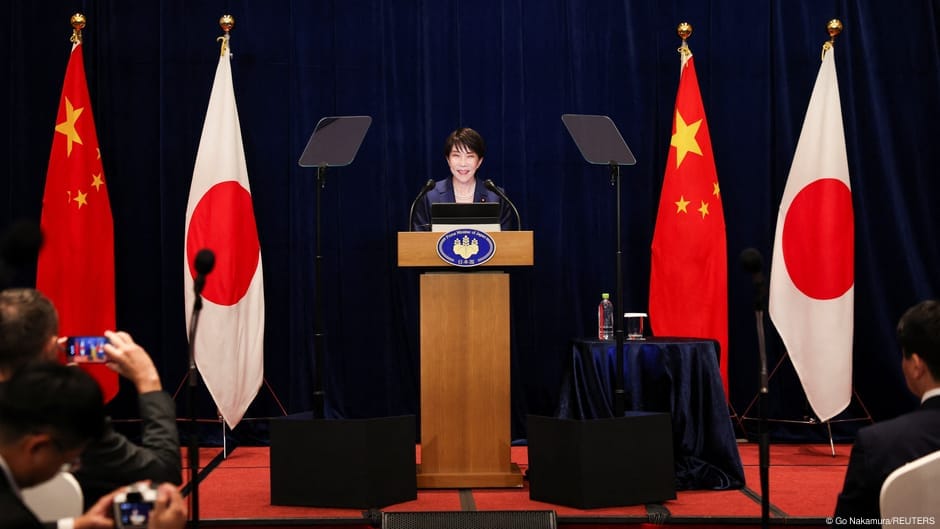
Japanese Prime Minister Sanae Takaichi arrived at the APEC summit in Shenzhen on November 18 and was met with what analysts describe as deliberate diplomatic theater. Mobile stairs fell short of the aircraft door by roughly 40 centimeters, forcing her to grip the door frame. No musical performances, no crowds, no traditional welcome — just a mid-level Foreign Ministry official and a small guard of honor. When she approached Xi Jinping at the dinner reception, his reaction was described as cold, and Japan was denied the sidebar one-on-one meetings granted to virtually every other regional leader.
Extraction Map
The freeze traces directly to Takaichi's November 2025 statement in the Diet that any Taiwan contingency would inevitably threaten Japanese national security. David Adebahr, a professor of international relations at Kobe University, notes she was merely saying aloud what had been the internal logic of Japanese security planning for years. Beijing's response has been disproportionate: demands for a retraction, restrictions on rare-earth mineral exports critical to Japanese industry, a ban on Japanese seafood imports, and official discouragement of Chinese tourism to Japan. The leverage calculus has shifted. Beijing believes it holds more cards than in previous diplomatic spats. Japan depends on Chinese rare earths. China maintains an increasingly visible military presence around Japanese waters, sometimes in coordination with Russia. And the Trump administration has urged Tokyo to de-escalate rather than offering firm backing — leaving Japan without the diplomatic cover that once came automatically. Takaichi is caught in a structural bind. As a committed conservative who has talked tough on China's military buildup, South China Sea island seizures, and pressure on Taiwan, she cannot retract her statement without losing her hardline base. But she also cannot escalate without risking economic retaliation that hits Japanese industry immediately. William Yang of the International Crisis Group calls it a tightrope between reducing tensions and preparing for a potential Taiwan contingency. The coercion strategy carries its own risks for Beijing. Adebahr points out that heavy-handed pressure could prompt Japan to accelerate defense spending and deepen security ties with other partners — exactly the outcome China wants to prevent. The pattern echoes Beijing's economic retaliation against South Korea over THAAD deployment and against Australia over COVID-19 inquiry calls, both of which pushed those countries closer to the US security orbit rather than further from it. Full decoupling remains unlikely. Trade, technology, and critical minerals are now treated as security issues by both sides, creating complex interdependencies that make a clean break prohibitively expensive. Adebahr argues transaction costs are simply too high for either party. The old pattern of separating politics from economics is dead, but the economic entanglement itself acts as a stabilizer, however uncomfortable. The structural picture is one of managed hostility. China will continue calibrated pressure — targeted export limits, military assertions with Russia and North Korea, and accusations of Japanese remilitarization. Japan will seek small-scale goodwill gestures in return for minor compromises. The trajectory of the relationship now depends less on Tokyo and Beijing than on how the Trump administration shapes its Asia-Pacific posture for the remainder of its term.
Worth reading?
SKIP
Score
20
/100
Extractive — Beijing is deploying economic coercion and diplomatic humiliation to extract political concessions from Japan, redistributing leverage rather than creating mutual value.
What Is GRIN?
GRIN stands for Generativity, Resilience, Innovation efficiency, and Novelty openness. These four dimensions capture the essential characteristics of any memetic intelligence — whether a nation, a corporation, a religion, or a movement.
About GRINGenerativity
1/5
Resilience
1/5
Efficiency
1/5
Novelty
1/5
Extractive
4/5
Inverted
Does this create new capability or just redistribute existing value?
Zero-sum by design. Rare-earth restrictions, seafood bans, and tourism suppression destroy bilateral trade value without creating alternatives. No new capability emerges — only redistribution of pain.
Verified Facts (8)
Mobile stairs were some way short of the threshold, requiring her to hold on to the door frame to step down around 40 centimeters (about 15 inches) to the top step
Takaichi was received by a mid-level Chinese Foreign Ministry official and a small guard of honor in Shenzhen
Yomiuri newspaper reported on November 20 that when Takaichi met Chinese leader Xi Jinping at the dinner reception, 'his reaction was cold'
Diplomatic relations were normalized in 1972
Takaichi responded to a question in Japan's parliament, the Diet, by saying that any 'contingency' involving Taiwan would also inevitably threaten the national security of Japan
China has restricted exports of rare earth minerals critical to Japanese industry, banned imports of Japanese seafood and told tourists to take Japan off their destination list
David Adebahr is a professor of international relations and Asia-Pacific security policy at Kobe University
William Yang is a Taiwan-based analyst for the International Crisis Group
More latest news
Read all