INDIA AID PACKAGE
$1.63B
FLOOD DAMAGE EST.
$4.8B
FLOOD DEATHS
1,450+
PM AGE · YOUNGEST
36
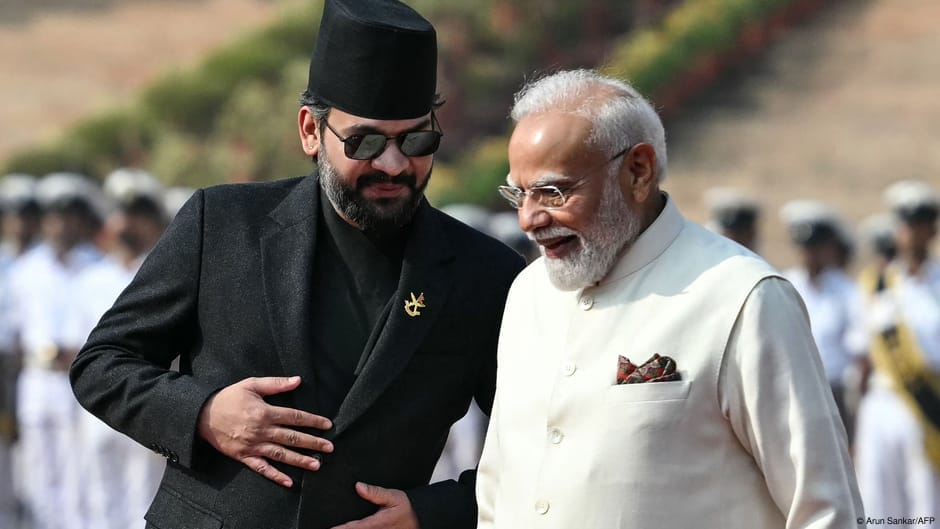
Balendra Shah, a 36-year-old rapper-turned-politician, traveled to New Delhi this week for his first bilateral visit as Nepal's prime minister — and came home with $1.63 billion in Indian commitments for flood reconstruction and infrastructure. The package includes roughly $380 million in grants and the remainder as concessional loans, earmarked primarily for rebuilding after August's devastating flash floods that killed more than 1,450 people and left 5,745 missing or unaccounted for, with reconstruction costs estimated at $4.8 billion.
Extraction Map
The economic focus was deliberate. As mayor of Kathmandu, Shah built nationalist credibility by raising territorial disputes over Kalapani, Lipulekh, and Limpiyadhura — a contested Himalayan territory in Nepal's northwest that both countries claim. As prime minister, he shelved the issue entirely during the Modi visit. Former Foreign Minister Bimala Rai Paudyal told DW the new government "didn't show interest or the guts to address this," even as she acknowledged the visit could serve as a starting point for future resolution. The bilateral talks produced a broad menu of cooperation commitments: trade and investment, connectivity and infrastructure development, educational and innovation partnerships, energy cooperation, improved market access, and enhanced port and air access for landlocked Nepal through Indian territory. A new long-term vision document was launched aimed at deepening economic integration. These are the standard outputs of South Asian summitry — the question, as always, is implementation. Nepal's structural position shapes every move Shah makes. The country runs a massive trade imbalance with India, its largest trading partner. It is landlocked and transit-dependent on Indian ports. The 1950 Treaty of Peace and Friendship remains a source of Nepalese resentment, perceived as encoding an unequal relationship. And Nepal sits between India and China, a geography that Ashok Swain of Uppsala University argues should be transformed "from a strategic vulnerability into an economic and diplomatic asset" rather than forcing Kathmandu to choose sides. Shah's domestic mandate is genuine — he represents a break from decades of revolving-door coalition governments led by the same three establishment parties. But mandates decay quickly when flood-damaged roads remain unrepaired and jobs don't materialize. The $1.63 billion headline number covers only about a third of Nepal's estimated $4.8 billion reconstruction bill, and concessional loans still require repayment from an economy that cannot afford the gap. The strategic calculation is transparent: Shah is banking that visible economic deliverables will sustain his political capital long enough to eventually address the harder sovereignty questions from a position of domestic strength rather than desperation. Constantino Xavier of the Center for Social and Economic Progress in New Delhi cautioned against expecting too much from any single visit, arguing for "big, long-term ambition coupled with small, short-term steps" centered on economic cooperation. Whether this sequence works — money first, borders later — depends on whether Indian commitments actually disburse, whether reconstruction reaches affected communities, and whether Shah can avoid being captured by the same dependency dynamics his predecessors navigated for decades. The agreements announced this week are inputs. The outputs remain entirely speculative.
Worth reading?
OPTIONAL
Score
48
/100
Mixed — potentially generative if Indian investment materializes as infrastructure and connectivity, but the loan-heavy structure and unresolved sovereignty questions risk deepening Nepal's structural dependency on India.
What Is GRIN?
GRIN stands for Generativity, Resilience, Innovation efficiency, and Novelty openness. These four dimensions capture the essential characteristics of any memetic intelligence — whether a nation, a corporation, a religion, or a movement.
About GRINGenerativity
3/5
Resilience
2/5
Efficiency
2/5
Novelty
2/5
Extractive
2/5
Inverted
Does this create new capability or just redistribute existing value?
Conditionally generative. $1.63B could build real infrastructure and connectivity for landlocked Nepal, but only $380M is grant; the rest is debt. Value creation hinges entirely on disbursement and project quality.
Verified Facts (8)
Balendra Shah is 36 years old, a rapper-turned-politician, and Nepal's new prime minister
Modi announced a package of $1.63 billion, around $380 million as a grant with the rest as a concessional loan
August flash floods claimed the lives of more than 1,450 people, while 5,745 are missing or unaccounted for
Reconstruction bills estimated at around $4.8 billion (about €4.4 billion)
Nepal and India both have competing territorial claims over Kalapani, Lipulekh and Limpiyadhura
Constantino Xavier is a senior fellow at the Center for Social and Economic Progress in New Delhi
Bimala Rai Paudyal is a former Foreign Minister of Nepal
Ashok Swain is head of the Department of Peace and Conflict Research at Sweden's Uppsala University
More latest news
Read all