STARFISH PRIME ALT
400 km
LAST SPACE TEST
1962
GPS ORBIT ALT
20,200 km
TREATY INSPECTIONS
0
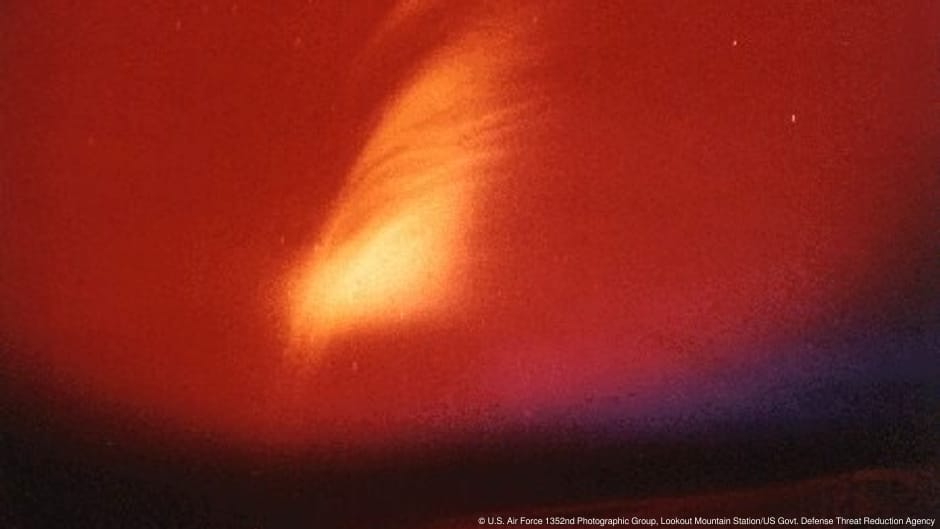
The question sounds like science fiction, but the United States already answered it in 1962. Starfish Prime — a 1.4-megaton warhead detonated 400 kilometers above the Pacific — knocked out streetlights in Hawaii, disrupted radio links, and quietly destroyed satellites for months afterward. The physics in vacuum are fundamentally different from a surface blast: no fireball, no shock wave, no concentrated fallout. Instead, X-rays hammer nearby spacecraft immediately, and Earth's magnetic field traps a belt of energized electrons that keeps irradiating every satellite that passes through it.
Extraction Map
The vulnerability pyramid is straightforward. Satellites in low Earth orbit catch the worst of it — both the initial X-ray burst and the lingering radiation belt. GPS satellites at 20,200 kilometers could survive longer, but the interconnected systems that rely on them are only as strong as their weakest node. A ship's emergency beacon uses GPS to fix its position, then hands off to a separate satellite relay to reach rescuers. Knock out one link in that chain, and the signal stalls. The second-order effects are where the real systemic risk lives. Radiation doesn't necessarily destroy satellites — it can leave them structurally intact but unable to maneuver. Uncontrolled satellites become collision hazards. Each collision generates debris that threatens other spacecraft, and if the density reaches a critical threshold, the chain reaction sustains itself indefinitely. This is Kessler syndrome: a self-reinforcing debris cascade that could render entire orbital bands unusable for years or decades, even if no new objects are launched. Defenses exist but are partial. Radiation shielding adds weight and cost. Backup constellations take years to deploy. Ground-based navigation aids can substitute for GPS over the contiguous United States, but not over oceans or remote terrain. Replacement satellites launched into a contaminated orbit face the same radiation and debris environment that destroyed their predecessors. The legal framework is clearer than the enforcement mechanism. The 1967 Outer Space Treaty prohibits placing nuclear weapons in orbit; the 1963 Limited Test Ban Treaty bars space detonations. But the Outer Space Treaty has no inspection regime for spacecraft payloads. Detection comes after the fact — US sensors are designed to pick up detonation signatures, not to prevent launch. The core asymmetry is this: a single detonation by one actor could degrade space infrastructure used by every nation on Earth. The attacker needs one weapon. The defenders need to harden, diversify, and replace thousands of satellites across multiple orbital planes. The costs are radically asymmetric, and the commons — orbital space itself — bears the residual damage. Fallout risk to the ground is minimal. Without soil and water to carry radioactive material, particles disperse and decay. The concentrated local contamination from a surface burst doesn't replicate in vacuum. The threat is not to people directly — it's to the invisible orbital layer that modern navigation, communication, finance, and emergency response quietly depend on.
Worth reading?
SKIP
Score
16
/100
Extractive. A space nuclear detonation is the purest form of commons destruction — one actor's weapon degrades orbital infrastructure shared by all nations, with costs borne by global civilian populations and recovery costs borne by taxpayers.
What Is GRIN?
GRIN stands for Generativity, Resilience, Innovation efficiency, and Novelty openness. These four dimensions capture the essential characteristics of any memetic intelligence — whether a nation, a corporation, a religion, or a movement.
About GRINGenerativity
0/5
Resilience
1/5
Efficiency
1/5
Novelty
2/5
Extractive
5/5
Inverted
Does this create new capability or just redistribute existing value?
Purely destructive. No new capability is created; existing satellite infrastructure and orbital commons are degraded or destroyed for all users globally.
Verified Facts (7)
On the evening of July 8, 1962, the United States detonated a nuclear weapon about 400 kilometers (250 miles) above the Pacific in a test called Starfish Prime.
An electromagnetic pulse knocked out some streetlights in Hawaii, and some Pacific radio links briefly went down.
GPS satellites orbit about 20,200 kilometers above Earth.
The 1967 Outer Space Treaty bars its parties from placing nuclear weapons in orbit.
The 1963 Limited Test Ban Treaty prohibits its parties from carrying out nuclear explosions in space.
The Outer Space Treaty has no dedicated system for checking what spacecraft carry.
Kessler syndrome: a self-reinforcing debris cascade where fragments from collisions hit other satellites, creating more debris and triggering further collisions.
More latest news
Read all