FOREIGN CREW · TIANGONG
1st
MISSION DURATION
~5 days
PAK-CHINA COOPERATION
75 yrs
CHINA MOON TARGET
2030
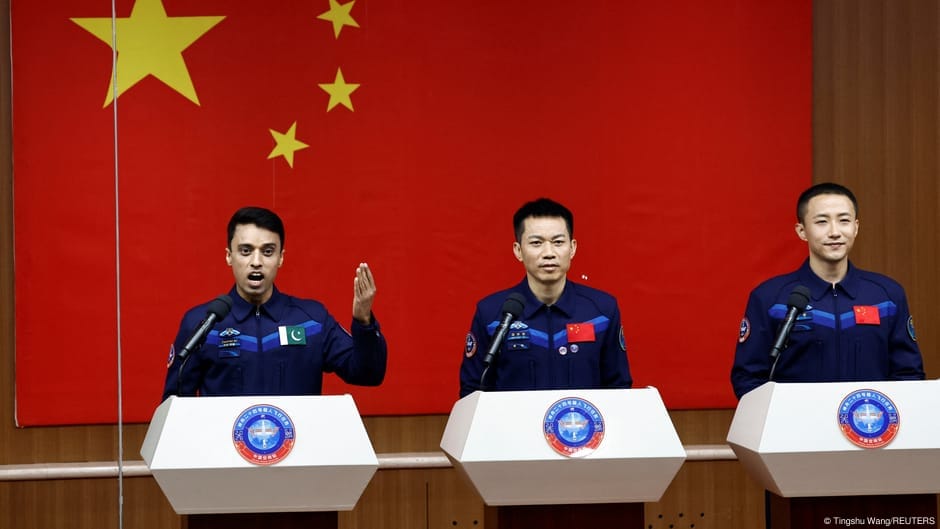
China announced Tuesday that Pakistani payload specialist Muhammad Zeeshan Ali, a 40-year-old former air force pilot, will join two Chinese colleagues aboard the Shenzhou-24 mission launching Wednesday from Jiuquan in the Gobi Desert. Ali becomes the first foreign astronaut ever to board China's Tiangong space station — a distinction Beijing chose to bestow on Pakistan, not on a wealthier or more technologically advanced partner.
Extraction Map
The selection is diplomatic architecture disguised as a science mission. Pakistan and China are marking 75 years of bilateral cooperation, and Pakistani officials leaned hard into the symbolism. Information Minister Attaullah Tarar called the mission a "source of joy and pride for the entire nation." Planning Minister Ahsan Iqbal invoked the "iron brotherhood" between the two countries. Ali himself, switching between Urdu, Mandarin, and English at the press conference, said he carried "the hopes of 250 million Pakistanis" on his shoulders. The mission itself is modest in scope: a roughly five-day orbital flight in which Ali will conduct experiments in biotechnology and photosynthetic microorganisms before returning to Earth aboard the Shenzhou-23 spacecraft that docked at Tiangong in May. Ali is not the first Pakistani in space — Monaco-based polar explorer Namira Salim flew on Virgin Galactic's Galactic 04 suborbital mission in October 2023 — but he is the first to fly a full orbital mission on a state-sponsored program. The geopolitical calculus is straightforward. China has poured billions into its space program and operates Tiangong with rotating three-person crews on six-month cycles. By opening the station to a Pakistani astronaut, Beijing signals that its space infrastructure is a platform for coalition-building — a parallel to the International Space Station model that the US and its partners have operated for decades, but one where China controls the guest list. The choice of Pakistan, China's most reliable South Asian ally and a linchpin of the Belt and Road Initiative, is not accidental. Ali's rhetoric pointed forward: "I hope the next chapter of China-Pakistan space cooperation will grow from one astronaut and one flight to multiple joint flights, to the Moon, to Mars, and beyond." This maps neatly onto China's stated ambition to land astronauts on the Moon by 2030, running roughly parallel to NASA's own lunar return timeline targeting 2028. The question is whether Tiangong's international opening is a one-off gesture or the beginning of a structured program of partner-nation access. The cost-benefit structure here is worth examining plainly. Pakistan gets enormous domestic prestige and a tangible marker of its strategic partnership with China. China gets a demonstration that its space program is not a closed national project but a vehicle for international influence — without ceding any operational control. The experiments Ali will conduct are real but secondary to the diplomatic payload. For China, the generative value is reputational infrastructure; for Pakistan, it is aspirational nation-branding directed at both domestic and global audiences. The US-China space rivalry is the ambient context. Washington and Beijing are in a slow-motion competition over lunar access, deep-space capability, and the institutional architecture that governs who gets to participate. Every partner China brings aboard Tiangong is a data point in that competition — not because Pakistan adds technical capacity, but because it demonstrates that China's space program can function as a multilateral platform. That is the structural signal worth tracking.
Worth reading?
OPTIONAL
Score
56
/100
Mildly generative — creates new diplomatic infrastructure and national aspiration capital for Pakistan, but the primary generative value accrues to China's geopolitical positioning; actual scientific output is minimal.
What Is GRIN?
GRIN stands for Generativity, Resilience, Innovation efficiency, and Novelty openness. These four dimensions capture the essential characteristics of any memetic intelligence — whether a nation, a corporation, a religion, or a movement.
About GRINGenerativity
3/5
Resilience
3/5
Efficiency
2/5
Novelty
3/5
Extractive
2/5
Inverted
Does this create new capability or just redistribute existing value?
Modest new capability. Five days of biotech experiments add little to the science frontier. The real output is diplomatic infrastructure — China demonstrating Tiangong as a multilateral platform.
Verified Facts (12)
Muhammad Zeeshan Ali, a 40-year-old former Pakistani air force pilot
Launch from Jiuquan launch center in China's northwestern Gobi Desert at 8:18 a.m. local time (0018 GMT) on Wednesday
Ali switched between Urdu, Mandarin and English at the press conference
Pakistan and China are marking 75 years of cooperation in space
Information Minister Attaullah Tarar described the mission as a 'source of joy and pride for the entire nation'
Planning Minister Ahsan Iqbal said the mission underscored the 'iron brotherhood' between the two countries
Namira Salim flew on Virgin Galactic's Galactic 04 mission in October 2023
Short orbital flight expected to last around five days
Experiments in the fields of biotechnology and photosynthetic microorganisms
Returning to Earth aboard the Shenzhou-23 spacecraft, which docked at the Tiangong in May
Beijing is aiming to land Chinese astronauts on the moon for the first time by 2030
The United States is hoping to return to the lunar surface in 2028
More latest news
Read all