COFFEE COST SPIKE
5×
COMPLAINT LETTERS
14,000+
COFFEE FROM WEST
~25%
VIETNAM GLOBAL RANK
#2
In 1977, East Germany faced a problem only a command economy could produce: global coffee prices surged after a poor Brazilian harvest, but the state couldn't pass costs to consumers because the Politburo had frozen all retail prices by law. The regime spent roughly 150 million Valutamarks on coffee in 1974-75; by 1976, that bill had quintupled. Something had to give.
Extraction Map
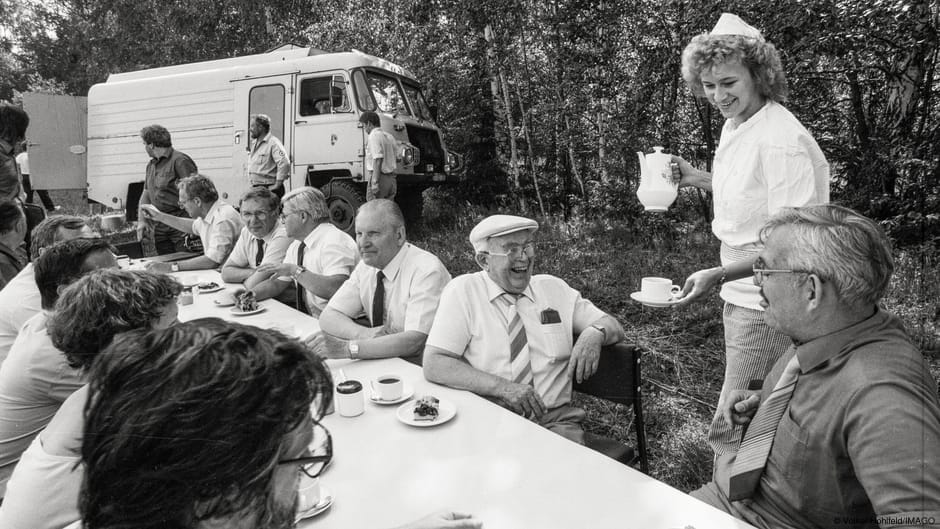
What gave was quality. On August 1, 1977, the government introduced "Kaffee Mix" — 51% imported beans blended with rye, barley, chicory, and sugar beet. The result was universally despised. More than 14,000 complaint letters flooded government offices. The Stasi itself reported to the SED leadership that the product was "rejected by broad sections of the population." Coffee machines clogged; some reportedly exploded. Citizens joked it was indistinguishable from a neutron bomb. The backlash was disproportionate to the product because coffee occupied a structural role in East German social life. The post-lunch coffee hour was, as historian Stefan Wolle puts it, "the social glue that held together East Germany's particular brand of conviviality." An estimated 25% of all coffee consumed in the GDR came via care packages from West German relatives — a dependency the SED leadership tolerated uneasily. The regime's first fix was characteristically Cold War: it traded weapons and military trucks to Angola and Ethiopia in exchange for beans, equipment that ended up fueling Ethiopia's civil war. But it also sought a longer-term play. Vietnam, a socialist ally where coffee had thrived under French colonial rule, became the target of a major infrastructure investment program starting in the 1980s. East Germany supplied machinery, built transport routes, and constructed worker housing for large-scale plantations. The timing was catastrophic for East Germany and transformative for Vietnam. Coffee plants take several years to reach harvest maturity. By the time the Vietnamese plantations were producing, the Berlin Wall had fallen and the GDR had ceased to exist. Vietnam rapidly privatized the plantations and scaled production. Today it is the world's second-largest coffee exporter — a position built directly on East German capital and infrastructure. The irony is almost perfectly circular. A planned economy that couldn't tolerate price signals created a crisis, responded with autarkic substitution, failed, pivoted to arms-for-commodities barter, then made a generative long-term investment it couldn't survive long enough to benefit from. The recipient — a fellow socialist state — converted the gift into private enterprise and global market share within a decade of reunification. What Wolle notes is the final twist: most consumers don't know their coffee comes from Vietnam. The Vietnamese themselves, he suggests, still believe coffee must come from Latin America to carry prestige. The infrastructure is East German, the production is Vietnamese, the branding is invisible, and the value chain has been globalized beyond recognition.
Worth reading?
SKIP
Score
32
/100
Generative — but the generativity accrued entirely to Vietnam, not to the investing state. East Germany's infrastructure investment created lasting productive capacity, but the investor collapsed before capturing any return.
What Is GRIN?
GRIN stands for Generativity, Resilience, Innovation efficiency, and Novelty openness. These four dimensions capture the essential characteristics of any memetic intelligence — whether a nation, a corporation, a religion, or a movement.
About GRINGenerativity
3/5
Resilience
1/5
Efficiency
1/5
Novelty
1/5
Extractive
3/5
Inverted
Does this create new capability or just redistribute existing value?
Accidentally high. East German capital built world-class coffee infrastructure that Vietnam converted into the planet's #2 export position. The investing state captured zero return; the recipient captured all of it.
Verified Facts (8)
In 1974 and 1975, East Germany spent around 150 million Valutamarks on imported coffee
The following year, it had to pay almost five times as much
On August 1, 1977, it introduced 'Kaffee Mix'
51% of the blend consisted of imported coffee beans
More than 14,000 complaint letters poured into government offices
It is estimated that around 25% of all coffee consumed in East Germany came from the West
Vietnam is now the world's second-largest coffee exporter
Instead of paying in hard currency, they paid with military equipment — weapons and trucks
More latest news
Read all