ANNUAL IMPORT CAP
15%
CN RECORD SHARE
13.1%
DE SHARE LOSS
-3.3pp
CN EU SALES YOY
+73.4%
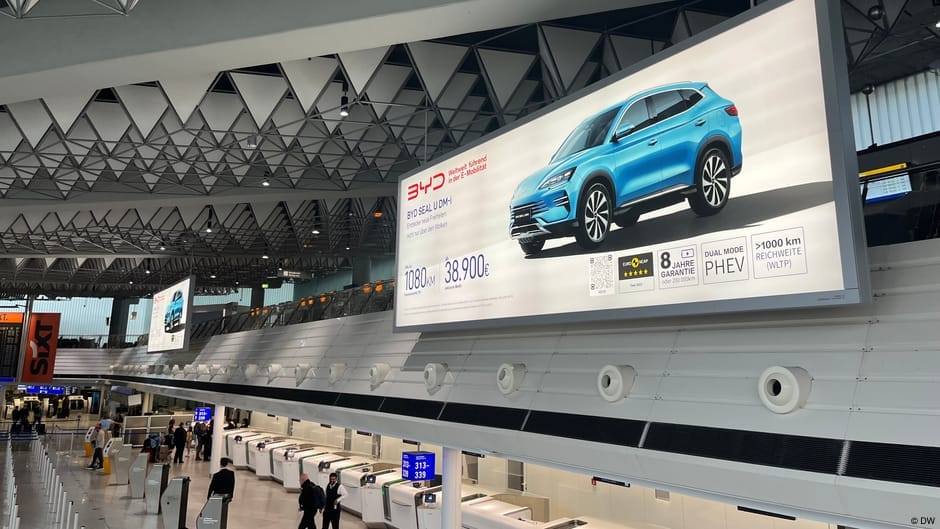
The European Commission announced import quotas on hybrid vehicles from China, capping annual growth at roughly 15% above the prior year's volume. The measure covers full hybrids, plug-in hybrids, and mild hybrids, and takes effect December 1. While framed as country-specific to China, any nation exceeding 2% of EU imports in 2025 faces the same cap, with a residual quota for everyone else.
Extraction Map
The move follows an October agreement between EU trade commissioner Maros Sefcovic and Chinese Trade Minister Wang Wentao. Beijing responded by urging the EU to honor what it called the "compliant, and balanced" deal. The Commission justified the quota by citing a surge in imports driven by global overcapacity and the displacement effect of US tariffs under the Trump administration — Chinese cars locked out of America are now flooding into Europe. The numbers tell the story of an industry in structural retreat. German automakers saw EU sales fall 5.7% in October despite a growing overall market, their share dropping from 41.5% to 38.2% according to EY. Chinese manufacturers moved in the opposite direction: EU sales up 73.4%, achieving a record 13.1% market share. New electric vehicle registrations across the bloc surged 61.4% year-over-year, with plug-in hybrids booming in Italy (+73.1%), Spain (+32.3%), and Germany (+11%). The quota is a classic trade-defense instrument: cap the volume of incoming goods to give domestic producers breathing room. The theory is that slowing the flood of cheaper Chinese hybrids buys time for European automakers to close their competitiveness gap in electrified drivetrains. Whether that time gets used productively or simply delays the reckoning is the central question. Germany is the obvious primary beneficiary and the implicit reason for the policy. Several German manufacturers have announced widespread layoffs as market share erodes. The quota provides political cover — Brussels is seen to act — but does nothing to address the underlying cost and technology gap that made Chinese hybrids competitive in the first place. The extractive logic runs in two directions. European consumers face constrained choice and likely higher prices as supply tightens. Chinese manufacturers lose market access they earned through price and product competitiveness. The beneficiaries are incumbent European automakers and their political sponsors, who gain time without being forced to earn it through better products. The deeper problem is that quotas treat a supply-side competitiveness failure as a trade problem. Europe's hybrid and EV market is booming — demand is there. The question is who fills it. A 15% annual growth cap is generous enough to avoid an immediate supply shock but tight enough to signal that Brussels will manage competition rather than let it run. If European automakers use the runway to invest and restructure, the quota buys real value. If they use it to protect margins while delaying transformation, it simply raises consumer prices and slows the green transition.
Worth reading?
SKIP
Score
28
/100
Extractive. The quota redistributes market share from competitive entrants to incumbents without creating new capability. Consumers and the EV transition bear the cost.
What Is GRIN?
GRIN stands for Generativity, Resilience, Innovation efficiency, and Novelty openness. These four dimensions capture the essential characteristics of any memetic intelligence — whether a nation, a corporation, a religion, or a movement.
About GRINGenerativity
1/5
Resilience
2/5
Efficiency
2/5
Novelty
1/5
Extractive
4/5
Inverted
Does this create new capability or just redistribute existing value?
No new capability created. The quota buys time for incumbents but doesn't fund R&D, build factories, or close the technology gap. Time without obligation is a gift, not an investment.
Verified Facts (9)
The quota is to stand at around 15% on top of the volume imported in the previous year
The cap is set to come into effect on December 1
German car manufacturers saw their sales fall by 5.7% in the EU despite a growing market
Market share in the bloc fell from 41.5% to 38.2%, according to consulting firm EY
Chinese manufacturers increased their EU sales by 73.4% and achieved a new record market share of 13.1%
New electric car registrations were up 61.4% across the bloc
Plug-in hybrids were up in particular in Italy (+73.1%), Spain (+32.3%), and Germany (+11%)
Hybrid electric vehicles were around a third of all new registrations, with plug-in hybrids making up around 10%
The country-specific import quota will be valid for all countries whose imports made up more than 2% of EU imports in 2025
More latest news
Read all