TROOPS REQUESTED
30K+
DPRK PERSONNEL IN RUSSIA
~8,500
BALLISTIC MISSILES
DOZENS/MO
SUMMIT HELD
0
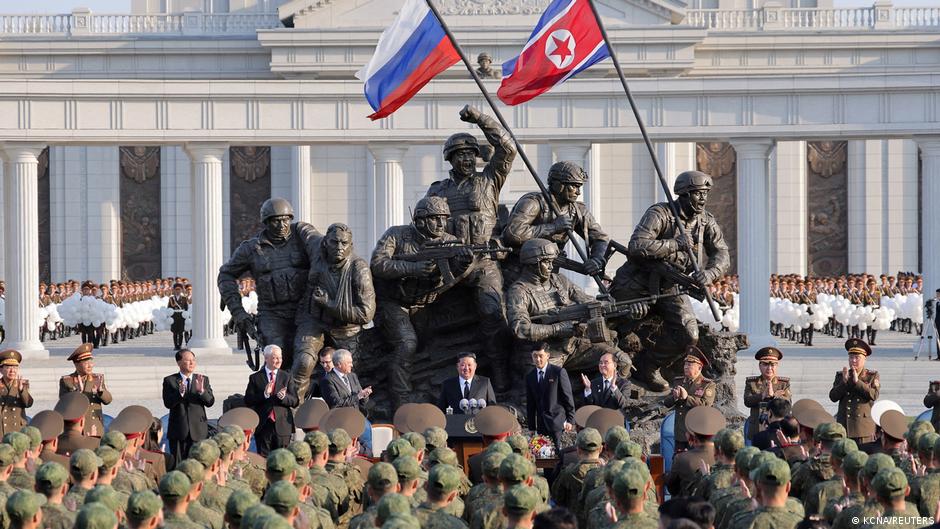
Moscow asked for more than 30,000 additional North Korean troops for an autumn offensive in Ukraine. Pyongyang said no. According to Andrii Kovalenko, former head of Ukraine's Center for Countering Disinformation, an August intelligence assessment flagged the Kremlin's request, but a planned Kim-Putin summit in September never materialized. The troop buildup Zelenskyy warned about — 30,000 to 50,000 soldiers — has not happened.
Extraction Map
The refusal appears to have a specific red line: offensive operations in Russian-occupied Donetsk. Kovalenko assesses that North Korea was willing to deploy troops to defend Russian territory in Kursk, where thousands fought in 2024, but crossing into occupied Ukraine for offensive action is a qualitatively different commitment Pyongyang is not prepared to make. The distinction matters — it separates defensive partnership from co-belligerency. North Korea has not withdrawn from the war. Around 8,500 support personnel remain in rear areas, including drone operators, engineers, and sappers. A missile unit is still stationed in Russia's Voronezh region. Zelenskyy reported on November 17 that Russia was receiving dozens of North Korean ballistic missiles each month. The hardware pipeline is intact even as the troop pipeline has narrowed. The weapons flow serves both sides. For Russia, it is ammunition and missiles. For North Korea, it is live battle-testing of drones and missiles that refines Pyongyang's capabilities in ways no simulation can replicate. Zelenskyy warned this creates security risks for countries around the Korean Peninsula — a point Seoul and Tokyo will not miss. Analysts describe Pyongyang's posture as a deliberate "containment strategy." By limiting military exposure while maintaining the alliance, North Korea retains Russian assistance for drone technology and naval development without betting its position on the war's outcome. Former South Korean NIS deputy director Han Ki-bum noted that the winter lull and reduced frontline intensity give Pyongyang little immediate reason to escalate. A visit to Moscow this week by Jo Yong-won, a senior aide to Kim, may signal whether this holding pattern shifts. The China angle is the structural story beneath the troop numbers. Multiple South Korean analysts told DW that Pyongyang's recent moves toward Beijing reflect dissatisfaction with what Moscow has delivered in return. Former Unification Ministry spokesperson Jeong Joon Hee suggested Pyongyang may be using improved China ties to pressure Russia into offering more. Former vice minister Kim Hyung Suk argued North Korea needs China's economic, political, and diplomatic backing regardless of the war — it is not a substitute for Russian military cooperation but a parallel necessity. The net picture: Pyongyang is managing a three-way leverage game. It offers Russia enough to maintain the alliance — ammunition, missiles, support personnel — while withholding the troop commitment Moscow wants. It tilts toward Beijing to hedge against a war outcome it cannot control. And it extracts technology transfers and foreign currency from both relationships. This is not a country being dragged into someone else's war. It is a small state maximizing its position between two larger patrons.
Worth reading?
SKIP
Score
24
/100
Extractive. No new capability is being created for broader populations. Value flows to three authoritarian states: Russia gets ammunition, North Korea gets weapons technology and currency, and the extraction falls on Ukrainian civilians and regional security.
What Is GRIN?
GRIN stands for Generativity, Resilience, Innovation efficiency, and Novelty openness. These four dimensions capture the essential characteristics of any memetic intelligence — whether a nation, a corporation, a religion, or a movement.
About GRINGenerativity
1/5
Resilience
1/5
Efficiency
2/5
Novelty
1/5
Extractive
4/5
Inverted
Does this create new capability or just redistribute existing value?
Zero-sum arms transfers. Missiles and ammunition flow to a war of destruction; drone and naval tech transfers strengthen an isolated regime's kill chain. No productive capacity is being built.
Verified Facts (11)
Zelenskyy said he expected between 30,000 and 50,000 North Korean soldiers would be deployed to Russia
Andrii Kovalenko resigned in September as head of Ukraine's Center for Countering Disinformation
August intelligence assessment indicated the Kremlin had requested more than 30,000 additional North Korean troops
North Korea previously sent thousands of troops to Russia's Kursk region in 2024
North Korea still had a missile unit in Russia's Voronezh region and around 8,500 support personnel in rear areas
Zelenskyy said on November 17 that Russia was receiving dozens of North Korean ballistic missiles each month
Jo Yong-won, a senior North Korean official and close aide to Kim, visited Moscow this week
Han Ki-bum is a former deputy director of South Korea's National Intelligence Service
Ahn Chan-il is a former North Korean soldier who defected to South Korea in 1979 and heads the World Institute for North Korea Studies in Seoul
Jeong Joon Hee is a former South Korean Unification Ministry spokesperson
Kim Hyung Suk is a former South Korean vice minister of unification
More latest news
Read all