ESSENTIAL DRUGS SHORT
~40
SPECIALTY GAPS
100+
BLACK MKT MARKUP
10×
PHARMACIES VISITED
20
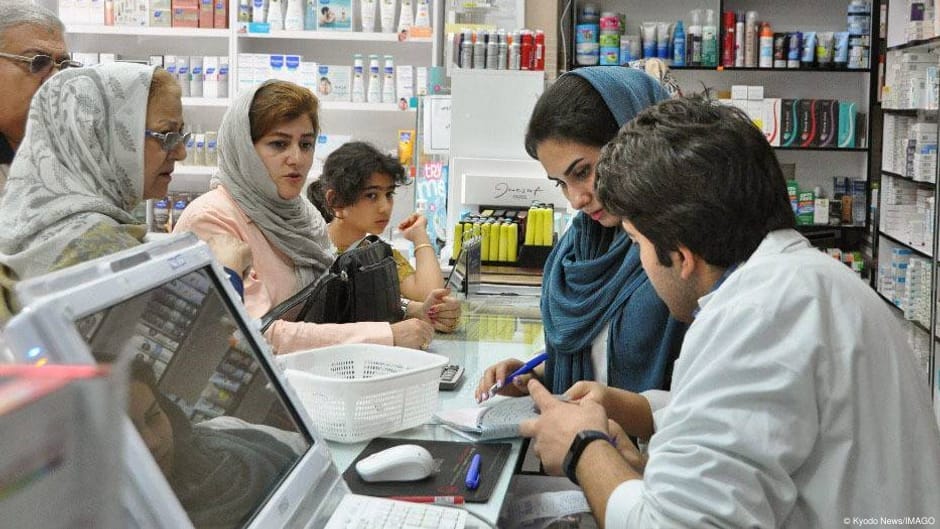
Ahmad, 67, visited nearly 20 Tehran pharmacies for the antipsychotic chlorpromazine. Mitra, 37, spent days hunting insulin. Neither found what they needed. Their stories are not anomalies — they are the visible surface of a supply chain that has seized at every link simultaneously.
Extraction Map
The mechanics are brutal in their simplicity. Iran's currency has cratered, but domestic drug prices remain government-controlled. That scissor effect has drained manufacturer profits to the point where production is no longer economically viable for many essential medicines. Meanwhile, hospitals owe distributors massive unpaid debts, and insurers delay pharmacy reimbursements by months. Distributors now demand cash upfront for scarce items. The entire chain has stopped trusting the next link. The official line from Iran's Food and Drug Administration is that fewer than 40 of roughly 700 essential drugs face supply difficulties. Pharmacists on the ground paint a different picture. Leili, a pharmacist in Mahabad, reports general pharmacies lacking about 40 items, while specialty pharmacies stocking chemotherapy and complex treatments lack over 100 — including psychiatric drugs, Parkinson's medications, and insulin vials. Some drugs, like nimodipine tablets and certain injectable antibiotics, have vanished from the official supply chain entirely. The downstream consequences are exactly what you'd predict. Chronic patients are stretching doses. Families are buying from street markets outside clinics — markets that lack cold-chain controls and sell counterfeits or drugs with altered expiration dates. Scarce medicines fetch up to 10 times official prices on the black market. Middle-class patients who can't afford markups but don't qualify for charity fall through every safety net. US sanctions sit atop this structure like a capstone. Washington insists its measures include "broad authorizations and exceptions" for food, medicine, and medical devices, and points to Iran's "corrupt ruling elite" for misallocating resources. Iran's Health Minister calls the exemption claims "a big lie," citing banking, insurance, flight, and shipping sanctions that block imports in practice regardless of paper exemptions. The truth almost certainly involves both: sanctions create friction that a functional government could partially navigate, but Iran's government is not functional in this domain. The IFDA's raw materials chief identified currency, banking, customs, and shipping hurdles as the main bottleneck — a tacit admission that the problem is systemic, not a temporary shortage of a few items. An IFDA official told DW that unless the Plan and Budget Organization provides realistic currency allocations, banks extend loans to drugmakers, and insurers settle debts, "this disaster cannot be stopped." That is a list of three things that are not happening and show no sign of starting. What makes this particularly corrosive is the feedback loop. As pharmacies drop insurance contracts and refuse costly insured drugs, the formal system shrinks. As patients move to black markets, counterfeit risk rises. As manufacturers lose revenue, production falls further. Each failure makes the next one more likely. The people bearing the cost — elderly patients, psychiatric patients, diabetics, cancer patients — have zero leverage over any of the actors causing the breakdown.
Worth reading?
SKIP
Score
8
/100
Extractive at every layer. Currency collapse extracts manufacturer viability, price controls extract production incentives, unpaid debts extract distributor trust, sanctions extract import capacity — and patients absorb the cumulative cost with no mechanism for recourse or recovery.
What Is GRIN?
GRIN stands for Generativity, Resilience, Innovation efficiency, and Novelty openness. These four dimensions capture the essential characteristics of any memetic intelligence — whether a nation, a corporation, a religion, or a movement.
About GRINGenerativity
0/5
Resilience
0/5
Efficiency
1/5
Novelty
1/5
Extractive
5/5
Inverted
Does this create new capability or just redistribute existing value?
Zero new capability created. The system is cannibalizing existing pharmaceutical capacity with no reinvestment mechanism. Street markets and dose-rationing are survival adaptations, not generative responses.
Verified Facts (7)
Ahmad visited nearly 20 Tehran pharmacies for the antipsychotic drug chlorpromazine but left empty-handed
IFDA spokesman Mohammad Hashemi told Iran's semi-official ILNA news agency on November 9 that fewer than 40 of roughly 700 essential drugs faced supply difficulties
Leili said that general pharmacies can lack about 40 items, and larger specialty pharmacies stocking chemotherapy and complex treatments can lack over 100
Scarce medicines fetch up to 10 times official prices
Health Minister Mohammad Reza Zafarghandi called US exemption claims 'a big lie'
US State Department told DW its sanctions follow international law and allow 'broad authorizations and exceptions' for food, medicine and medical devices
IFDA's raw materials chief cited currency, banking, customs and shipping hurdles as the main bottleneck
More latest news
Read all