PROJECTED · 2034
$500M
STREAM GROWTH · 2020-24
195%
SOUNDSTORM GUESTS
400K+
FIRST LEGAL CONCERTS
2017
Saudi Arabia's pop music industry didn't grow — it was engineered. As part of Crown Prince Mohammed bin Salman's Vision 2030, the kingdom has constructed an entire cultural ecosystem from the top down: festivals, record labels, radio stations, talent incubators, all flowing from state coffers and state approval. The Saudi Music Commission projects the sector could reach $500 million by 2034. Spotify reports a 195% increase in streams of Saudi-made music between 2020 and 2024. The numbers look like a boom. The structure underneath tells a different story.
Extraction Map
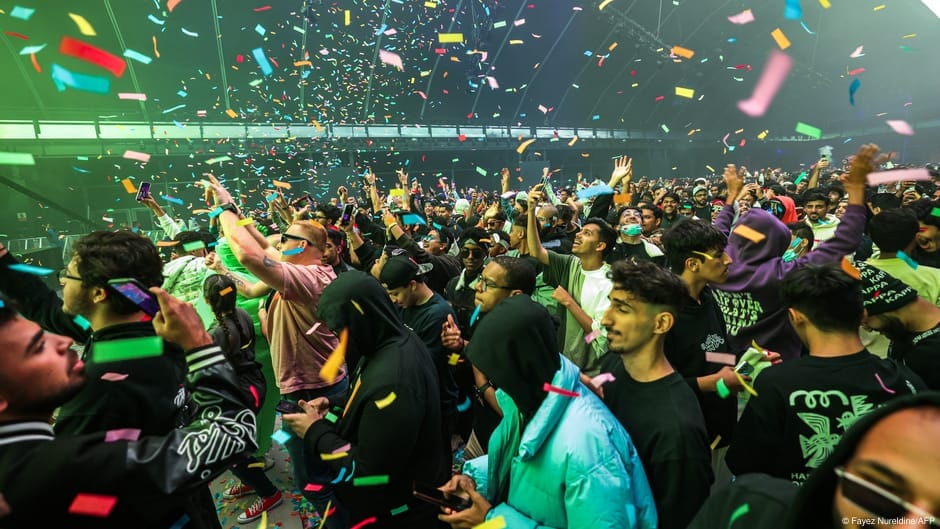
The case of rapper Asayel Bishi captures the paradox cleanly. In 2020, Mecca's governor called for the arrest of her production team after she released a music video featuring people dancing in a local cafe. By 2023, she was signed to MDLBEAST, the state-adjacent entertainment conglomerate that runs Soundstorm, an annual festival drawing over 400,000 guests. The distance between arrest threat and record deal was not artistic evolution — it was a policy shift in which direction the state wanted cultural energy to flow. MDLBEAST sits at the center of this architecture. Created in 2019 as a festival organizer, it has since expanded into a record label, radio station, distributor, promoter, and talent incubator. Researcher Amr Abdelrahim of Sciences Po documented in a 2024 study how post-2016, young musicians who had carefully hidden countercultural activities "suddenly became central to the ambitions of the state." Their careers, he wrote, "became tied to the destiny of the crown prince." The Saudi royal family has long used oil wealth distribution to ensure loyalty; what changed under MBS is the degree of centralization and the emergence of new clientelist networks around culture specifically. The control mechanisms are not subtle. ALQST for Human Rights told DW that "almost all major events are organized by the state or funded by closely linked entities," affecting not just the music produced but how artists act and what they say to fans. The organization argues musicians have even less artistic freedom under the new system than when they performed privately and off the grid. Nora Derbal of the University of Hamburg reported in a 2020 paper that Saudi artists described government project invitations as offers they couldn't refuse. The guitarist of Saudi black metal band Al-Namrood, who has kept his identity secret for nearly two decades, put it plainly: "The exchange is clear: You want to perform, it has to be under our rules." Al-Namrood represents the counter-case — a band formed in 2008 that has never played at home, refuses state support, and has condemned Saudi conservatism, religion, and politics in their music. They illustrate what the new system prices out: dissent. As Mephisto explained, the state doesn't necessarily buy loyalty directly — it creates incentives that make criticism increasingly costly. That's a distinction with minimal practical difference for most working musicians. The paradox, as postdoctoral researcher Fannie Agerschou-Madsen of the University of Roskilde frames it, is real but bounded: social liberalizations are challenging conservative norms — young Saudis enjoy dance parties, public performances, and self-expression — but political liberalization has not followed. Young Saudis are aware of the red lines and continually negotiate boundaries, creating incremental social change through everyday practices. One Saudi DJ described the first Soundstorm as "kind of our Woodstock" and "like Berlin after the fall of the wall." The euphoria is genuine. So is the cage. The structural question is whether a state-built culture industry can generate genuine artistic output or only the appearance of it. Independent monitoring of the sector only began recently, and despite the streaming growth, the most-streamed artists inside Saudi Arabia remain international acts. The kingdom has built the infrastructure for a music industry. Whether it has built, or can build, the conditions for music — which historically requires exactly the kind of friction, dissent, and ungovernable energy that this system is designed to eliminate — remains the $500 million question.
Worth reading?
SKIP
Score
28
/100
Extractive. The state captures political legitimacy, international soft power, and economic diversification benefits while musicians trade artistic autonomy for access and income, and dissenting voices are priced out entirely.
What Is GRIN?
GRIN stands for Generativity, Resilience, Innovation efficiency, and Novelty openness. These four dimensions capture the essential characteristics of any memetic intelligence — whether a nation, a corporation, a religion, or a movement.
About GRINGenerativity
2/5
Resilience
1/5
Efficiency
2/5
Novelty
1/5
Extractive
4/5
Inverted
Does this create new capability or just redistribute existing value?
Infrastructure exists but generativity is capped by design. The state builds venues, labels, and festivals — then controls what flows through them. No independent ecosystem can form under these conditions.
Verified Facts (12)
In 2020, Mecca's governor called for the arrest of Bishi's whole production team after release of 'Bint Mecca' music video
By early 2023, Bishi was signed to MDLBEAST
Vision 2030 plan announced in 2016
First major festival, Soundstorm, held in 2019, now draws over 400,000 guests
Saudi Music Commission report suggests sector could be worth $500 million by 2034
Spotify reports Saudi-made music streams inside Saudi Arabia increased by 195% between 2020 and 2024
Most-streamed artists inside Saudi Arabia are still international
First officially sanctioned music gigs began in 2017
Al-Namrood formed in 2008, have never played at home, kept identities secret for almost two decades
Amr Abdelrahim researcher at Sciences Po published 2024 study
Nora Derbal, professor at University of Hamburg, published 2020 paper in Arabian Humanities
Fannie Agerschou-Madsen, postdoctoral researcher at University of Roskilde
More latest news
Read all