TIME DETAINED
1 yr
YEARS IF CONVICTED
12-20
WATER RATION (LOW)
5 L/wk
KARIMLI AS APFP CHAIR
24 yrs
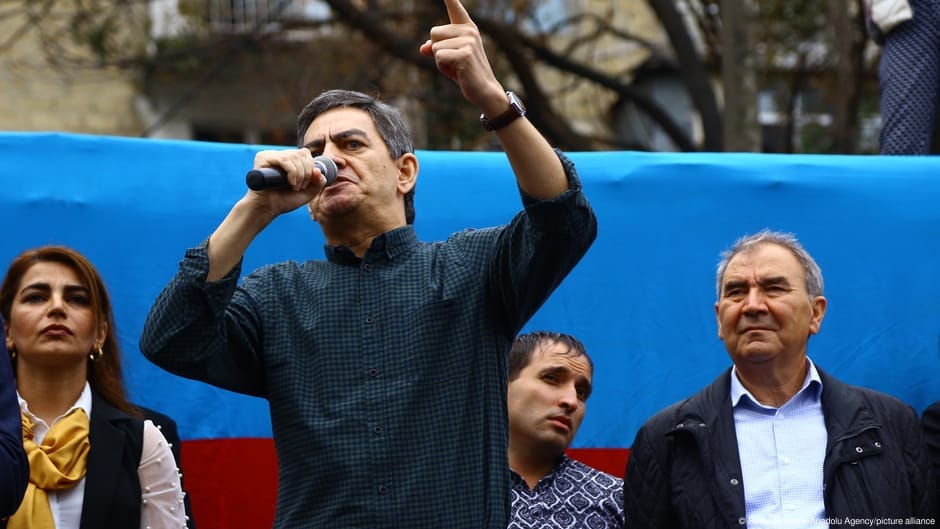
Ali Karimli, chairman of the Azerbaijani Popular Front Party, has now spent a full year in prison on charges of conspiring to seize power by force under Article 278.1 of Azerbaijan's Criminal Code — a charge carrying 12 to 20 years or life imprisonment. His co-defendant, longtime adviser Mammad Ibrahim, faces the same charges. Both men say the prosecution is politically motivated. Amnesty International has called for Karimli's release and described his detention as part of an ongoing campaign to crush all political opposition.
Extraction Map
The state's narrative stretches credulity under scrutiny. Prosecutors allege Karimli conspired with Ramiz Mehdiyev, the former head of the Presidential Administration, and foreign intelligence services to exploit a July 2020 pro-army rally in Baku to storm parliament and state television. Karimli says he did not attend the rally, that his party was not involved in organizing it, and that he has never met or communicated with Mehdiyev. Mehdiyev's own lawyer confirms his client denies any connection to Karimli. The two men occupied opposing political positions for decades. The trial itself is held behind closed doors, with foreign diplomats denied entry — justified, the court says, on grounds of state secrets. In a 15-page court motion obtained by DW, Karimli made clear he seeks political change but exclusively through democratic elections. He described the National Council of Democratic Forces, an opposition coalition formed in 2013, as an open effort to field a joint presidential candidate, not a coup vehicle. The court rejected his motion to drop the charges but added it to the case file. Detention conditions have drawn sharp international condemnation. Karimli's son Turkel, based in the United States, reports that family phone calls and in-person visits have been denied since June. Over the summer, authorities temporarily stopped accepting food parcels and restricted drinking water to 5 liters per week. Amnesty International reported that Karimli fainted from severe dehydration during an August 6 court hearing. Water has since been increased to 10 liters per week. His legal team says he has lost considerable weight, suffers persistent sleep disruption from noise, restricted exercise, worsening back pain, and poor ventilation. Amnesty has warned these conditions could amount to torture or other ill treatment. Ibrahim's family reports parallel concerns. His son Turan says his father suffers from kidney problems and insomnia, and that medical care in detention is inadequate. Ibrahim's wife, unemployed and living in rented accommodation, delivers food weekly and is permitted glass-partition visits twice monthly — while struggling financially since the arrest. Ibrahim previously served time in prison after a 2016 hooliganism conviction that Human Rights Watch described as spurious. The APFP has continued to operate during Karimli's detention, relying on collective decision-making structures built over his two-decade chairmanship. But founding member Rahim Hajiyev, now based in France, told DW that party members active on social media continue to face short-term administrative detention. The pattern is familiar: decapitate the leadership, harass the rank-and-file, and let the organizational structure atrophy. International response has been vocal but toothless. The European Parliament adopted a resolution on October 8 calling for Karimli's immediate and unconditional release. He received the 2026 Magnitsky Human Rights Award. When German Foreign Minister Johann Wadephul raised the case during a November 18 visit to Baku, Azerbaijani Foreign Minister Jeyhun Bayramov replied that belonging to the opposition did not exempt anyone from legal responsibility — a line that reveals the regime's operating logic perfectly. The opposition is not illegal, it is simply never immune from prosecution.
Worth reading?
SKIP
Score
8
/100
Extractive. The Aliyev regime is converting the remaining structural capacity for political opposition into consolidated one-party control, using the criminal justice system as the extraction tool.
What Is GRIN?
GRIN stands for Generativity, Resilience, Innovation efficiency, and Novelty openness. These four dimensions capture the essential characteristics of any memetic intelligence — whether a nation, a corporation, a religion, or a movement.
About GRINGenerativity
0/5
Resilience
1/5
Efficiency
1/5
Novelty
0/5
Extractive
5/5
Inverted
Does this create new capability or just redistribute existing value?
Zero generative output. This eliminates organized political competition, destroying the capacity for democratic accountability without creating any new institutional value.
Verified Facts (10)
Karimli has been charged under Article 278.1 of the Criminal Code, covering actions aimed at forcibly seizing power or changing the country's constitutional order, carrying 12 to 20 years or life imprisonment.
Mammad Ibrahim was detained on November 29, 2025, alongside Karimli.
In 2016, Ibrahim was sentenced to three years on hooliganism charges that Human Rights Watch described as spurious.
Water allowance was limited to 5 liters a week, later increased to 10 liters a week.
Amnesty International reported Karimli fainted from severe dehydration during an August 6 court hearing.
The European Parliament adopted a resolution on October 8 calling for Karimli's immediate and unconditional release.
Karimli was awarded the 2026 Magnitsky Human Rights Award.
German Foreign Minister Johann Wadephul raised the case during a November 18 visit to Baku.
Azerbaijani Foreign Minister Jeyhun Bayramov said that belonging to the opposition did not exempt anyone from legal responsibility.
Karimli has led the APFP since 2000.
More latest news
Read all