JOBS LOST · 2019-25
123K+
ANNUAL CUTS · VW
€1.5B
POSITIONS VIA ATTRITION
100K
AUTO WAGE PREMIUM
+30%
For eighty years, the German auto industry ran on a deal: workers got a seat at the table, and management got stability. That compact is now being dismantled not by ideology but by arithmetic. The EV transition erased the core labor argument — that German workers produced the most technologically advanced combustion engines — and Chinese competition exposed what that sophistication was actually costing.
Extraction Map
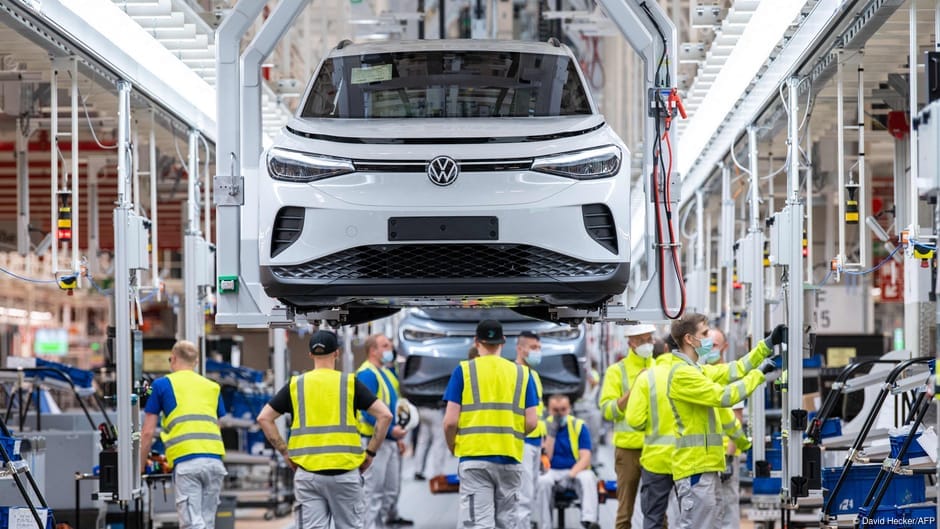
Volkswagen's negotiating posture tells the story. After canceling labor agreements and threatening factory closures in 2024, management extracted €1.5 billion in annual savings through abandoned wage hikes and 50,000 positions eliminated via attrition. Workers got job security through 2030 in return. This summer, management came back for more: four plant closures, another 50,000 positions slated for attrition, and a demand for a two-year wage freeze with slashed allowances and bonuses. Mercedes is running the same playbook. Both companies are demanding longer hours under existing pay — a direct assault on the 35-hour workweek that IG Metall won in 1984 after seven weeks of strikes. Mercedes acknowledged the concession was "hard-won" but stated flatly that "the conditions under which it was agreed upon no longer exist today." Volkswagen frames its demand as "flexibility in both directions." Union negotiator Thorsten Gröger translated: "Volkswagen wants its employees to perform unpaid work." The structural shift is what matters. When combustion technology was the competitive moat, workers' councils could argue that German production quality justified German wages. EV manufacturing is more commoditized. Management now says openly what was previously unsayable: "It doesn't matter for us where we produce." The leverage has migrated from labor to capital. Between 2019 and 2025, the German auto industry shed more than 123,000 jobs, according to the Ifo Institute. Labor's remaining weapons are blunt instruments. Warning strikes and walkout threats generate headlines but do not change the cost equation. Workers' councils, once strategic partners who hired business consultants to influence company direction, are now playing defense. As labor researcher Thomas Haipeter put it, what workers lack is "a kind of more offensive strategy" — they are negotiating the terms of retreat, not the terms of advance. The 35-hour workweek is the symbolic line in the sand. Analyst Ferdinand Dudenhöffer argues it is too sacred to concede: "As soon as one factory, one production hall, gives up the 35-hour workweek, then they will have a conflagration." He draws a parallel to the early 1990s, when then-Lower Saxony Premier Gerhard Schröder mediated a work-sharing deal. But that crisis came before globalized EV supply chains gave management a credible exit option. Auto workers still earn nearly a third more per hour than the typical German worker when bonuses and allowances are factored in, according to Destatis. That premium is now the target. The question is not whether concessions will be made, but how much of the postwar labor model survives the transition — and whether co-determination becomes a ceremony rather than a constraint.
Worth reading?
SKIP
Score
24
/100
Extractive. Management is leveraging an external shock (EV transition, Chinese competition) to claw back decades of labor gains. The savings flow to corporate balance sheets, not to reinvestment in German production capability or workforce adaptation.
What Is GRIN?
GRIN stands for Generativity, Resilience, Innovation efficiency, and Novelty openness. These four dimensions capture the essential characteristics of any memetic intelligence — whether a nation, a corporation, a religion, or a movement.
About GRINGenerativity
1/5
Resilience
1/5
Efficiency
2/5
Novelty
1/5
Extractive
4/5
Inverted
Does this create new capability or just redistribute existing value?
Net-negative. No new capability is being created — value is being redistributed from labor to capital. The €1.5B in annual savings comes from abandoned wages and attrition, not innovation or productivity gains.
Verified Facts (10)
Germany's auto industry losing more than 123,000 jobs between 2019 and 2025, according to the Ifo Institute
Auto workers earning nearly a third more per hour than the typical German worker when bonuses and allowances are factored in, according to Germany's Federal Statistical Office (Destatis)
IG Metall won the concession for a 35-hour workweek in 1984 after seven weeks of strikes
In 2024, Volkswagen abruptly canceled a series of labor agreements and threatened factory closures
Labor agreed to significant cuts — €1.5 billion yearly in abandoned wage hikes and the elimination of 50,000 positions through attrition — in exchange for job security for current employees through 2030
Management returned this summer with a restructuring plan that included the closures of four German plants and slated another 50,000 positions for attrition
Co-determination at Volkswagen dates to a 1945 deal promising a hot shower a day
Berlin anchored labor's strong say in Volkswagen in 1960, before the firm issued public shares
Mercedes called for employees to agree to an exception to the 35-hour workweek across the company
Volkswagen CEO Oliver Blume praised cooperation with the unions as one of the company's 'great strengths' during the 80th anniversary of the 1945 agreement
More latest news
Read all