AI INFRA · MALAYSIA
€510B
CHINA COMPUTE OFFSHORE
24%
DATA CENTERS · MY
125
TENCENT-ORACLE · COLLAPSED
$7B
Since Washington restricted the export of high-performance AI chips to China — targeting Nvidia GPUs and ASML lithography machines — Chinese companies have found an elegant workaround. They don't buy the chips. They rent time on them, remotely, from data centers in countries where those chips are legally installed. Malaysia is the primary hub.
Extraction Map
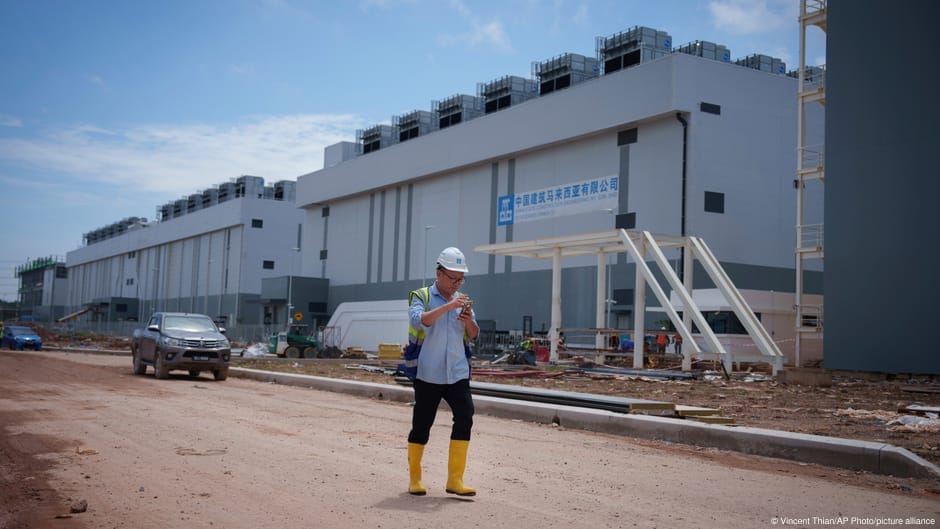
The numbers are striking. Some €510 billion has flowed into Malaysian AI infrastructure since February 2025. Fitch Solutions counts 125 data centers in the country. Sixteen of 27 new facilities sit in the western state of Johor, which offers cheap electricity and submarine cable access. Amazon, Oracle, Google, and Microsoft have collectively committed over $30 billion. The Malaysian government says up to 90% of jobs will go to locals. Digital Minister Gobind Singh Deo published a vision statement in Chinese — a signal that tells you everything about who the actual demand-side clients are. The Institute for Progress in Washington estimated that by end of 2025, roughly 24% of China's total computing power came from remote access to overseas data centers, three-quarters of them in Southeast Asia. That share is projected to reach 31% by 2027. Alibaba Cloud runs six data centers in Malaysia. TikTok's parent company ByteDance operates capacity in Johor. Tencent signed a $7 billion, five-year contract with Oracle for access equivalent to 100,000 modern AI chips — until the deal collapsed under pressure from both Beijing and Washington. The Tencent-Oracle collapse reveals the double bind. Beijing wants China to develop indigenous chip capability and dislikes dependency on American infrastructure. Washington wants to prevent Chinese access to advanced compute entirely. Both capitals torpedoed the same deal for opposite reasons. The intermediate countries — Malaysia, Singapore, Thailand, Indonesia — are caught in the vise, economically dependent on data center investment while politically exposed to tariff threats if they're seen as facilitating circumvention. Washington's response is escalating from product-level to system-level control. New rules from the Bureau of Industry and Security, issued the same day Trump met Xi in Shenzhen, now regulate remote access to advanced AI chips and servers. Data centers must conduct ownership and control checks on their clients. New licensing requirements cover advanced semiconductors destined for Indonesia, Malaysia, Singapore, Thailand, and Brazil — though US company subsidiaries are exempt, a carve-out that protects American cloud providers while squeezing Chinese ones. The Malaysian government moved quickly when threatened with 25% tariffs, introducing licensing requirements for transshipment of high-end chips and opposing illegal resale. But the core tension remains: the data center boom that Malaysia desperately wants for jobs and economic development is partly fueled by the very demand Washington is trying to suppress. Chinese industry expert Xu Sanlang put it plainly — the US now wants to control not just where chips go, but where they're used, who operates them, and which customers they serve. This is the shape of tech decoupling in practice: not a clean break but a leaky membrane, with intermediary countries serving as the osmotic layer between two superpowers that need them precisely because they can't deal with each other directly.
Worth reading?
SKIP
Score
24
/100
Extractive — value concentrates with US and Chinese tech giants while Southeast Asian host countries absorb geopolitical risk, tariff exposure, and regulatory whiplash without meaningful technology transfer.
What Is GRIN?
GRIN stands for Generativity, Resilience, Innovation efficiency, and Novelty openness. These four dimensions capture the essential characteristics of any memetic intelligence — whether a nation, a corporation, a religion, or a movement.
About GRINGenerativity
1/5
Resilience
1/5
Efficiency
1/5
Novelty
2/5
Extractive
4/5
Inverted
Does this create new capability or just redistribute existing value?
Minimal new capability creation for host countries. Data centers create construction and operations jobs but no indigenous chip design, no IP transfer. Malaysia rents land and power; the generative capacity stays in Beijing and Silicon Valley.
Verified Facts (11)
Some €510 billion ($559 billion) have been invested into AI infrastructure across Malaysia since February 2025
Fitch Solutions has opened 125 data centers in Malaysia
16 of 27 new data centers are located in Johor
Amazon and Oracle have each invested $6 billion, while Microsoft and Google have invested $2 billion apiece
Google's parent company, Alphabet, announced additional investments of $15 billion
About 24% of China's total computing power came from remote access to overseas data centers, three-quarters of which were in Southeast Asia
Predicted to rise to 31% by the end of 2027
Alibaba Cloud currently operates six data centers in Malaysia
The company has invested $53 billion in data centers in total
Tencent signed a five-year $7 billion contract with Oracle, allowing it to use computing capacity equivalent to 100,000 modern AI chips
US threatened to impose an additional 25% tariff on Malaysia imports
More latest news
Read all