POST-BIG BANG
630M yr
BLACK HOLE MASS
360M☉
LIGHT TRAVEL TIME
13.1B yr
UNIVERSE AGE AT OBS
5%
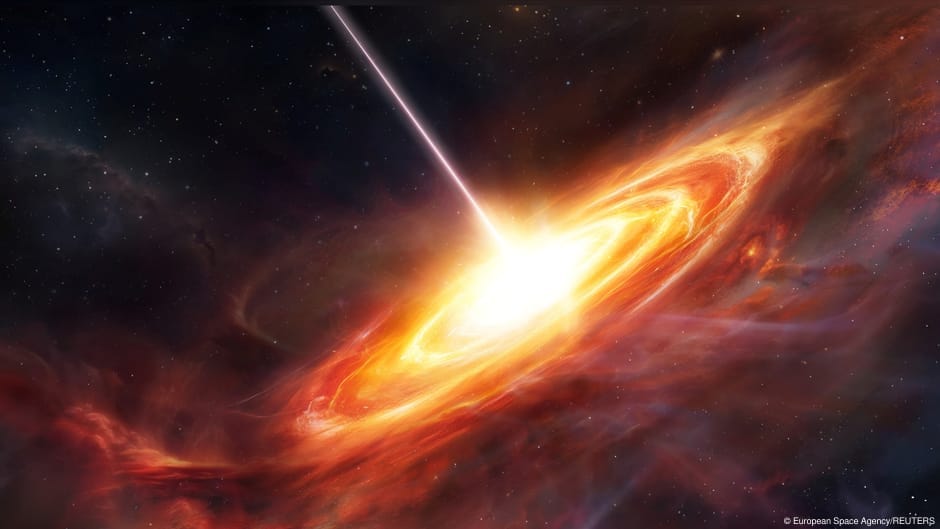
A European team led by astronomer Julien Wolf of the European Southern Observatory has identified the most distant quasar ever observed — a supermassive black hole nicknamed Dún Aonghas, formally J1504+6252, shining from just 630 million years after the Big Bang. The discovery, published in Astronomy and Astrophysics, pushes the observational frontier deeper into the infant universe than any previous quasar detection.
Extraction Map
The object was first spotted by ESA's Euclid space telescope, a mission designed to map dark matter and dark energy, then confirmed and characterized using a combination of ground- and space-based observatories. That Euclid — a dark-universe mapper, not a quasar hunter — made this find underscores how wide-field survey instruments generate serendipitous science far beyond their primary mission. The numbers are stark. At 360 million solar masses, Dún Aonghas had already assembled an enormous black hole when the universe was barely 5% of its current 13.8-billion-year age. This timeline is uncomfortable for models that grow supermassive black holes slowly through stellar-mass seeds and gradual accretion. Instead, the discovery supports a direct-collapse scenario: massive primordial gas clouds skipping the star-formation step entirely and collapsing straight into black holes that then hoover up surrounding matter. Study co-author Silvia Belladitta of the Max Planck Institute for Astronomy and the INAF Bologna Observatory explained the physics: gas, dust, and matter spiraling into the black hole form a superheated accretion disk that outshines the entire host galaxy by factors of hundreds or thousands. That extreme luminosity is precisely what makes quasars detectable across billions of light-years — and why they serve as cosmic flashlights illuminating conditions in the early universe. The scientific value here is genuinely generative. Each quasar at this distance is a data point constraining how galaxies formed, how black holes grew, and what physical processes dominated the first billion years. The direct-collapse formation pathway, if confirmed by additional early-universe quasars, would reshape the standard narrative of hierarchical structure formation. Euclid's role is worth noting separately. The telescope's primary mandate — surveying dark energy and dark matter — means it was not optimized for this kind of discovery. That it delivered one anyway reflects the generative power of large survey instruments: broad data collection creates optionality that narrow-purpose missions cannot. The discovery is a byproduct of infrastructure investment, not a targeted search. What remains open is whether Dún Aonghas is an outlier or the leading edge of a population. Future Euclid data releases and follow-up campaigns with the James Webb Space Telescope will determine whether supermassive black holes at this epoch are common or freakishly rare — a distinction that matters enormously for cosmological models.
Worth reading?
ESSENTIAL
Score
84
/100
Generative — this is new knowledge creation with no value extraction. Public investment in Euclid infrastructure produced a serendipitous discovery that constrains fundamental cosmological models and is freely published.
What Is GRIN?
GRIN stands for Generativity, Resilience, Innovation efficiency, and Novelty openness. These four dimensions capture the essential characteristics of any memetic intelligence — whether a nation, a corporation, a religion, or a movement.
About GRINGenerativity
4/5
Resilience
4/5
Efficiency
4/5
Novelty
4/5
Extractive
0/5
Inverted
Does this create new capability or just redistribute existing value?
Strongly generative. A new observational record creates a data point that constrains black hole formation models for the entire field. No value is redistributed — only created.
Verified Facts (9)
The quasar is formally known as J1504+6252, nicknamed Dún Aonghas
Formed within 630 million years of the Big Bang
The black hole had already grown to about 360 million times the mass of the sun
The red dot corresponds to seeing the universe as it was roughly 13.1 billion years ago — just 5% of its current age
Lead author is Julien Wolf of the European Southern Observatory in Germany
Co-author Silvia Belladitta of the Max Planck Institute for Astronomy and the INAF Bologna Observatory of Astrophysics and Space Science in Italy
Published in the journal Astronomy and Astrophysics
First detected by the European Space Agency's Euclid telescope
The universe is 13.8 billion years old
More latest news
Read all