FOREIGN CREW · CHINA
1st
ZHU STAY · RECORD
1 yr
EXPERIMENTS
90+
MOON TARGET
2030
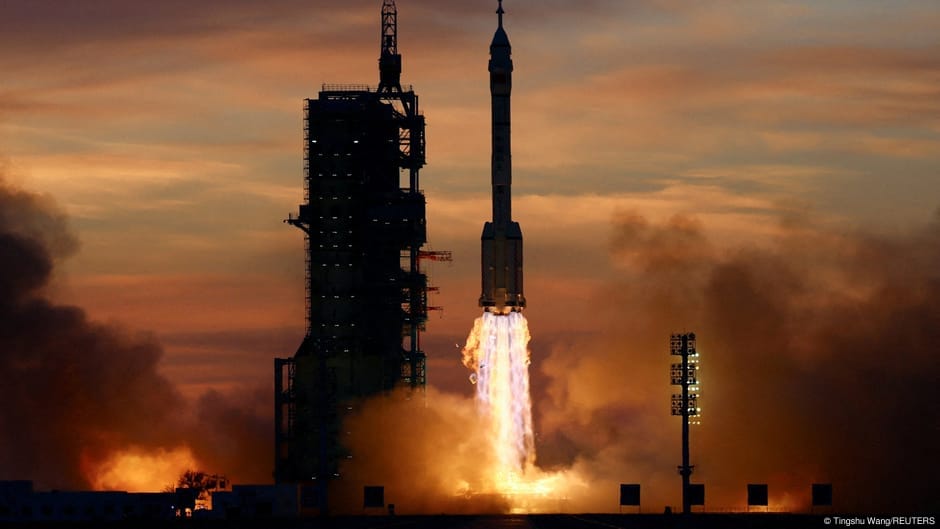
China launched Shenzhou-24 from Jiuquan at 0018 GMT on Wednesday, delivering three crew members to Tiangong station aboard a Long March-2F rocket. The capsule separated ten minutes after liftoff and entered orbit without incident. State media called it a "complete success." The crew — commander Tang Hongbo on his third flight, rookie Wu Yi, and Pakistani pilot Muhammad Zeeshan Ali — are now en route to dock with the station.
Extraction Map
Ali is the headline. He is the first non-Chinese national to fly on a Chinese crewed mission, and his selection is not incidental. "I carry the name of Pakistan on my shoulder, the hopes of 250 million Pakistanis," he told reporters, switching between Urdu, Mandarin, and English. Beijing is signaling that Tiangong is open for partner nations — a direct counter to the Wolf Amendment, which since 2011 has barred NASA from bilateral cooperation with China. Pakistan, already China's closest strategic partner, gets a prestige payload; China gets proof that its station is an international platform, not just a national project. The station handover is unusual. Shenzhou-23 commander Zhu Yangzhu will stay aboard for a full year — reportedly China's longest single crewed stay — while his crewmates Lai Ka-ying (Hong Kong's first astronaut) and Zhang Zhiyuan return to Earth alongside Ali. Zhu's extended mission is explicitly a stress test for human endurance ahead of planned lunar and potentially Mars missions. The science is straightforward: how does the body cope over twelve months in microgravity? The data feeds directly into China's 2030 crewed Moon landing timeline. That timeline remains unchanged despite the delay to Chang'e-7, the robotic lunar south pole mission. More than 90 experiments and technology tests are scheduled for the Shenzhou-24 crew rotation. Tang acknowledged at a pre-launch briefing that cross-cultural teamwork — differences in language, culture, and psychology — had been a genuine challenge during training, but said both sides' efforts were paying off. The geopolitical context is unavoidable. The United States is targeting 2028 for its own crewed lunar return via Artemis. China's 2030 target puts it roughly two years behind, but Beijing's cadence — consistent, incremental, on-schedule — contrasts with Artemis's repeated delays. Tiangong now hosts international crew, conducts year-long endurance missions, and runs a steady experimental program. It is no longer a demonstration project; it is operational infrastructure. What matters over the next decade is not who lands on the Moon first, but who builds the ecosystem around sustained presence. Ali's flight is a small data point with large signaling value: China is building that ecosystem, and it is inviting partners the U.S. cannot or will not serve. The science aboard Tiangong is genuine. The diplomacy is inseparable from it.
Worth reading?
RECOMMENDED
Score
68
/100
Generative. Genuine capability is being built — year-long crewed stays, international crew integration, 90+ experiments — but the diplomatic packaging means partner nations receive prestige while China captures the operational knowledge and station control.
What Is GRIN?
GRIN stands for Generativity, Resilience, Innovation efficiency, and Novelty openness. These four dimensions capture the essential characteristics of any memetic intelligence — whether a nation, a corporation, a religion, or a movement.
About GRINGenerativity
4/5
Resilience
3/5
Efficiency
4/5
Novelty
3/5
Extractive
2/5
Inverted
Does this create new capability or just redistribute existing value?
Real capability expansion: year-long stays generate biomedical data for deep-space missions, 90+ experiments build institutional knowledge. Not redistributive — this creates new human spaceflight capacity that didn't exist.
Verified Facts (9)
Shenzhou-24 lifted off at 8:18 am local time (0018 GMT) from Jiuquan on a Long March-2F rocket
Capsule separated about 10 minutes after liftoff and entered orbit
Tang Hongbo is making his third trip to space and will be first astronaut to board Tiangong three times
Muhammad Zeeshan Ali is the first foreigner to fly on a Chinese crewed mission
Ali quoted: 'I carry the name of Pakistan on my shoulder, the hopes of 250 million Pakistanis'
Shenzhou-23 commander Zhu Yangzhu will remain on board for a year — reportedly China's first full-year stay
Crew will carry out more than 90 experiments and technology tests per Xinhua
China's 2030 target for crewed Moon landing is unchanged despite Chang'e-7 delay
United States aiming for 2028 crewed lunar return
More latest news
Read all