DECREES SINCE 2021
100+
GIRLS BARRED · SCHOOL
2.6M
WOMEN NEED NUTRITION · 2027
1.27M
POPULATION · MEDIAN AGE 17
45M
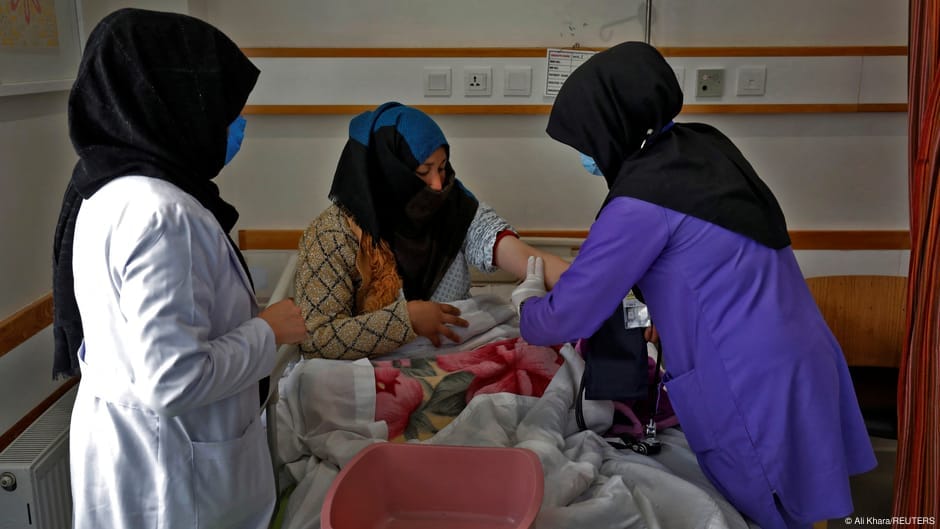
The Taliban have constructed a healthcare chokepoint that is killing women by design. By barring male doctors from treating female patients while simultaneously preventing women from attending universities or working in most professions, the regime has created a closed loop: no female doctors trained, no male doctors permitted, no care delivered. The UNAMA report from September 2025 documents Taliban Ministry for the Promotion of Virtue inspectors actively enforcing these restrictions at medical facilities.
Extraction Map
The numbers are staggering in their implications. Afghanistan's population of roughly 45 million has a median age of approximately 17, with 42% under 15. By UN estimates, more than 4 million children under five and around 1.27 million pregnant and breastfeeding women will require acute malnutrition treatment in 2027 alone. Meanwhile, 2.6 million girls are locked out of secondary education — the pipeline that would produce the next generation of female medical professionals. Activist Tamana Zaryab Paryani, 28, who was detained by the Taliban in January 2022 alongside her sisters before escaping to Europe, frames the logic with brutal clarity: "If a pregnant woman dies because male doctors are not allowed to treat her, her husband can marry another, younger woman. That is how the Taliban think." She addressed the UN Security Council in October, calling the system gender apartheid and urging the international community not to normalize it. Haroon Mutasem, professor of International Criminal Law at the American University of Afghanistan and research fellow at Humboldt University in Berlin, argues the situation transcends even the Rome Statute's existing definition of gender-based persecution. "This is not just about individual acts of persecution, but about an institutionalised system of oppression and domination of one gender group by another," he told DW. He warns that silence from the international community risks signaling to other authoritarian regimes that such systems are tolerable. The crisis is compounded by collapsing international aid. Susan Ferguson, the UN's Special Representative in Afghanistan, described the situation as "the world's worst women's rights crisis" and noted that funding cuts have forced humanitarian organizations into "impossible decisions about which women and girls can receive support and which have to be turned away." The double squeeze — Taliban restrictions plus donor fatigue — means the few remaining channels of care are narrowing simultaneously. What makes this extractive rather than merely negligent is the institutional architecture. Over 100 decrees since 2021 systematically remove women from education, employment, and public life. The healthcare ban is not an isolated policy failure but one node in a comprehensive system designed to reduce women to domestic and reproductive roles with no independent agency. The Taliban have not failed to build a healthcare system for women — they have succeeded in dismantling one. The twenty-year trajectory is demographic catastrophe layered on institutional collapse. A generation of girls denied education means a generation of women denied professional capability. Maternal mortality rises. Malnutrition compounds. The workforce shrinks. And the precedent propagates — Mutasem's warning about authoritarian copycat behavior is not theoretical but structural.
Worth reading?
SKIP
Score
8
/100
Extractive. The Taliban regime has built an interlocking system of decrees that systematically strips women of healthcare access, education, and economic agency — concentrating power and control while distributing mortality and suffering.
What Is GRIN?
GRIN stands for Generativity, Resilience, Innovation efficiency, and Novelty openness. These four dimensions capture the essential characteristics of any memetic intelligence — whether a nation, a corporation, a religion, or a movement.
About GRINGenerativity
0/5
Resilience
0/5
Efficiency
0/5
Novelty
0/5
Extractive
5/5
Inverted
Does this create new capability or just redistribute existing value?
Anti-generative by design. Banning girls from education and women from work destroys the pipeline for female doctors, teachers, and professionals. Human capital is being incinerated at scale.
Verified Facts (10)
Taliban have issued more than 100 decrees severely restricting the lives of women and girls since returning to power in 2021
Around 2.6 million girls are excluded from secondary education according to the UN
Afghanistan has a population of around 45 million with a median age of approximately 17
Around 42% of its population is under the age of 15
In 2027 more than 4 million children under the age of five and around 1.27 million pregnant and breastfeeding women will require treatment for acute malnutrition according to UN estimates
Tamana Zaryab Paryani was detained by the Taliban in Kabul in January 2022 alongside her sisters
Paryani addressed the UN Security Council at the end of October
UNAMA reported in September 2025 that inspectors from the Taliban's Ministry for the Promotion of Virtue and Prevention of Vice were further restricting women's access to healthcare
Susan Ferguson described the situation as the world's worst women's rights crisis
Haroon Mutasem is professor of International Criminal Law at the American University of Afghanistan and research fellow at Berlin's Humboldt University
More latest news
Read all