GERMAN FDI IN AFRICA
<2%
UAE · MAURITANIA DEAL
$34B
SUMMIT EDITION
6th
UAE · EGYPT DEAL
$24B
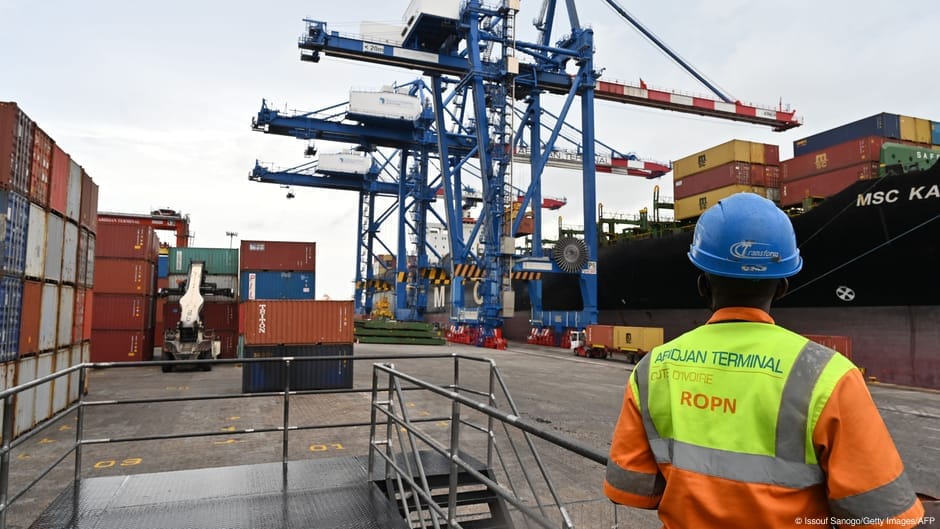
The sixth German-African Business Summit in Accra carried the same slogans — "win-win," "land of opportunity," "market of the future" — that have echoed through every edition. What changed is the context. German President Frank-Walter Steinmeier acknowledged openly what the business community has known for years: the comfortable North America–China export corridor is fracturing, and German industry needs somewhere else to go.
Extraction Map
The numbers tell a damning story of missed time. Africa accounts for less than 2% of total German foreign direct investment accumulated over decades. Meanwhile, the UAE has committed to megaprojects worth tens of billions — a $34 billion renewable energy project in Mauritania alone dwarfs Germany's entire green hydrogen portfolio on the continent. Turkey, India, and Gulf states have built commercial infrastructure across Africa while German firms debated risk matrices in Berlin. The structural case for Africa hasn't changed: fast-growing economies like Ethiopia and Rwanda, a working-age population that will add hundreds of millions over coming decades, expanding consumer classes with rising purchasing power, and mineral wealth critical to Europe's supply-chain diversification away from China. What changed is that Germany's alternatives got worse simultaneously — US tariffs punish exports, China's slowdown reduces demand, and Russian energy cutoffs forced a wholesale EU energy rethink. African leaders at the summit signaled impatience with the old extractive model. ECOWAS energy commissioner Amin Amidu Sulemani drew the line explicitly: "It's not a relationship where we send raw materials outside of Africa every time, when we can actually process them here." Germany's migration pacts with Kenya and Ghana, designed to ease domestic labor shortages, add another dimension — Berlin needs African workers as much as it wants African markets. The obstacles are real and familiar: corruption, governance gaps, unreliable energy, forex risk, poor infrastructure. But the more revealing complaint comes from German business itself — inadequate financing tools, excessive bureaucracy, fragmented strategy across ministries, and a risk perception that treats 54 diverse countries as a monolithic hazard. As Khadi Camara of the German-African Business Association put it, successful companies "don't do business as usual" and adapt models country by country. The UNCTAD 2026 World Investment Report confirms the competitive landscape has shifted. Gulf and Asian investors dominate greenfield megaprojects in energy, logistics, real estate, and infrastructure. Germany's comparative advantage — engineering expertise, vocational training, long-term industrial investment that creates stable jobs — remains strong in theory but has not translated into commercial presence. Goodwill without capital deployment is just reputation. The core tension is whether this pivot is generative partnership or a scramble for replacement markets dressed in development language. Steinmeier's plea — "be curious, take risks" — is directed at German executives, not African governments. The question is whether Berlin will build the institutional infrastructure (financing, guarantees, streamlined bureaucracy) to make the rhetoric operational, or whether this summit joins its five predecessors as another round of aspirational speeches while competitors sign contracts.
Worth reading?
OPTIONAL
Score
44
/100
Potentially generative but structurally extractive until proven otherwise — Germany is seeking replacement markets for its export model, not redesigning the relationship. African value-add processing remains aspirational, not contractual.
What Is GRIN?
GRIN stands for Generativity, Resilience, Innovation efficiency, and Novelty openness. These four dimensions capture the essential characteristics of any memetic intelligence — whether a nation, a corporation, a religion, or a movement.
About GRINGenerativity
2/5
Resilience
3/5
Efficiency
2/5
Novelty
2/5
Extractive
3/5
Inverted
Does this create new capability or just redistribute existing value?
Mostly redistributive. Germany seeks replacement export markets, not new capability creation. Green hydrogen and vocational training have generative potential, but the dominant motive is plugging holes in Germany's own export model.
Verified Facts (9)
Africa accounts for less than 2% of the total foreign investment made by German firms over the past several decades
The UAE has invested in the $34 billion Infinity Power renewable energy project in Mauritania
The $24 billion Ras El Hikma real estate development project in Egypt
The $6 billion H2 Global Energy hydrogen project in Tunisia
Germany has signed a migration pact with Kenya and is working on one with Ghana
German President Frank-Walter Steinmeier: 'Be curious, take risks and invest in our common future'
ECOWAS energy commissioner Amin Amidu Sulemani: 'It's not a relationship where we send raw materials outside of Africa every time'
Khadi Camara, deputy CEO of the German-African Business Association, urged companies to be 'more bold and maybe also innovative'
The 2026 World Investment Report by UNCTAD showed Gulf and Asian investors are becoming important sources of investment in Africa
More latest news
Read all