TOTAL SPEND · 2027
€561B
NEW BORROWING
€210B
DEFENSE TOTAL
€139B
SOCIAL / LABOR
€200B+
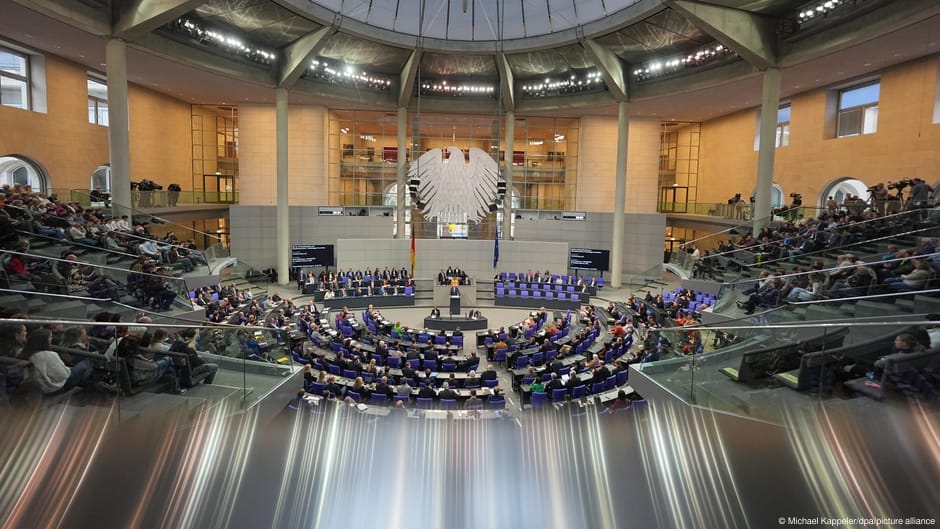
Germany's 2027 federal budget clocks in at €561 billion — the highest in the republic's history — financed by €210 billion in new borrowing. That's €401,000 in new debt per minute, as the AfD helpfully calculated. The debt brake Chancellor Friedrich Merz promised to restore is now a relic of the campaign trail.
Extraction Map
The defense budget tells the clearest story of geopolitical reality overriding fiscal doctrine. At €109 billion baseline — €139 billion with the special military fund — it represents the largest defense allocation in German history, a €27 billion year-on-year increase. Merz frames this as existential: Russia wants more than Ukraine, he told the Bundestag, citing escalation in the Baltic, Poland, the Black Sea, and space. The Greens agree. The AfD and Left Party call it militarization. But defense is not the budget's center of gravity. The Ministry of Labor and Social Affairs consumes over €200 billion — the single largest line item, and growing. Germany's pension system already cannot sustain itself on wage contributions alone: in 2025, €420 billion was paid out in pensions, with €127 billion coming directly from the federal government. By 2027, the government aims to trim €3 billion from that subsidy, likely by raising contribution rates. The demographic math is unforgiving: the 1960s cohort — over a million births per year — is heading into retirement. Birth rates halved by the mid-1970s and kept falling. The coalition's internal fracture runs along a predictable axis. Merz warns that tax revenue will no longer cover what Germans have grown accustomed to — a signal to cut. SPD parliamentary leader Matthias Miersch counters that large fortunes, inheritances, and family-business tax exemptions must be on the table — a signal to tax. These are not complementary positions. They are the structural disagreement that will define every budget negotiation until the coalition breaks or one side capitulates. The family-business inheritance exemption is a telling pressure point. Currently, heirs who continue running a family business can be exempted from inheritance tax — a provision designed to prevent forced sales. The SPD views this as a loophole that lets dynastic wealth escape the tax base while real-estate and financial-asset heirs pay full freight. The CDU/CSU views it as essential to the Mittelstand. This fight is a proxy for the larger question of who bears the cost of Germany's simultaneous rearmament and aging. Opposition attacks land from both flanks. The AfD's Tino Chrupalla frames Ukraine aid as money stolen from German households, asking "Whose chancellor are you, Mr. Merz?" after Zelenskyy left Berlin with a €200 million check. The Left Party's Heidi Reichinnek calls it "brutal social cuts" alongside "boundless rearmament." Neither offers a coherent alternative budget — but they don't need to. The populist frame writes itself when a government borrows at record levels while cutting unemployment benefits. Merz closed by asking for compromise between "admittedly quite different" coalition partners. With state elections in spring 2027 approaching, neither the CDU/CSU nor the SPD has incentive to compromise on the tax-versus-cut question. The budget passes, but the coalition's fiscal contradictions are now load-bearing structural features, not bugs to be patched.
Worth reading?
SKIP
Score
20
/100
Extractive — record borrowing finances current consumption (pensions, defense) rather than productive investment, shifting costs to future taxpayers who will inherit both the debt and the demographic deficit.
What Is GRIN?
GRIN stands for Generativity, Resilience, Innovation efficiency, and Novelty openness. These four dimensions capture the essential characteristics of any memetic intelligence — whether a nation, a corporation, a religion, or a movement.
About GRINGenerativity
1/5
Resilience
1/5
Efficiency
1/5
Novelty
1/5
Extractive
4/5
Inverted
Does this create new capability or just redistribute existing value?
Almost nothing generative. €210B in borrowing funds pensions and defense procurement, not capacity-building investment. No industrial strategy, no productivity agenda, no structural reform visible in the numbers.
Verified Facts (11)
Spending at just under €561 billion ($614 billion) will be higher than ever before
Record borrowing for the year totaling €210 billion
Government will incur €401,000 in new debt every minute next year (AfD calculation)
Defense budget €109 billion allocated for 2027, an increase of €27 billion on last year
Total defense budget to €139 billion including special military fund
Ministry of Labor and Social Affairs rising to over €200 billion
In 2025, just over €420 billion in pensions were paid out, with the government contributing €127 billion
By 2027, the government aims to save €3 billion on pension figure
Zelenskyy 'walks out of the chancellery here in Berlin with a check for €200 million'
Temporary reduction in the electricity tax would save the average family a mere €100 a year
This government has now been in office for about 20 months
More latest news
Read all