GLOBAL TRADE · SEA
90%
SEAS CONTESTED
3
ASSAD FELL
Dec '24
UKR NAVY SHIPS
0
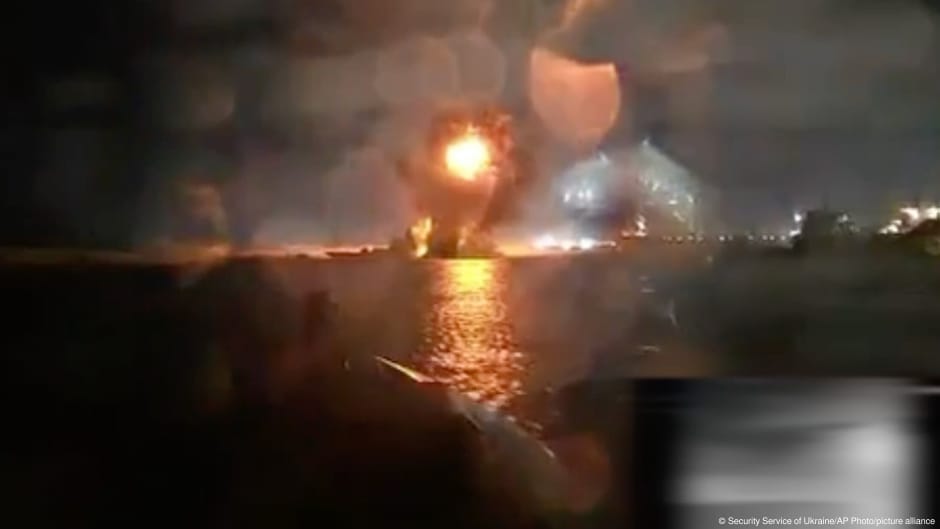
Ukraine has opened a global maritime front against Russia, striking the cargo vessel Sparta II off Finland, sinking the corvette Merkury off Libya, and continuing drone campaigns deep into Russian territory including oil refineries in Siberia. These operations span the Baltic, Mediterranean, and Black Sea — a remarkable geographic expansion for a country that began the war with almost no functional navy.
Extraction Map
The operational logic is straightforward: Russia uses the Baltic to supply its Kaliningrad exclave and export oil via its shadow fleet. It uses the Mediterranean to escort cargo vessels locked out of the Black Sea by Turkey's closure of the Bosporus and Dardanelles. Ukraine is hitting both supply chains, demonstrating it can identify and reach Russian military logistics anywhere on the planet. As Atlantic Council security expert Elisabeth Braw told DW, "Ukraine is showing that it knows exactly, and secondly that it's able to hit them wherever and whatever waters they are in." The political calculus is layered. Military experts see these strikes as Zelenskyy signaling strength ahead of potential peace negotiations, particularly as frustration with the US grows. University of Bonn security expert Joachim Weber suggested on Tagesschau that Ukraine is showing "less inhibition" and a willingness to expand the conflict geographically to increase pressure on Russia. The attacks on Sparta II — suspected of carrying military equipment, which Moscow denies — and the Merkury corvette are designed to demonstrate that no Russian vessel is safe anywhere. Russia, for its part, has been responding by increasing military escorts for its shadow fleet cargo ships. This is a rational defensive move but it escalates the risk calculus significantly. Weber warned that "the likelihood that an accidental exchange of fire between armed forces, coast guards or anyone could occur is rising." The more armed vessels crowd contested waters, the thinner the margin for miscalculation becomes — especially near NATO territory, where suspected Russian missiles recently crashed in Poland near an ongoing military exercise. The deeper structural risk is normative. Braw pointed out that violations of the Law of the Sea are rising not just in the Russia-Ukraine context but across the South China Sea, the Strait of Hormuz, and the Red Sea. Roughly 90% of global trade moves by ocean. If belligerents — state or non-state — conclude that violating maritime rules yields short-term gains without meaningful consequences, the entire architecture of open commercial shipping degrades. Ukraine's operations are strategically rational, but they contribute to a broader pattern where maritime law becomes optional. Ukraine's prior unconventional operations — special forces strikes against Russian facilities in Syria before the Assad regime fell in December 2024, and reported support for Tuareg fighters in Mali who inflicted heavy losses on the Malian army and Russian mercenaries — show this isn't a one-off escalation. It's a sustained doctrine of global disruption targeting Russia's military and economic networks. The question is whether the genie goes back in the bottle when the war ends. The immediate risks are concrete: an accidental engagement near NATO waters, a strike on a third-country vessel, or a provocation that triggers Article 5 considerations. The long-term risk is that the precedent normalizes maritime conflict outside of declared war zones, making the world's oceans fundamentally less predictable for commercial shipping and energy transport.
Worth reading?
SKIP
Score
28
/100
Extractive — both sides are consuming the global commons of maritime safety and international norms to gain bilateral advantage. The costs are borne by global shipping, third-party nations, and the rules-based order.
What Is GRIN?
GRIN stands for Generativity, Resilience, Innovation efficiency, and Novelty openness. These four dimensions capture the essential characteristics of any memetic intelligence — whether a nation, a corporation, a religion, or a movement.
About GRINGenerativity
2/5
Resilience
1/5
Efficiency
1/5
Novelty
2/5
Extractive
4/5
Inverted
Does this create new capability or just redistribute existing value?
Ukraine is generating asymmetric capability — a no-navy nation projecting global maritime power via drones and special forces. But this creates no new economic value; it's redistributive military pressure.
Verified Facts (11)
Attack on Russian cargo vessel Sparta II off the Finnish coast
Attack on Russian corvette Merkury and a dry cargo vessel allegedly carrying weapons off the coast of Libya
Several suspected Russian missiles crashed in Poland near an international military exercise
Ukraine targeted oil refinery in Omsk, Siberia
Ukraine struck oil terminals around St. Petersburg, in Ust-Luga and Primorsk
Ukrainian special forces carried out operations against Russian military facilities in Syria before the fall of the Assad regime in December 2024
Support lent to Tuareg fighters in Mali against the Malian army and Russian mercenaries
Turkey's blockade of the Bosporus and the Dardanelles prevents Russian Black Sea Fleet vessels from returning
Elisabeth Braw, security expert, Atlantic Council
Joachim Weber, security expert, University of Bonn
About 90% of global trade is conducted via the oceans
More latest news
Read all