COMBINED POPULATION
730M
TARIFF LINES CUT
98%
ID EXPORT GROWTH EST
~60%
PHASE-IN PERIOD
15yr
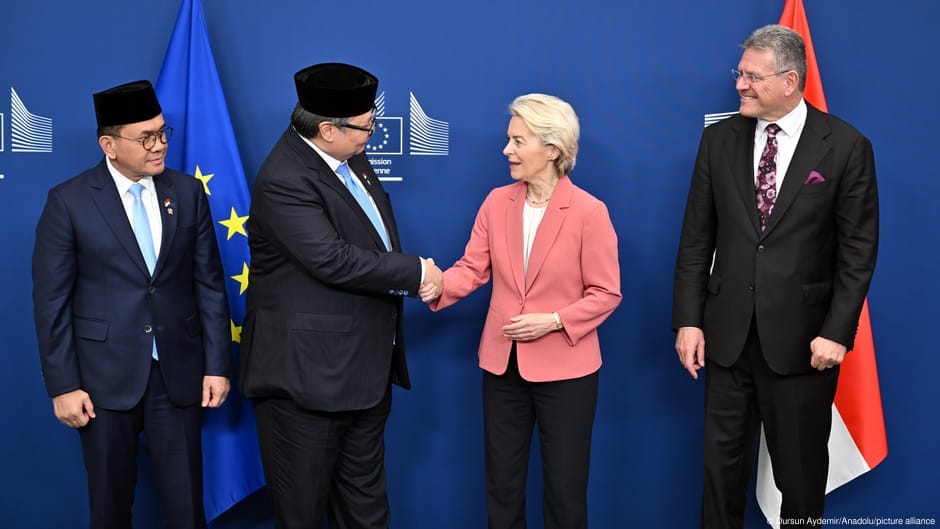
The EU and Indonesia signed a comprehensive trade agreement in Brussels last week, the product of nearly a decade of negotiations. European Commission President Ursula von der Leyen called it one of the bloc's "most ambitious deals" in the region, connecting markets of 730 million people. The agreement will phase out tariffs on more than 98% of product categories over 15 years, covering nearly the entire value of bilateral trade.
Extraction Map
For Europe, the strategic logic is transparent: reduce dependency on Chinese supply chains, lock in access to critical raw materials — especially nickel, essential for batteries and electric vehicles — and open a large, growing consumer market for European firms. Philip Schleifer, an associate professor at the University of Amsterdam, identified the core EU interests as "opening up a large and growing market, diversifying economic partnerships, reducing strategic dependencies on China, and securing access to critical raw materials." Indonesia's potential upside is real but conditional. The Center for Strategic and International Studies (CSIS) in Jakarta estimates Indonesian exports could increase by around 60%. Labor-intensive sectors — textiles, garments, footwear, furniture — stand to benefit alongside commodities. But economist Yose Rizal Damuri warned that market access alone does not translate into higher exports. Indonesia's existing trade agreements have "relatively low utilization rates," with actual export volumes using preferential access lagging far behind potential. The structural tension sits at the center of the deal. Indonesia wants to move beyond raw-material exports toward domestic processing and higher-value production. The EU wants reliable, cheap access to those same raw materials. Eline Blot of the Institute for European Environmental Policy identified the core friction: "The challenge for the EU is to reconcile its own interest in securing raw material supply with Indonesia's industrial development objectives." This is not a minor wrinkle — it is the central question of whether the deal is generative or extractive for Indonesia over time. Environmental risks compound the structural problem. Nickel mining and palm oil production carry well-documented costs in pollution, ecosystem degradation, and deforestation. The EU's Deforestation Regulation (EUDR) imposes compliance requirements that could disproportionately burden Indonesian smallholders who lack resources, technical capacity, and documentation. Blot cautioned against using smallholder hardship as a reason to weaken regulations, arguing instead for "adequate financial and technical support" — though no specific funding mechanism is detailed in reporting on the deal. The agreement includes a Trade and Sustainable Development chapter covering climate, biodiversity, forest management, and labor rights, with mechanisms for civil society participation. Schleifer was blunt about the track record: "Experience with other EU trade agreements suggests that there is often a big gap between sustainability commitments on paper and outcomes on the ground." Syafruddin Karimi of Andalas University stressed that Indonesian products must become traceable, including verification that production does not involve "environmental damage or labor practices that undermine human dignity." Whether the deal generates broad-based development or simply widens the extraction pipeline depends on Indonesia's domestic follow-through. Yose emphasized that without improvements in the business climate, regulatory predictability, and production standards — particularly for small and medium enterprises — "everything will remain good on paper but will not turn into real momentum for change." The agreement is a door, not a destination. The question is who walks through it and what they carry out.
Worth reading?
OPTIONAL
Score
52
/100
Conditionally generative, structurally tilted toward extraction — Europe secures critical mineral access immediately while Indonesia's higher-value industrial development depends on domestic reforms that have historically underperformed.
What Is GRIN?
GRIN stands for Generativity, Resilience, Innovation efficiency, and Novelty openness. These four dimensions capture the essential characteristics of any memetic intelligence — whether a nation, a corporation, a religion, or a movement.
About GRINGenerativity
3/5
Resilience
3/5
Efficiency
2/5
Novelty
3/5
Extractive
3/5
Inverted
Does this create new capability or just redistribute existing value?
Potential but front-loaded for the EU. Indonesia gets market access; Europe gets nickel. The 60% export increase estimate is aspirational — past Indonesian trade deals show low utilization rates.
Verified Facts (9)
Agreement will gradually scrap tariffs on more than 98% of product categories over 15 years
Von der Leyen described the deal as one of the EU's 'most ambitious deals' in the region, linking markets of 730 million people
CSIS estimates Indonesian exports could increase by around 60%
Philip Schleifer is an associate professor of political science at the University of Amsterdam
Eline Blot is a senior policy analyst at the Institute for European Environmental Policy (IEEP)
Yose Rizal Damuri is an economist at the Center for Strategic and International Studies (CSIS)
Syafruddin Karimi is an economist at Andalas University
Various trade agreements signed by Indonesia have relatively low utilization rates
The EU's Deforestation Regulation (EUDR) presents challenges for Indonesian smallholders
More latest news
Read all