CONTRACT RUNS TO
2030
SEIZURE DIAGNOSIS
Apr 2025
CONTRACT SIGNED
Feb 2025
LILLE UCL LOSS
2-1
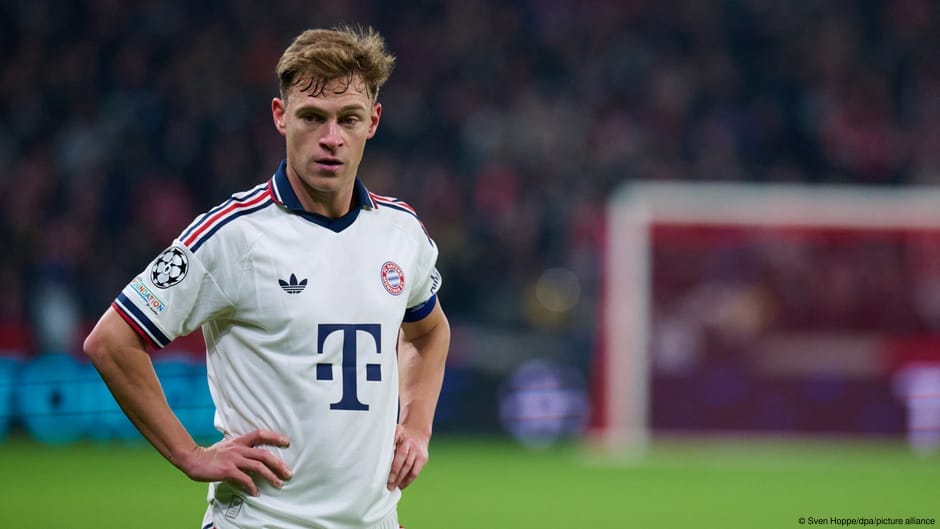
Joshua Kimmich stood in the mixed zone after Bayern Munich's 2-1 Champions League loss to Lille and did something rare in elite football: he directly challenged the men who run his club. His target was the public comments made by supervisory board members Uli Hoeness and Karl-Heinz Rummenigge about teammate Jamal Musiala's health, performance, and contract value. "It must never happen that something like this is played out at a player's expense," Kimmich said. "The club is bigger than the player, but it's not bigger than the person."
Extraction Map
The backdrop is Musiala's disclosure that he suffers from a neurological condition causing absence seizures, diagnosed after he collapsed during preseason matches in August. Rather than treating this as a private medical matter, Bayern's most powerful figures responded publicly — and financially. Rummenigge told Sky that if Musiala doesn't return to form, "the current financial figures would no longer be justifiable," a clear signal about the player's contract, which runs to 2030 and makes him one of the club's top earners. Hoeness called the situation a "dilemma" for the club. CEO Jan-Christian Dreesen raised the prospect of talks with Musiala's management and family. The collective effect was unmistakable: a coordinated public pressure campaign tying a player's medical condition to his economic value. Kimmich drew a sharp line between legitimate performance criticism and what he saw here. "It's not that he has problems because he's unprofessional. He's there every day trying to get the maximum out of himself." His point was procedural as much as moral: these conversations belong around a table, not in front of cameras. Bayern met with Musiala's agents on Tuesday and established a timeline that undercuts any suggestion of concealment. The club confirmed Musiala was first examined for seizure symptoms in April 2025 — two months after signing his contract extension. The sequence matters: it means the condition was not known at the time of signing, neutralizing any legal or ethical argument about hidden information. The episode reveals a structural tension at Bayern that extends beyond one player. The club's governance model concentrates enormous informal power in figures like Hoeness, who holds the title of Honorary President but wields outsized influence. When that power is exercised publicly against a player dealing with a health crisis, it raises questions about whether the institution's duty of care has any real enforcement mechanism — or whether the commercial calculus always wins. Kimmich's intervention is notable precisely because captains at clubs of Bayern's stature almost never publicly criticize the board. The fact that he felt compelled to suggests the internal temperature was already high, and that the dressing room saw the public comments as a breach of an unwritten compact between club and player.
Worth reading?
SKIP
Score
20
/100
Extractive. Bayern's boardroom figures leveraged public pressure and a player's neurological diagnosis to reframe a duty-of-care issue as a contract-value negotiation, concentrating leverage while externalizing reputational and psychological cost onto the player.
What Is GRIN?
GRIN stands for Generativity, Resilience, Innovation efficiency, and Novelty openness. These four dimensions capture the essential characteristics of any memetic intelligence — whether a nation, a corporation, a religion, or a movement.
About GRINGenerativity
1/5
Resilience
1/5
Efficiency
1/5
Novelty
1/5
Extractive
4/5
Inverted
Does this create new capability or just redistribute existing value?
Zero new value created. Public pressure on a player's health condition generates no capability — it's pure leverage redistribution from individual to institution in a contract dispute.
Verified Facts (10)
Bayern lost 2-1 to Lille in the Champions League
Musiala came on for the last quarter of an hour against Lille
Kimmich: 'It must never happen that something like this is played out at a player's expense'
Rummenigge told Sky: 'If he doesn't return to being the Jamal of old, then we need to have a conversation with his family, with the player, and, above all, with his agency – because, frankly, the current financial figures would no longer be justifiable'
Hoeness described the situation as a 'dilemma' for the club
Musiala collapsed on the pitch in preseason matches in August
Musiala diagnosed with a neurological condition causing occasional absence seizures
Musiala first examined for seizure symptoms in April 2025
Contract extension signed making Musiala one of the club's top earners, keeping him in Munich until 2030
Bayern met with Musiala's agents on Tuesday
More latest news
Read all