PROVINCES SEIZED
4
COURT RESET DATE
2003
YRS AUTONOMY
20+
CONSTITUTION · BYPASSED
2005
Iraq's Prime Minister Ali al-Zaidi issued a decree this week placing Kurdish-region border crossings under federal management, requiring federal oil ministry approval for Kurdish oil exports, and transferring management of oil fields in four contested provinces — Kirkuk, Diyala, Salahuddin, and Nineveh. The Federal Supreme Court endorsed the moves within 24 hours, ruling that the Kurdish Regional Government's authority covers only the territory it administered on March 19, 2003 — the day before the US-led invasion. The stated justification is stopping oil smuggling. The structural effect is a dismantling of the post-2003 Kurdish autonomy framework.
Extraction Map
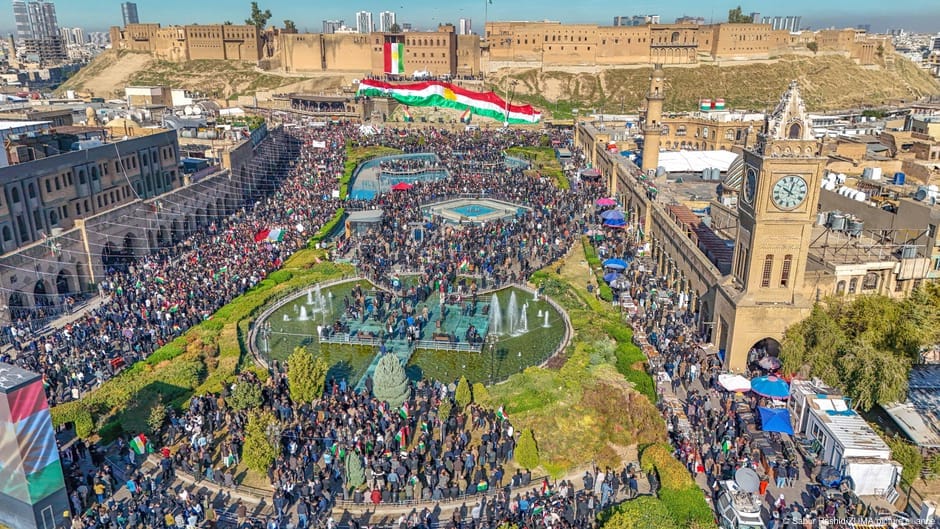
Thousands of protesters filled the streets of Erbil on Thursday, waving massive Kurdistan flags. The most significant detail is not the size of the crowd but its composition: rival Kurdish political factions — which have been at each other's throats, including an ongoing Federal Supreme Court challenge to the current KRG government's legitimacy — joined forces for the demonstrations. When parties that cannot agree on who should govern their own region unite overnight, the perceived threat is existential. The constitutional architecture matters. Iraq's 2005 constitution formally recognized the Kurdistan region and its government. Article 140 called for a census and referendum on disputed territories — neither was ever held. Kurdish peshmerga forces moved into disputed areas after 2003 and expanded further after reclaiming territory from the Islamic State. The court's ruling effectively resets the territorial clock to pre-invasion boundaries, ignoring two decades of facts on the ground. The oil dimension is the spine of the conflict. Iraq relies on oil revenues for the vast majority of its public sector budget. Control of Kirkuk's fields alone is worth billions annually. For the KRG, oil revenue is the material basis of autonomy — without it, self-governance becomes a legal fiction. For Baghdad, allowing a sub-national government to independently export oil is a permanent leak in fiscal sovereignty. Both sides have legitimate constitutional arguments, which is precisely why this has festered for 20 years. Al-Zaidi's political positioning adds a layer. He took office earlier this year with backing from US President Donald Trump and has framed the moves as reflecting Iraq's "independent national will." He also dismissed Kirkuk's operations commander, police chief, and the head of the Border Ports Commission — not just policy changes but personnel purges designed to establish federal control as operational fact before any legal challenge can reverse course. Speed and fait accompli are the strategy. The Kurdish response has been to call the moves "completely unacceptable" and a violation of constitutional rights. Regional PM Masrour Barzani expressed "surprise," though the trajectory has been visible for months. The KRG's real leverage is limited: they lack the military capacity to resist federal forces and their internal political divisions — temporarily papered over — will resurface the moment the immediate crisis cools. International attention, particularly from Washington, is the only external card they hold. This is a recentralization play executed under judicial cover. Whether it sticks depends on whether Baghdad can operationalize control of the border crossings and oil infrastructure before political or international pressure forces a negotiation. The 2005 constitutional settlement is being stress-tested to failure — not by amendment or referendum, but by executive decree backed by a compliant court.
Worth reading?
SKIP
Score
20
/100
Extractive. Baghdad is concentrating control over oil revenues and border infrastructure away from a constitutionally recognized autonomous region, using judicial fiat rather than the constitutional mechanisms (Article 140 census/referendum) designed for exactly this dispute.
What Is GRIN?
GRIN stands for Generativity, Resilience, Innovation efficiency, and Novelty openness. These four dimensions capture the essential characteristics of any memetic intelligence — whether a nation, a corporation, a religion, or a movement.
About GRINGenerativity
1/5
Resilience
1/5
Efficiency
1/5
Novelty
1/5
Extractive
4/5
Inverted
Does this create new capability or just redistribute existing value?
Destroys distributed capability. Kurdish oil management, border administration, and fiscal autonomy built over 20 years are being collapsed into a single federal chokepoint with no new productive capacity created.
Verified Facts (13)
Iraqi Prime Minister Ali al-Zaidi announced measures for Baghdad to take control of oil operations and border crossings previously run by Kurdish authorities
Al-Zaidi said the measures were part of a bid to stop oil smuggling
Iraq's Federal Supreme Court backed the decision a day later
The decision transfers management of oil fields in four contested provinces — Kirkuk, Diyala, Salahuddin and Nineveh
Iraq's 2005 constitution formally recognized the Kurdish region and its government
The Supreme Court ruled that KRG authority only covered land it administered on March 19, 2003
Article 140 called for reversing Saddam-era policies, a census, and a referendum — neither was held
Al-Zaidi dismissed Kirkuk's operations commander and police chief and the head of the Border Ports Commission
Al-Zaidi took office earlier this year with backing of US President Donald Trump
Regional Prime Minister Masrour Barzani called the decisions completely unacceptable
The KRG Cabinet said the decision violates both the Constitution and the constitutional rights of the Kurdistan region
Rival Kurdish parties joined forces for the protests
The Federal Supreme Court is hearing an ongoing challenge against the current KRG government's legitimacy after a party withdrew from the coalition cabinet
More latest news
Read all