WORKERS COVERED
3.7M
PHASE 1 · MAY 2027
2.0%
PHASE 2 · APR 2028
2.3%
ONE-OFF · MAR 2027
€150–450
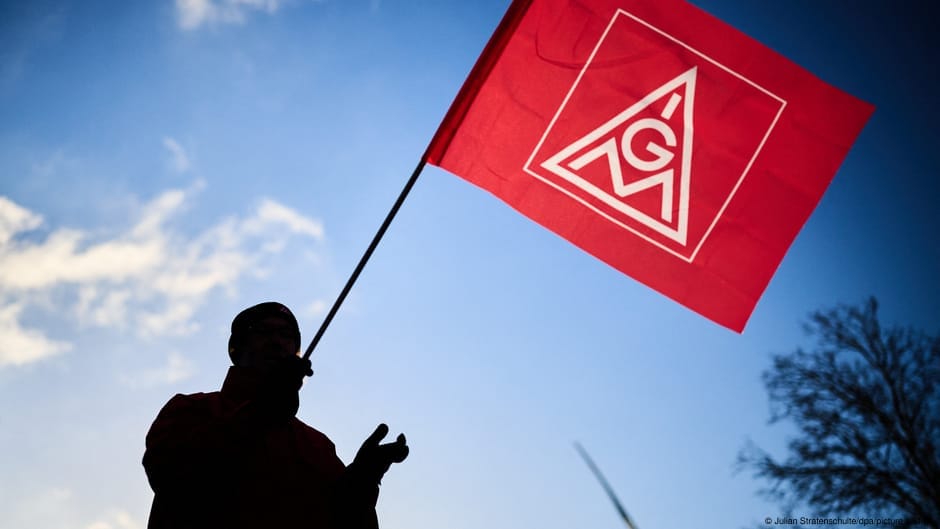
IG Metall, representing 3.7 million workers across Germany's metal and electrical industry, has concluded a wage agreement with employers after a marathon 24-hour negotiation session. The deal runs through November 2028 and covers workers at Volkswagen, Mercedes-Benz, Siemens, ThyssenKrupp, and Salzgitter AG — a roster that reads like the backbone of German industrial output.
Extraction Map
The headline numbers are deliberately modest: a 2.0% raise effective May 2027 and a 2.3% bump from April 2028, supplemented by one-off payments ranging from €150 to €450 in March 2027. For context, these increases will likely hover around or below Eurozone inflation targets, meaning real purchasing power gains are marginal at best. This is not a deal that makes workers richer — it is a deal designed to keep them employed. That framing matters because the negotiation took place against a backdrop of accelerating job cuts across German industry, particularly in the automotive sector. Volkswagen has been signaling restructuring for months. ThyssenKrupp's steel division is in existential flux. The union's strategic calculus was clear: accept restrained wage growth in exchange for binding commitments on investment and job preservation within Germany. The investment and jobs guarantee is the load-bearing clause. Without it, this deal would read as a straightforward concession to employer pressure. With it, IG Metall is attempting to anchor manufacturing capacity in Germany at a moment when every major automaker and industrial conglomerate is weighing relocation to lower-cost jurisdictions or accelerating automation. Whether the guarantees have teeth — enforceable timelines, specific investment floors — will determine whether this was shrewd or naive. For employers, the deal is a gift of predictability. Labor costs are locked through late 2028 at rates that pose no margin threat. The one-off payments are a classic negotiating lubricant — visible enough for union leadership to sell to members, cheap enough that employers concede them without resistance. The structure suggests both sides wanted a deal more than either wanted a fight. The broader signal for the German economy is mixed. Industrial peace removes one source of uncertainty, and the investment commitments, if real, could slow the bleed of manufacturing jobs. But the deal also ratifies the current power dynamic: employers hold the leverage because they control the investment decisions, and workers accept below-inflation raises because the alternative — strikes during a downturn with mass layoffs already underway — carries existential risk. Twenty-four hours of talks produced stability, not transformation. IG Metall bought time for 3.7 million workers. Whether that time gets used to restructure German industry or merely to delay its contraction is the question this deal cannot answer.
Worth reading?
OPTIONAL
Score
40
/100
Mildly extractive. Employers lock in below-inflation labor costs for three years while offering investment 'commitments' of unspecified enforceability — the wage restraint is concrete, the job guarantees are promissory.
What Is GRIN?
GRIN stands for Generativity, Resilience, Innovation efficiency, and Novelty openness. These four dimensions capture the essential characteristics of any memetic intelligence — whether a nation, a corporation, a religion, or a movement.
About GRINGenerativity
1/5
Resilience
3/5
Efficiency
3/5
Novelty
1/5
Extractive
3/5
Inverted
Does this create new capability or just redistribute existing value?
Near-zero new value creation. The deal stabilizes existing arrangements but generates no new capability, training pipelines, or productivity mechanisms. Investment pledges are vague.
Verified Facts (8)
IG Metall represents 3.7 million workers in the German metal and electrical industry
Pay increase in two phases: 2.0% from May 2027 and 2.3% from April 2028
One-off payments in March 2027 of between €150 ($164) and €450
Collective agreements will be in effect until November 30, 2028
Deal will also ensure new investments and jobs in Germany
IG Metall represents workers in Volkswagen, Mercedes-Benz, Siemens, ThyssenKrupp, and Salzgitter AG
Talks lasted more than 24 hours
IG Metall is Germany's largest trade union
More latest news
Read all