DE-AFRICA TRADE · 2025
€63.4B
YOY GROWTH
+10.5%
POTENTIAL CARS / YR
5-10M
KENYANS IN GERMANY
9,500
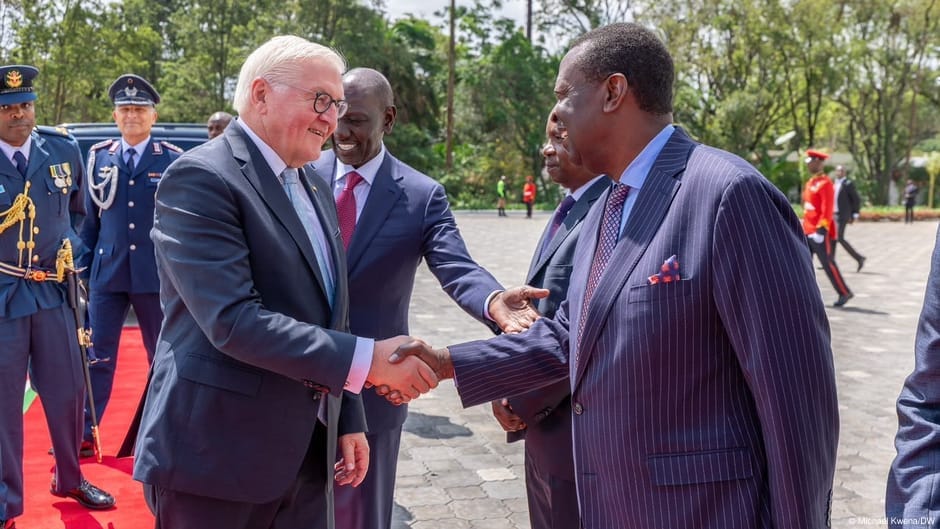
Frank-Walter Steinmeier's final presidential trip to Africa — Ghana, Côte d'Ivoire, Kenya — was part valedictory, part intervention. The 30th Africa visit of his political career carried a pointed message to German business: stop preparing and start doing. The subtext was blunt. China, Turkey, and Gulf states are eating Germany's lunch on direct investment across the continent, and the window won't stay open.
Extraction Map
The numbers tell a split story. German-African trade reached €63.4 billion in 2025, a 10.5% increase. That sounds healthy until you note that Asia-Pacific trade with Africa dwarfs it in absolute terms. Trade volume is not the same as strategic positioning. China is building rail lines, buying ports, and locking up raw materials — the kind of capital-intensive, long-horizon moves that create dependency and leverage. Germany is still mostly exporting finished goods. The delegation included voices from German SMEs and advisory firms like ICUnet, whose CEO Fritz Audebert described a "very favorable window" driven by geopolitical reshuffling — complications in China, the Iran conflict, and rising interest in alternatives to concentrated supply chains. Côte d'Ivoire, the world's largest cocoa exporter, impressed the delegation with ministerial competence. Bosch Africa's president Markus Thill put a number on automotive potential: five to ten million new cars per year could be built and sold in Africa, targeting households earning €10,000 or more annually. Instead, Europe dumps millions of used cars that wouldn't pass its own registration standards. The labor equation is equally consequential. Kenya alone sends one million young people into the labor market annually. Germany's response is a bilateral migration partnership — 9,500 Kenyans now working in Germany, 1,300 in vocational training — and support for vocational schools in Africa. This is real but small-bore relative to the demographic pressure. If the investment doesn't follow the training, the trained workers simply leave. China's model offers a revealing contrast. Beijing extends large loans, builds infrastructure, and extracts resources — but imports its own labor force, creating minimal local employment. Germany's pitch — vocational training, local job creation, fair migration pathways — is more sustainable in theory. In practice, German risk aversion means the pitch stays theoretical while Chinese concrete gets poured. Steinmeier's framing of three stable democracies (Ghana, Côte d'Ivoire, Kenya) as deliberate political partners, not just markets, signals an attempt at differentiation. Germany offers governance alignment and institutional reliability rather than raw capital. Whether that matters to African governments choosing between a German feasibility study and a Chinese construction crew is the open question. The emerging African Continental Free Trade Area (AfCFTA) is the structural catalyst everyone references but nobody has priced. If AfCFTA matures into a functioning single market, early movers gain compounding advantages in supply chains, distribution networks, and brand loyalty. Germany's tradition of industrial precision and vocational education could be a genuine competitive advantage — but only if firms actually deploy capital on the continent rather than studying the opportunity from Frankfurt.
Worth reading?
OPTIONAL
Score
48
/100
Mildly generative in intent but functionally extractive by omission — Germany's hesitation lets more extractive actors (China, Gulf states) set the terms of Africa's industrial development.
What Is GRIN?
GRIN stands for Generativity, Resilience, Innovation efficiency, and Novelty openness. These four dimensions capture the essential characteristics of any memetic intelligence — whether a nation, a corporation, a religion, or a movement.
About GRINGenerativity
3/5
Resilience
2/5
Efficiency
2/5
Novelty
2/5
Extractive
2/5
Inverted
Does this create new capability or just redistribute existing value?
Germany's offer — vocational training, SME investment, local auto production — is genuinely generative, but mostly aspirational. Actual capital deployed remains thin relative to China's infrastructure lock-in.
Verified Facts (8)
German-African foreign trade rose by 10.5% in 2025 to €63.4 billion ($69.4 billion)
Steinmeier has made 30 trips to African countries over 20 years
There are now around 9,500 Kenyans working in Germany, and nearly 1,300 in vocational training
Bosch Africa's Markus Thill said households with annual income of €10,000 or more can afford a new car, meaning potentially 5-10 million new cars per year could be built and sold in Africa
Fritz Audebert is CEO of ICUnet
Côte d'Ivoire is the world's largest cocoa exporter
In Kenya alone, one million young people enter the labor market each year
First German-African business summit held in Berlin in 2015
More latest news
Read all