POPULATION LOST · 2011-23
420K
MEDIAN MONTHLY WAGE
€620
TWO-MAN DUOPOLY
21 yrs
2025 VOTER TURNOUT
<45%
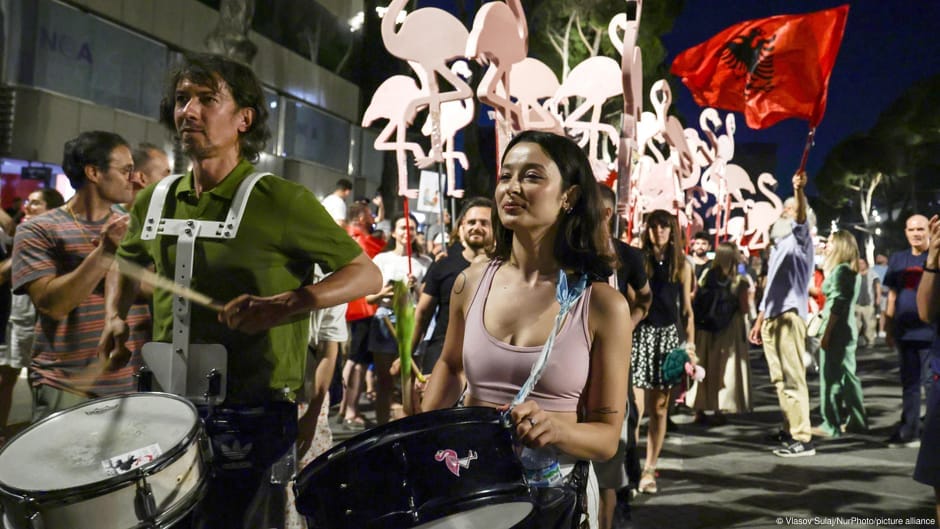
For three decades, Albania's political class had a pressure valve: the suitcase. Dissatisfied citizens left. Between 2011 and 2023, the country shed roughly 420,000 people — nearly 15% of its population — primarily through emigration. The number of Albanian citizens in Germany alone more than doubled between 2018 and 2024, reaching almost 120,000. That valve is now jammed. The Flamingo Revolution, named for protests that began in May against a luxury resort in a coastal nature reserve linked to Ivanka Trump and Jared Kushner, has become the most sustained civic mobilization in Albania's post-communist history.
Extraction Map
The movement's demands are specific: Prime Minister Edi Rama's resignation, a transitional government, electoral reform, and fresh elections. Thousands marched almost every evening for four months, largely peacefully, until a student protest on October 13 escalated into clashes with police. Since then, tear gas, water cannons, rubber bullets, hundreds of arrests, and significant property damage have marked the standoff. Rama has invited dialogue; protesters have refused. The structural complaint is about capture, not ideology. Albania's 2008 constitutional reform gave party leaders effective control over who enters parliament, severing the link between lawmakers and constituents. The result: in 2025, a new party won roughly 64,000 votes but just one seat, while the Socialists secured approximately one seat per 10,000 votes. For 21 years, the prime minister has been either Edi Rama (Socialist leader since 2005) or Sali Berisha (Democratic Party chairman since 1991). Freedom House classifies Albania as "partly free." The OSCE described the 2025 elections as "competitive and professionally managed" but noted "intimidation, misuse of public resources and pressure on public employees." Turnout was below 45%. The economic grievance is real and measurable. Half of all Albanian employees earn less than 60,000 lek (roughly €620) per month after taxes. Meanwhile, food prices sit slightly above the EU average. Real estate prices in Tirana have nearly doubled since 2018, with rents rising at similar pace. GDP growth — which the government highlights — has not translated into broad-based prosperity. Critics point to public procurement and concession systems that channel taxpayer money to a small number of well-connected companies through prestige projects and public-private partnerships. Rama's defense is twofold: governments should change at the ballot box, not on the streets, and his resignation would jeopardize Albania's EU accession bid, targeted for 2030. Both arguments are structurally weak. The electoral system his own party helped design makes ballot-box change extraordinarily difficult for new entrants, and the vast majority of Albanians — including protesters — are pro-EU. From the streets' perspective, it is the Rama government, not its critics, that is the obstacle to European integration. The obvious regional parallel is Serbia, where a student-led movement recently forced a long-entrenched leader from office. Whether Albania follows that trajectory depends on whether a generation with traditionally low political engagement can convert protest energy into electoral participation within a system designed to resist new entrants. The movement is leaderless, cross-spectrum, and domestically driven — Rama's claims of "foreign hands" have produced little supporting evidence. What makes the Flamingo Revolution structurally significant is the signal it sends about exit versus voice. When emigration is the dominant response to institutional failure, incumbents face no domestic accountability. The burning suitcase in the Education Ministry courtyard was not theater — it was a declaration that the pressure valve has closed. Albania's political duopoly now faces a population that intends to stay and fight, not leave. Whether the system can absorb that pressure without cracking, or whether it cracks productively, is the defining question for Albanian governance in the decade ahead.
Worth reading?
SKIP
Score
24
/100
Extractive. A two-party duopoly and its connected business networks capture public resources, procurement, and coastal land, while half the workforce earns under €620/month and emigration has been the only release valve.
What Is GRIN?
GRIN stands for Generativity, Resilience, Innovation efficiency, and Novelty openness. These four dimensions capture the essential characteristics of any memetic intelligence — whether a nation, a corporation, a religion, or a movement.
About GRINGenerativity
1/5
Resilience
1/5
Efficiency
1/5
Novelty
2/5
Extractive
4/5
Inverted
Does this create new capability or just redistribute existing value?
Near-zero generativity for the broad population. GDP growth funnels through connected firms and prestige projects; half the workforce earns under €620/month. Tourism booms, but prosperity pools at the top.
Verified Facts (11)
According to the 2023 census, the population shrunk by about 420,000 between 2011 and 2023 — by nearly 15% — primarily because of emigration.
The social movement began in May with demonstrations against a luxury resort in a coastal reserve that Ivanka Trump and Jared Kushner were involved in.
On October 13, a student protest escalated and there were clashes with police.
In 2025, a new party received about 64,000 votes, but only one seat. The Socialists, by contrast, won about one seat for every 10,000 votes.
Rama has been the leader of the Socialists since 2005, while Berisha first became the chairman of the Democratic Party in 1991.
Half of all employees earn less than 60,000 lek (roughly €620 or $680) per month after taxes.
Food prices are slightly above the EU average and real estate prices in Tirana have nearly doubled since 2018.
The number of Albanian citizens in Germany more than doubled between 2018 and 2024, reaching almost 120,000.
Freedom House classifies Albania as 'partly free.'
Turnout was below 45%.
OSCE said elections took place 'in a highly polarized environment and contestants did not enjoy a level playing field.'
More latest news
Read all