AFD VOTE · SAXONY-ANHALT
~44%
BSW VOTE · SAXONY-ANHALT
5.3%
VOTES SHORT · BUNDESTAG
<10K
MYSTERY EXTRA VOTES · SPEAKER BALLOT
9
The Sahra Wagenknecht Alliance — now rebranded as the Alliance for Social Justice and Economic Reason — was built on a single proposition: offer disaffected voters a home that wasn't the far-right Alternative for Germany. Thirty-four months later, the BSW is the party most likely to put the AfD into a state premiership for the first time in German history. The irony is structural, not incidental.
Extraction Map
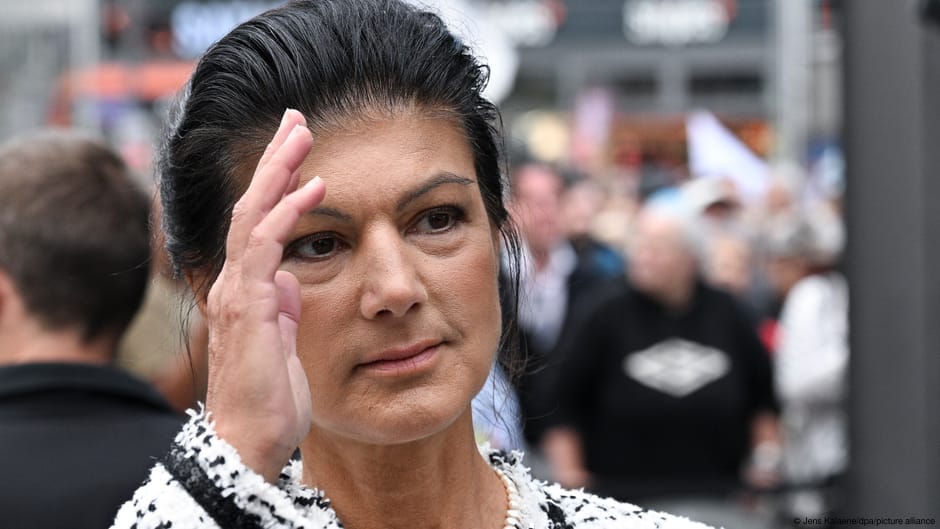
The mechanics are precise. In Saxony-Anhalt, the AfD won nearly 44% of the vote in September but lacks an absolute majority. AfD lead candidate Ulrich Siegmund needs 42 votes to become state premier. If the first two rounds fail, a third round requires only a simple majority. The BSW has announced it will abstain in that third round — a procedural maneuver that functionally lowers the threshold Siegmund needs to clear. During the secret ballot for state parliament speaker, AfD candidate Tobias Rausch received 9 more votes than the AfD holds seats, suggesting cross-party support already exists in the chamber. The BSW's position is a party caught between its founding myth and electoral arithmetic. Board member Christian Leye, writing in Die Zeit, quoted Wagenknecht's own founding pledge: "Of course we will not collude with the AfD." But Wagenknecht herself has since argued that the mainstream firewall policy — refusing any cooperation with the AfD — has failed and should be abandoned. She simultaneously rejects coalition with the AfD and rejects joining a firewall coalition against it. Co-chair Fabio De Masi described the situation as "riding on the edge of a razor blade." The party's electoral trajectory tells the deeper story. After missing the 5% Bundestag threshold in February 2025 by fewer than 10,000 votes, the BSW challenged the result in Germany's Constitutional Court and lost. The court found no evidence of voting errors — just "unproven assumptions." In 2025 state elections, the BSW scored below 2% in Baden-Württemberg, Rhineland-Palatinate, and Hamburg, confirming its irrelevance in western Germany. Its governing coalitions in Brandenburg and Thuringia both collapsed. Saxony-Anhalt's 5.3% is the last arena where the BSW holds any leverage, and the party is spending that leverage to enable the force it was created to oppose. Wagenknecht's own trajectory mirrors the party's contradiction. She stepped back from frontline leadership in December 2025, retreating to chair a "commission on fundamental values" — the kind of advisory role that signals diminished operational influence while preserving ideological veto power. The party renamed itself to remove her name but cannot remove her gravitational pull. Her successor De Masi inherits a party whose western base is functionally zero and whose eastern base survives only as a kingmaker for the AfD. The upcoming party conference in Dresden will force a reckoning the BSW has avoided for months. The internal split is real: one faction holds to the founding anti-AfD line, another follows Wagenknecht's pragmatic argument that firewalls have failed. But "pragmatic" is doing heavy lifting here — abstaining in a premier vote is a distinction without a meaningful difference from enabling. If Siegmund becomes Germany's first AfD state premier with BSW abstentions providing the margin, the party's founding rationale collapses entirely. The broader lesson is about the limits of personality-driven splinter parties in proportional systems. The BSW was always a vehicle for Wagenknecht's specific brand of left-conservative populism — anti-immigration, anti-NATO, pro-welfare. That cocktail attracted 4.97% nationally, not enough. Without Bundestag representation, without western relevance, and with its eastern leverage pointed at installing the AfD, the BSW is becoming the thing it promised to prevent.
Worth reading?
SKIP
Score
20
/100
Extractive. The BSW extracts legitimacy from anti-AfD voters while delivering the procedural conditions for AfD power, concentrating political benefit with the far right at the cost of democratic norms and its own electorate's stated preferences.
What Is GRIN?
GRIN stands for Generativity, Resilience, Innovation efficiency, and Novelty openness. These four dimensions capture the essential characteristics of any memetic intelligence — whether a nation, a corporation, a religion, or a movement.
About GRINGenerativity
1/5
Resilience
1/5
Efficiency
1/5
Novelty
1/5
Extractive
4/5
Inverted
Does this create new capability or just redistribute existing value?
Net negative. The BSW created no durable political capability — its founding proposition (anti-AfD alternative) is being actively consumed to produce the opposite outcome. Zero-sum at best, value-destroying at worst.
Verified Facts (16)
BSW launched in January 2024, originally named Sahra Wagenknecht Alliance
Since October 2026 the acronym stands for Alliance for Social Justice and Economic Reason
BSW took part in governing coalitions in Brandenburg and Thuringia; both collapsed relatively quickly
BSW failed to gain the 5% share in the February 2025 general election by less than 10,000 votes
Germany's Constitutional Court dismissed the BSW election challenge as inadmissible
Wagenknecht stepped back from frontline leadership in December 2025
Fabio De Masi and Amira Mohamed Ali are co-leaders
BSW received less than 2% in Baden-Württemberg, Rhineland-Palatinate, and Hamburg in 2025
BSW got 5.3% in Saxony-Anhalt in September
AfD won Saxony-Anhalt election with almost 44% of the vote
AfD classified as right-wing extremist in Saxony-Anhalt by domestic intelligence agency
Ulrich Siegmund is AfD lead candidate for state premier in December
Absolute majority requires 42 votes; third round requires only simple majority
AfD speaker candidate Tobias Rausch received 9 votes more than the AfD has lawmakers
Board member Christian Leye criticized the BSW's closeness to the AfD in Die Zeit
De Masi described dealing with the AfD as 'riding on the edge of a razor blade'
More latest news
Read all