CHINA COMPONENT SHARE
90%→28%
GERMANY INVESTMENT
€34M
UA DRONE COMPANIES
200+
UA DRONE CAPACITY
10M/yr
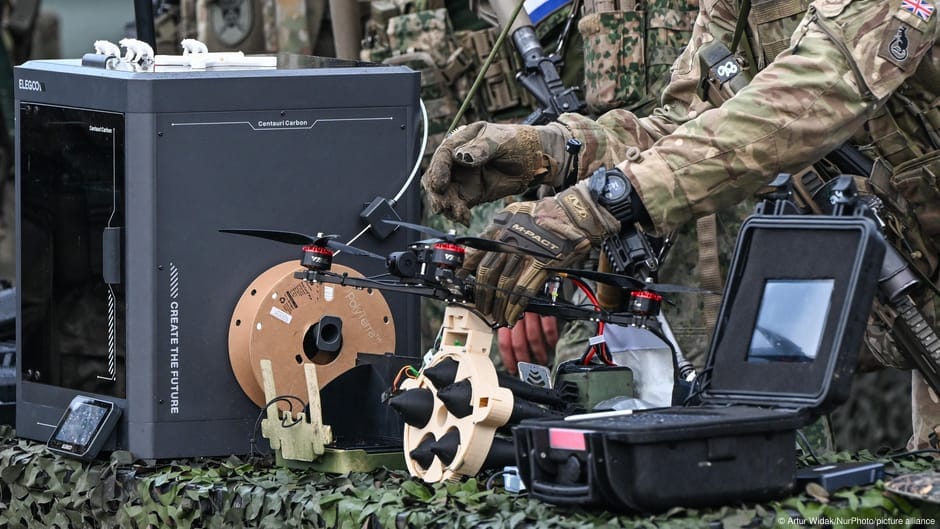
Germany is investing €34 million to manufacture Ukraine's Babka reconnaissance drone on German soil, via a joint venture between Wingcopter and Shadow Flytech. The deal, announced by Defense Minister Boris Pistorius after meeting Ukrainian counterpart Yevhenii Khmara, is one node in a rapidly expanding web of defense-industrial partnerships between Ukraine and Europe.
Extraction Map
The structural frame is the EU-Ukraine Drone Alliance, launched in July 2026 by Zelenskyy and von der Leyen. The logic is explicit: Ukraine contributes combat-proven technology and battlefield data; Europe contributes industrial capacity, funding, and secure supply chains. Bilateral Drone Deals now run with the Netherlands, Norway, Finland, the Baltics, the UK, and — notably — Qatar, Saudi Arabia, and the UAE. Around a dozen more countries are in negotiations. Ukraine's drone sector barely existed at scale before 2022. Seven state-approved models before the full-scale invasion became 67 by 2023 and roughly 200 companies by early 2024. By June 2026, 95% of drones procured by Ukraine's armed forces are manufactured domestically. Zelenskyy says current capacity is 10 million units per year, with an ambition to reach 20 million with European support. The supply chain picture has shifted dramatically. As recently as early 2024, some 90% of drone components — motors, control chips, cameras — came from China. Through its defense cooperation deals, Kyiv has reduced the share of components imported directly from China to around 28% in the first eight months of 2026. That dependency drop is the most strategically significant number in the story: it shows the partnerships are delivering real diversification, not just press releases. The UK is now manufacturing Ukrainian medium and long-range drones and producing the Octopus interceptor drone under license. Germany, while not formally in the Drone Deal framework yet, has German companies deeply embedded in Ukraine's drone industry. The pattern is consistent: Ukraine provides IP and operational knowledge, the partner provides capital and manufacturing infrastructure, and both gain defense-industrial depth. Security expert Nico Lange frames this as an evolution from wartime donations to a 'partnership between equals.' That phrase does real analytical work. Ukraine is not a supplicant receiving aid — it is a technology licensor and operational knowledge exporter integrating itself into European defense architecture. The 20-year implication is a European defense-industrial base with Ukraine as a core member, not a client state. The vulnerabilities are real. Drones are mass-produced consumables — many are destroyed after a single mission or neutralized by electronic jamming. Meeting demand at the scale Zelenskyy describes (20 million annually) requires funding, components, and production facilities that remain under threat from Russian strikes. Whether the partnerships can sustain this throughput under wartime conditions is the open question.
Worth reading?
RECOMMENDED
Score
76
/100
Generative. Ukraine converts wartime innovation into exportable IP; European partners gain drone capability and supply chain diversification. Both sides build capacity they did not previously have.
What Is GRIN?
GRIN stands for Generativity, Resilience, Innovation efficiency, and Novelty openness. These four dimensions capture the essential characteristics of any memetic intelligence — whether a nation, a corporation, a religion, or a movement.
About GRINGenerativity
4/5
Resilience
4/5
Efficiency
3/5
Novelty
4/5
Extractive
1/5
Inverted
Does this create new capability or just redistribute existing value?
Genuinely generative. Ukraine exports battlefield-tested IP; Europe gains manufacturing capability. The 7→67→200-company expansion and licensing model create new industrial capacity, not redistribution.
Verified Facts (11)
Germany investing around €34 million in the Babka drone project
German company Wingcopter and Ukrainian manufacturer Shadow Flytech have established a joint venture
In July 2026, the EU and Ukraine launched a joint 'Drone Alliance'
Before the full-scale war, only seven drone models had received state approval. By 2023, that number had risen to 67
By early 2024, around 200 companies were operating in Ukraine's drone sector
As of June 2026, 95% of the drones procured for its armed forces are now manufactured domestically
As recently as early 2024, around 90% of all drone components came from China
Kyiv has managed to reduce the share of components imported directly from China to around 28% in the first eight months of 2026
In July 2026, Zelenskyy said Ukraine could manufacture around 10 million drones domestically each year
The goal was to increase production to 20 million annually with support from European partners
In March, the two countries agreed to produce Ukraine's 'Octopus' interceptor drone under license in the UK
More latest news
Read all