BERLIN CASE SURGE
+28%
NRW URGENT · Q1
1.4K→3.6K
LONGEST AI FILING
800pg
PROPOSED FEE
€15
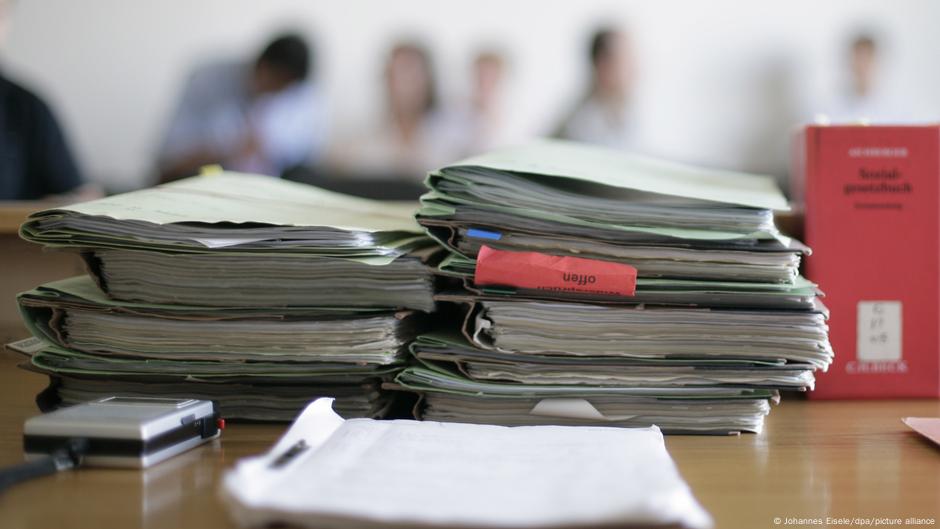
Germany's social courts — the low-barrier tribunals where citizens challenge benefit cuts, insurance hikes, and pension denials without needing a lawyer — are drowning in AI-generated filings. Berlin's state social court reports 28% more cases in 2026 than 2025. North Rhine-Westphalia's eight social courts saw urgent proceedings jump from 1,400 to 3,600 in the first quarter alone, a 157% spike. Judges say the culprit is obvious: chatbots.
Extraction Map
The tell is unmistakable. AI-drafted complaints arrive bloated with irrelevant legal citations, specialist formulations no ordinary citizen would use, and hallucinated case law that judges must still read and respond to. One Potsdam court received a single complaint stretching 800 pages. The filings strip out the human signal judges rely on — the sense of who is behind the case and what actually went wrong — replacing it with machine-generated legalese that obscures the real dispute. The asymmetry is brutal. Courts cannot deploy their own AI to summarize or triage these documents because judicial data-protection rules forbid routing sensitive medical and financial records through external servers. So judges read every bloated page by hand while the citizen who generated it spent minutes. The productivity tool works in one direction only. Conservative justice ministers want to plug the gap with fees — Hesse's Christian Heinz floated €15 per urgent complaint, with cost penalties for frivolous or abusive filings. The logic is straightforward deterrence. But social courts exist precisely because they carry no filing fees, serving the most vulnerable: the seriously ill appealing pension denials, care-dependent people seeking support. The VdK welfare association calls the fee proposal wall-building around courts that were designed to be open. The smarter counter-proposal comes from the VdK's Holger Lange: structured digital intake portals with clear questions and word limits that channel complaints into useful form before they reach a judge. This addresses the actual problem — signal-to-noise ratio — without erecting financial barriers. It also surfaces a more uncomfortable question: whether the recent surge partly reflects legitimate demand for legal protection that was always there but never articulated, because people didn't know how to file or didn't dare try. Context matters. Germany's social courts handled over 445,000 pending cases at the end of 2017. By end of 2024, that had dropped to 325,000 — a decline driven by economic conditions and benefit-law changes, not court efficiency. The current AI-driven bump is real but sits well within historical range. The crisis framing serves those who want to restrict access more than it serves accuracy. The structural question is whether Germany treats AI-assisted legal access as a problem to suppress or a signal to design for. Fees punish the wrong people. Structured intake systems address the right problem. The courts that figure this out first will set the template for every jurisdiction watching.
Worth reading?
SKIP
Score
32
/100
Mixed. AI democratizes legal access (generative) but floods courts with noise (extractive of judicial capacity). Proposed fee responses are extractive — taxing the vulnerable to solve an institutional design failure.
What Is GRIN?
GRIN stands for Generativity, Resilience, Innovation efficiency, and Novelty openness. These four dimensions capture the essential characteristics of any memetic intelligence — whether a nation, a corporation, a religion, or a movement.
About GRINGenerativity
2/5
Resilience
1/5
Efficiency
1/5
Novelty
2/5
Extractive
3/5
Inverted
Does this create new capability or just redistribute existing value?
Genuinely dual-edged. AI unlocks legal access for people who couldn't draft complaints before — real capability expansion — but the output quality is so low it creates net drag on the system.
Verified Facts (6)
Berlin's state social court is dealing with 28% more cases this year than in 2025, per spokesperson Marcus Howe
Urgent proceedings at NRW's eight social courts rose from around 1,400 in Q1 2025 to 3,600 in Q1 2026, per Legal Tribune Online
One complaint received by Potsdam social court stretched to 800 pages, per court president Friedrich-Johannes Graf von Pfeil
Hesse justice minister Christian Heinz proposed a fee of €15 ($16.40) for urgent complaints
Pending social court cases dropped from over 445,000 at end of 2017 to 325,000 at end of 2024
Courts cannot use AI to assess legal documents due to data-protection rules barring sensitive documents on external servers, per von Pfeil
More latest news
Read all