YOUTH NEET RATE
41.3%
EXTREME POVERTY
21%
REGISTERED VOTERS
1.15M
CANDIDATES
8
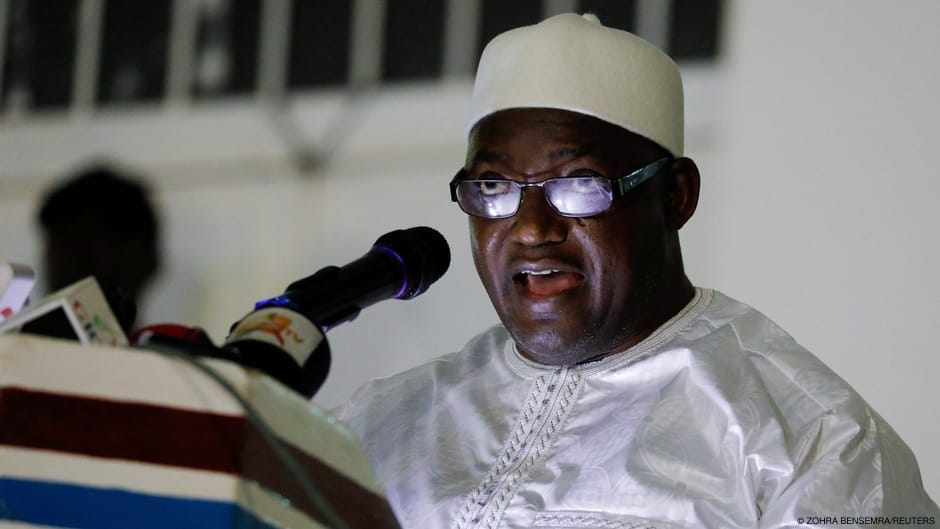
Gambia goes to the polls on December 5 with 1.15 million registered voters choosing among eight presidential candidates across 1,773 polling stations. The headline question is whether President Adama Barrow, who came to power in 2017 after ending Yahya Jammeh's 22-year military rule, can secure a third term. The more structural question is whether the democratic transition that began in 2016 is consolidating or quietly eroding.
Extraction Map
Barrow's candidacy is itself the fault line. He had pledged not to seek a third term, but reversed course after a proposed new constitution — which included presidential term limits — was rejected by the National Assembly in July 2025 for lacking a three-quarter supermajority. Barrow frames this as democratic choice: 'The Gambian people are the ones who elect a president. They decide the fate of a president.' That framing is technically correct and structurally convenient. The country still operates under the 1997 constitution drafted under Jammeh, a document designed for autocratic continuity, not democratic accountability. The opposition field is fragmented. Ousainou Darboe of the United Democratic Party leads the main challenge. Talib Ahmed Bensouda, who resigned as Kanifing's mayor just last week, runs as a youth candidate. Former Vice President Isatou Touray is the sole woman in the race. And Almameh Gibba, an independent lawmaker, carries the backing of exiled former dictator Jammeh — a reminder that the old regime's networks remain active, not dormant. The United Democratic Party's administrative secretary Lamin Manneh has signaled that opposition priorities extend beyond winning to ensuring the Independent Electoral Commission delivers a credible process. Political analyst Malang Faye cautions that rally turnout — where the incumbent appears ahead — does not translate cleanly to ballot box support. The campaign officially opened November 16, and some parties had barely begun organizing. Voter concerns are overwhelmingly economic. The World Bank projects 5.3% GDP growth in 2026, but extreme poverty is expected to hold at roughly 21%. Youth unemployment stands at 11.5%, while a staggering 41.3% of young Gambians are not in employment, education, or training. Voter Alhagie Sama framed the stakes bluntly: 'We need a country where young people do not have to risk their lives crossing the Mediterranean Sea in search of opportunities.' Activist Binta Bojang argued that conventional unemployment definitions fail to capture how joblessness manifests for ordinary Gambians. The election infrastructure is substantial for a country this size: 53 constituencies, 730 polling centers, trained officials, and an EU observation mission deployed at the government's invitation. The UN has urged all candidates to honor a peace pact signed November 16, in which candidates pledged to respect IEC independence and seek legal channels for disputes. Barrie Freeman of the UN's West Africa office delivered a pointed warning: 'History will judge not what you sign today, but what you do tomorrow.' What the December 5 vote measures is not simply Barrow's popularity but whether a small West African democracy can avoid the incumbency trap that has hollowed democratic transitions across the continent. The constitution that might have enforced limits is dead. The strongman's proxy is on the ballot. The economy delivers growth statistics that do not reach most citizens. The question is whether Gambia's institutions are strong enough to make elections meaningful constraints on power, or whether the machinery of democracy is becoming decorative.
Worth reading?
SKIP
Score
28
/100
Extractive — a broken constitutional reform process and a reversed term-limit pledge concentrate political power in the incumbent while economic gains bypass the majority of citizens.
What Is GRIN?
GRIN stands for Generativity, Resilience, Innovation efficiency, and Novelty openness. These four dimensions capture the essential characteristics of any memetic intelligence — whether a nation, a corporation, a religion, or a movement.
About GRINGenerativity
1/5
Resilience
1/5
Efficiency
2/5
Novelty
2/5
Extractive
4/5
Inverted
Does this create new capability or just redistribute existing value?
No new institutional capacity created. The failed constitution killed term limits; Barrow's re-run preserves the status quo under a Jammeh-era document. Growth exists on paper, not in livelihoods.
Verified Facts (11)
Gambia votes on December 5 in a presidential election
President Adama Barrow succeeded Jammeh in 2017 and is running for a third term
Proposed replacement constitution was rejected by the National Assembly in July 2025 after failing to secure the required three-quarter majority
1,146,474 people are registered to vote across 53 constituencies, 730 polling centers and 1,773 polling stations
The World Bank has projected economic growth of 5.3% in 2026
Extreme poverty is expected to remain at about 21%
Youth unemployment at 11.5%, while 41.3% of young people are not in employment, education or training
Independent candidate Almameh Gibba is backed by Jammeh
Former Vice President Isatou Touray is the only woman in the presidential race
EU has deployed an election observation mission
Peace pact signed on November 16
More latest news
Read all