JET FUEL SPIKE
2×+
2025 NET LOSS
$61.9M
PLANES SEIZED
12
CARRIER LIFESPAN
5 yrs
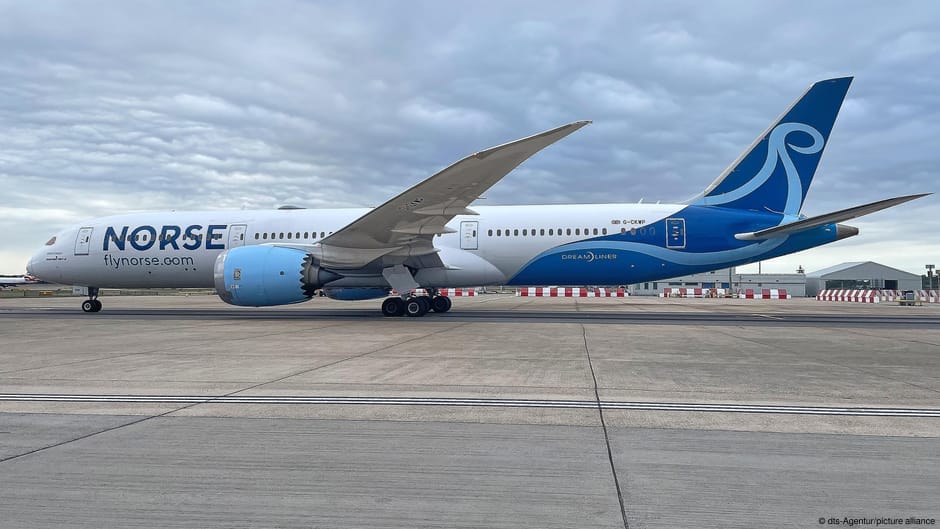
Norse Atlantic Airways, the Norwegian low-cost long-haul carrier founded just five years ago, filed for bankruptcy on Friday after its 12 aircraft lessors terminated their contracts and demanded the planes back. CEO Eivind Roald called it a "difficult decision" made "despite extensive efforts." The airline had suspended all flights the previous day and warned its financial situation was "critical."
Extraction Map
The proximate cause is jet fuel. The US-Iran war and resulting tension around the Strait of Hormuz sent aviation fuel prices spiking in early 2026, more than doubling at their peak — surpassing even the spike after Russia's full-scale invasion of Ukraine in 2022. A brief mid-summer dip on ceasefire hopes reversed as stalemate set in. For airlines operating on thin margins with no hedging cushion, this is an existential price environment. Norse Atlantic was structurally exposed. It ran 12 planes across 14 destinations on a low-cost, long-haul model — maximum fuel burn per seat-mile, minimum pricing power. The carrier had already posted a net loss of $61.9 million (€56.5 million) in 2025, before the Iran-driven fuel shock even hit. It was losing money in a benign fuel environment and had no reserves to absorb a doubling of its largest cost input. The bankruptcy filing covers the Norse Atlantic Airways operating unit only. The stock-market-listed parent Norse Atlantic ASA and the UK subsidiary are attempting to continue operations, though the viability of a holding company whose sole operating airline just went bankrupt is an open question. Management and advisers are "working to find a solution" — language that in aviation restructuring typically precedes either a fire-sale of slots and routes or a quiet wind-down. The broader industry context matters more than any single carrier's death. This is being called the worst aviation crisis since COVID, but the mechanism is different. COVID destroyed demand; the Iran fuel shock destroys margins on existing demand. Passengers still want to fly. Airlines simply cannot afford to carry them at current fuel prices without passing through costs that may suppress demand in turn. Small and low-cost carriers absorb this first because they lack hedging programs, fleet flexibility, and balance sheet depth. The structural pattern here is a geopolitical shock transmitting through commodity markets into the weakest nodes of a capital-intensive industry. Norse Atlantic is the canary. The question for the next 6-12 months is whether mid-tier carriers with similar exposure — thin capitalization, unhedged fuel books, long-haul routes — follow the same path, and whether the fuel price environment triggers a consolidation wave that leaves fewer, larger, more expensive airlines standing. For consumers, the extraction chain is clear: war drives fuel prices, fuel prices drive airline costs, airline costs drive either ticket price increases or carrier failures, and carrier failures reduce competition and route availability. The cost lands on travelers and airline employees. The benefits accrue to oil producers and surviving incumbents who inherit market share from the dead.
Worth reading?
SKIP
Score
20
/100
Extractive — geopolitical conflict concentrates costs on consumers and workers while destroying a competitor, benefiting oil producers and surviving incumbent airlines.
What Is GRIN?
GRIN stands for Generativity, Resilience, Innovation efficiency, and Novelty openness. These four dimensions capture the essential characteristics of any memetic intelligence — whether a nation, a corporation, a religion, or a movement.
About GRINGenerativity
1/5
Resilience
1/5
Efficiency
1/5
Novelty
1/5
Extractive
4/5
Inverted
Does this create new capability or just redistribute existing value?
Pure destruction. No new capability created — a carrier is eliminated, routes vanish, competition shrinks. The fuel shock generates nothing; it only redistributes losses downward.
Verified Facts (10)
Norse Atlantic Airways operating unit declared bankruptcy on Friday
Airline had warned on Wednesday that its financial situation was 'critical' and suspended all flights Thursday
Lessors terminated leasing contracts for all 12 aircraft in the fleet
CEO Eivind Roald stated: 'The Board of Norse Atlantic Airways AS has made the difficult decision to file for bankruptcy'
Norse Atlantic ASA parent company and Norse Atlantic UK subsidiary are not part of the filing
Founded five years ago, based in Arendal, Norway, with 12 planes and 14 destinations
Net loss of $61.9 million (€56.5 million) in 2025
Aviation fuel more than doubled in price at its peak in early 2026
Fuel spike surpassed the level seen after Russia's full-scale invasion of Ukraine in 2022
Crisis described as worst for the industry since the COVID pandemic
More latest news
Read all