TURTLES SEIZED
26
WILD POPULATION
~300
SPECIES IN ONE BAG
~10%
HABITAT LOST
99%+
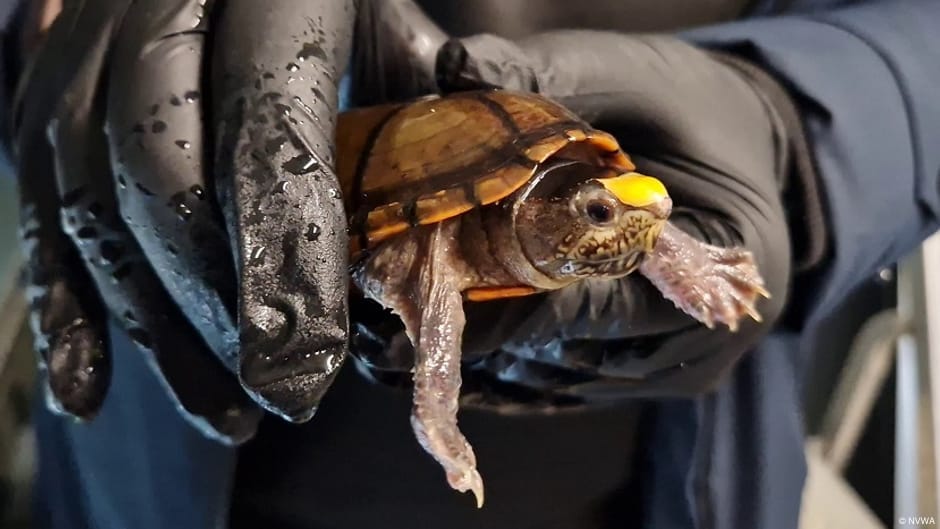
Dutch customs officers at Amsterdam's Schiphol Airport discovered 26 critically endangered Vallarta mud turtles in the luggage of a passenger bound for Hong Kong on November 21. The animals — one of the smallest known turtle species, formally catalogued only in 2018 — were wrapped in duct tape, packed alongside a toy car, and stuffed inside a sealed sock. All survived.
Extraction Map
The numbers are staggering not for their size but for the ratio they represent. The estimated wild population of Vallarta mud turtles is approximately 300 individuals, confined to a small range in the Mexican state of Jalisco. The seizure of 26 animals means a single suitcase potentially contained nearly 10% of the entire species. The Netherlands Food and Consumer Product Safety Authority (NVWA) stated the suspected poaching "may have reduced the population by nearly 10%," a figure that would be absurd in almost any other wildlife context but is arithmetically precise here. The species is endemic to western Mexico and faces compounding pressures. Over 99% of its natural habitat has been lost to urbanization and tourism development in Jalisco, according to the Turtle Island organization in Graz, Austria. Roads and traffic pose direct mortality risks to the slow-moving creatures. Despite strict legal protections under CITES Appendix I — the highest tier — their small size (under 10 centimeters) and striking appearance make them targets for illegal collectors. The trafficking route — Mexico to Hong Kong via Amsterdam — traces the standard geometry of the illegal exotic pet trade: extraction from biodiverse source countries, transit through major aviation hubs, delivery to high-demand consumer markets in East and Southeast Asia. The suspect remains in Dutch custody as federal prosecutors continue their investigation. The turtles have been transferred to a specialized rescue facility where the duct tape was carefully removed. Turtle Island has recently begun breeding Vallarta mud turtles in Austria as a "genetic reservoir for eventual rewilding" and is working on conservation in Mexico. That a captive breeding insurance population exists at all reflects how precarious the species' position already was before this seizure. When an organization in a landlocked European country is building a genetic backup for a Mexican freshwater turtle discovered six years ago, the conservation math has already turned grim. The IUCN Red List classifies the species as Critically Endangered. CITES Appendix I listing prohibits all commercial international trade. Yet enforcement remains reactive — this seizure resulted from a routine customs inspection, not targeted intelligence. The NVWA urged public reporting of suspected illegal trade via online forums, marketplaces, bird fairs, and curiosity markets, an implicit acknowledgment that detection depends heavily on chance and citizen vigilance. The structural problem is not that enforcement failed here — it worked. The problem is that the species' total population is so small that a single successful trafficking event could have constituted an extinction-level extraction. For species this rare, the margin between survival and collapse fits inside a carry-on bag.
Worth reading?
SKIP
Score
20
/100
Purely extractive. Wild-caught animals from a population of ~300 are removed to supply private collector demand, destroying irreplaceable genetic value while generating zero public benefit.
What Is GRIN?
GRIN stands for Generativity, Resilience, Innovation efficiency, and Novelty openness. These four dimensions capture the essential characteristics of any memetic intelligence — whether a nation, a corporation, a religion, or a movement.
About GRINGenerativity
0/5
Resilience
1/5
Efficiency
2/5
Novelty
2/5
Extractive
5/5
Inverted
Does this create new capability or just redistribute existing value?
Annihilative, not redistributive. Removing 10% of a 300-animal species doesn't transfer value — it destroys irreplaceable genetic diversity that no market can reprice or replace.
Verified Facts (15)
26 Vallarta mud turtles were seized from luggage of a passenger bound for Hong Kong via Schiphol Airport
Dutch customs agents discovered the animals on November 21 during a regular inspection
Vallarta mud turtles were formally discovered and catalogued in 2018
Estimated wild population of approximately 300 individuals
Over 99% of natural habitat has been lost to urbanization
Species endemic to western Mexico, specifically the state of Jalisco
Turtles do not grow larger than 10 centimeters (less than 4 inches)
IUCN Red List classifies the species as Critically Endangered
Subject to highest level of CITES protection
Most turtles were packed in a box alongside a toy car; others placed inside a sealed sock within a suitcase
Animals were wrapped in duct tape to prevent movement
All 26 turtles survived the journey
Turtle Island organization in Graz, Austria has started breeding the turtles as a genetic reservoir for eventual rewilding
The suspect remains in custody with federal prosecutors continuing investigations
NVWA stated the seizure may have reduced the population by nearly 10%
More latest news
Read all