WAR DURATION
~5 yrs
ANNEXED REGIONS
4
TALKS LENGTH
2 days
EU AT MAIN TABLE
0
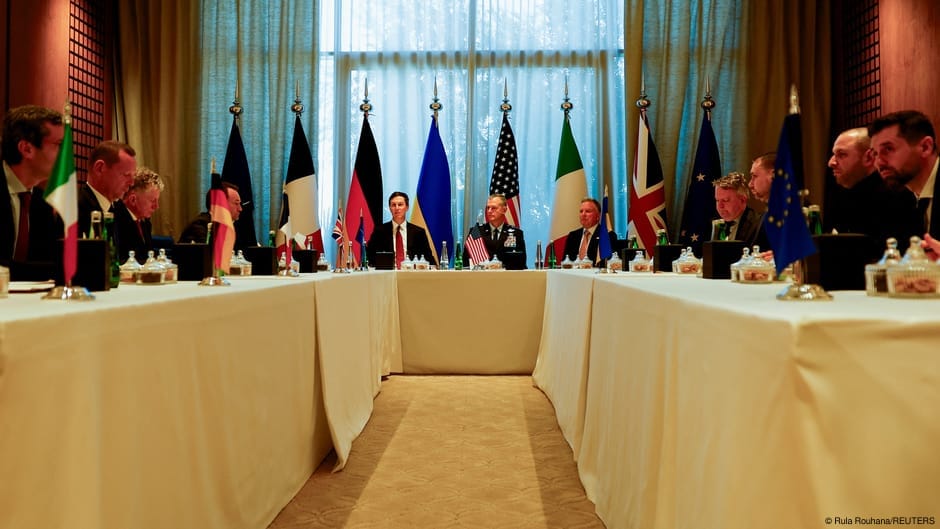
The first trilateral talks between Russia, Ukraine, and the United States since February opened in Abu Dhabi on November 10, 2026, mediated by Jared Kushner and Steve Witkoff. The two-day meeting arrives nearly five years into Russia's full-scale invasion of Ukraine, with fighting continuing unabated — Russian forces struck Black Sea shipping and a cargo vessel near Odesa on the eve of talks, while Ukrainian drones hit power infrastructure in Russian-controlled Luhansk.
Extraction Map
The central tension is not between Moscow and Kyiv but between what the talks are supposed to be about. Russia's delegation stated explicitly that the Ukrainian settlement is 'just one aspect' of a broader objective: 'the creation of a comprehensive and indivisible security architecture for the entire continent.' This is not a peace negotiation in Russia's framing — it is a bid to rewrite European security arrangements with Washington as co-architect, bypassing NATO and EU structures. Europe pushed back hard. European Commission President Ursula von der Leyen insisted that security architecture discussions can only happen after a ceasefire and must take place within NATO and EU forums. German Foreign Minister Johann Wadephul was blunter: 'We do not need to establish a new security architecture for Europe.' The fear, voiced openly by Zelenskyy as 'Yalta 2.0,' is that the US and Russia will carve out a continental settlement over the heads of European nations. The US position is deliberately ambiguous. Kushner's pre-talks statement spoke of 'lasting peace' and 'a sovereign, secure, and prosperous Ukraine' — but contained no acknowledgment that Russia initiated the war. His call for direct Russia-Europe talks 'on the broader security arrangements that affect them' aligns more closely with Moscow's agenda-setting than with Kyiv's or Brussels'. Both Kushner and Witkoff have drawn criticism for perceived softness toward Russia, and US media reports of back-door business dealings with Moscow compound suspicion about American motives. Ukraine arrived with a serious delegation — chief negotiator Rustem Umerov (who heads foreign intelligence), presidential chief of staff Kyrylo Budanov, and deputy Sergiy Kyslytsya — and conducted pre-session alignment meetings with UK, French, German, Italian, NATO, and European Commission representatives. The joint statement from those pre-meetings affirmed 'shared commitment to a strong post-war European security architecture' with NATO remaining 'central to Euro-Atlantic collective defense.' But EU negotiators are not expected at the main trilateral table. The underlying positions remain irreconcilable on paper. Putin demands Ukrainian withdrawal from four annexed regions, NATO membership abandonment, military capability limits, and cultural concessions on Russian language and the Moscow-affiliated Orthodox Church — backed by the threat of force. Zelenskyy refuses territorial concessions beyond what Russia has taken militarily, rejects force limits, and insists on freedom to pursue Western alliances. Nothing in the pre-talks choreography suggests either side has moved. Zelenskyy, meanwhile, traveled to Denmark for meetings with Nordic leaders on military support, air defense, and energy infrastructure — a parallel signal that Ukraine is hedging against a bad outcome in Abu Dhabi by reinforcing bilateral security relationships outside whatever framework the US and Russia might construct.
Worth reading?
SKIP
Score
24
/100
Extractive — the talks' structure concentrates agenda-setting power with Washington and Moscow while excluding European allies from the main table and pressuring Ukraine to accept terms set by its invader.
What Is GRIN?
GRIN stands for Generativity, Resilience, Innovation efficiency, and Novelty openness. These four dimensions capture the essential characteristics of any memetic intelligence — whether a nation, a corporation, a religion, or a movement.
About GRINGenerativity
1/5
Resilience
1/5
Efficiency
1/5
Novelty
2/5
Extractive
4/5
Inverted
Does this create new capability or just redistribute existing value?
Near-zero generative output so far. No ceasefire, no framework, no new capability — just competing agendas about who gets to redesign European security. The talks risk legitimizing annexation as a negotiable outcome.
Verified Facts (12)
Talks are the first such meeting since February, scheduled for two days in Abu Dhabi.
Russian delegation source: 'The Ukrainian settlement...is just one aspect of this wide-ranging discussion and is subordinate to the main objective — the creation of a comprehensive and indivisible security architecture for the entire continent.'
Von der Leyen: 'Any meaningful discussions about Europe's security architecture can only be undertaken once a ceasefire in Ukraine has been achieved.'
Wadephul: 'For Europe, it is clear: we do not need to establish a new security architecture for Europe.'
Kushner said a peace settlement will require direct Russia-Europe talks 'on the broader security arrangements that affect them.'
Kushner's statement contained no hint that Russia initiated the conflict with its full-scale invasion of Ukraine launched in February 2022.
Ukraine delegation: Rustem Umerov (chief negotiator, heads Foreign Intelligence Service), Kyrylo Budanov (chief of staff to Zelenskyy), Sergiy Kyslytsya (deputy), Davyd Arakhamia.
Pre-session statement affirmed 'shared commitment to a strong post-war European security architecture' with NATO remaining 'central to Euro-Atlantic collective defense.'
Russian forces hit a cargo vessel and a tanker in the Black Sea and another cargo vessel east of Odesa.
Ukrainian drones cut power supplies to Luhansk and nearby region under Russian control.
Putin demands Ukrainian withdrawal from Donetsk, Luhansk, Zaporizhzhia, and Kherson; NATO membership abandonment; military capability limits; and dropping restrictions on Russian language and Moscow-affiliated Orthodox Church.
Zelenskyy traveled to Denmark for meetings with Nordic leaders on military support, air defense, and energy infrastructure security.
More latest news
Read all