VOTE MAJORITY
~50
ELECTION DATE
Jan 30
MV COALITION DEAL
133pg
FEMALE PRESIDENT
1st
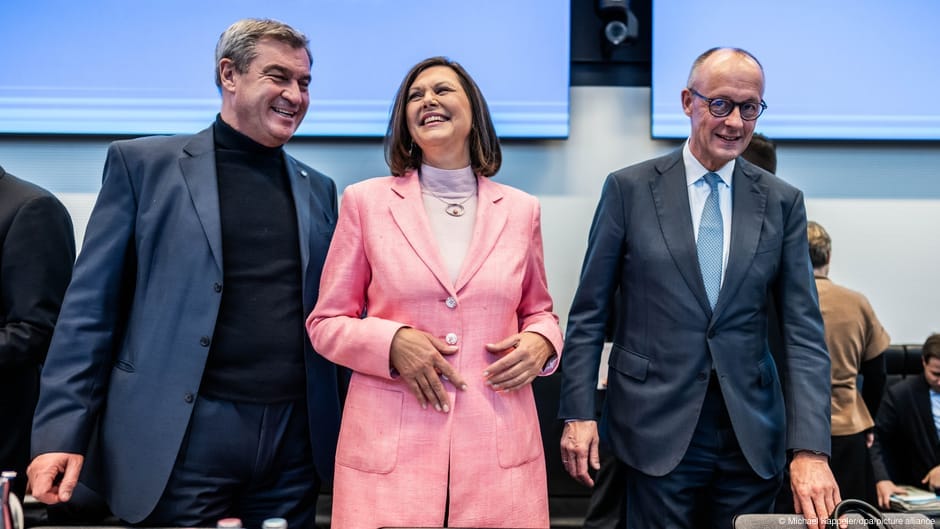
Germany's next president is, for all practical purposes, already chosen. Ilse Aigner, Bavaria's state parliament president from the CSU, has secured backing from the governing CDU/CSU bloc, the SPD, and the Green Party leadership — giving her an estimated majority of around 50 votes in the Federal Convention before the January 30 election. Standing ovations from Union lawmakers and formal SPD endorsement make the outcome a near-certainty on the first ballot.
Extraction Map
The more revealing subplot is Aigner's refusal to meet with the AfD in the Bundestag. Her team cited AfD lawmaker Beatrix von Storch's public dismissal of the nomination as a 'disgrace' as the reason. AfD co-leader Alice Weidel fired back, accusing Aigner of lacking 'political impartiality.' This is institutional boundary-drawing in real time: a future head of state declining to engage with a party that commands significant Bundestag seats, and doing so openly rather than through procedural indirection. Aigner herself is leaning into biography as political signal. She highlighted her apprenticeship and technical training background — no university degree — as a break from presidential precedent. She would be the first female president, the first from the CSU, and, as she noted with characteristic directness, single. 'In many ways, I am something of a first — or could be,' she said. Defending democracy, she declared, would be her central priority, warning it was under pressure 'from within and from outside.' Meanwhile, Chancellor Friedrich Merz used a separate Berlin meeting to reset German-Hungarian relations with new Prime Minister Peter Magyar. The two pledged closer cooperation on energy, defense, and trade — with Merz offering Hungary access to German LNG terminal capacity and renewable energy expertise to reduce Budapest's dependence on Russian energy imports. Magyar welcomed the offer but stressed that 'prices would be crucial,' a diplomatic reminder that goodwill needs competitive economics behind it. The Hungarian visit was timed around November 9, the anniversary of the Berlin Wall's fall. Magyar invoked Hungary's role in 1989 — the Pan-European Picnic and the subsequent border opening that allowed tens of thousands of East Germans to flee west. Both leaders framed the meeting as a 'fresh start,' though the substance was more incremental: trade facilitation, energy diversification, and ministerial-level working contacts. In Mecklenburg-Western Pomerania, an SPD-Left-Green coalition presented a 133-page agreement titled 'Solidarity, Confidence, Future' to govern the northeastern state — explicitly blocking the AfD, which won the most votes in the September election, from power. State premier candidate Manuela Schwesig described 'intensive negotiations, often late into the night.' Membership votes are scheduled for Friday and Saturday, with Schwesig's election as premier expected Monday. Taken together, the day's events show German institutional politics operating with deliberate coordination: a presidential selection sewn up before the formal vote, a far-right party systematically excluded from coalition and presidential engagement alike, and bilateral diplomacy being used to pull Hungary away from Russian energy dependence. The machinery works. The question is whether exclusion strategies strengthen or eventually strain democratic legitimacy.
Worth reading?
OPTIONAL
Score
56
/100
Mildly generative. Cross-party coordination delivers stable governance and energy diversification, but the systematic exclusion of a significant electoral force creates a resilience question mark that grows with time.
What Is GRIN?
GRIN stands for Generativity, Resilience, Innovation efficiency, and Novelty openness. These four dimensions capture the essential characteristics of any memetic intelligence — whether a nation, a corporation, a religion, or a movement.
About GRINGenerativity
3/5
Resilience
3/5
Efficiency
3/5
Novelty
2/5
Extractive
2/5
Inverted
Does this create new capability or just redistribute existing value?
Moderate value creation. LNG access for Hungary diversifies European energy supply; Aigner's presidency is institutional continuity, not new capability. The Mecklenburg coalition governs but doesn't innovate.
Verified Facts (10)
Aigner received standing ovations from CDU/CSU lawmakers
The governing parties hold an estimated majority of around 50 votes in the Federal Convention
The official vote will take place on January 30
AfD co-leader Alice Weidel said: 'Apparently, we cannot expect political impartiality from Ilse Aigner'
Aigner's team cited AfD lawmaker Beatrix von Storch's disparaging response to her nomination as the reason for declining the meeting
In August 1989, hundreds of East Germans escaped to Austria during the Pan-European Picnic on the Hungarian border
The SPD-Left-Green coalition agreement consists of a 133-page program titled 'Solidarity, Confidence, Future'
Merz offered to help Hungary reduce dependence on Russian energy imports by providing access to capacity at German LNG terminals
Magyar said 'prices would be crucial'
The AfD won the most votes in the September election in Mecklenburg-Western Pomerania
More latest news
Read all