SAY YOUTH IGNORED
82%
UNDER-35 CDU TRUST
5%
CLIMATE SHORTFALL
€1.3B
SPY POWERS VOTE
309-190
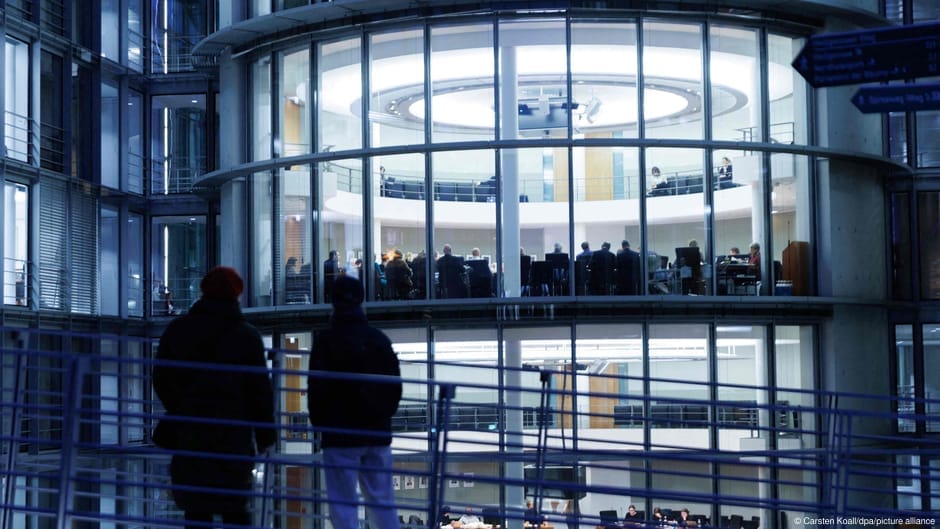
The German Bundestag packed a remarkable amount of structural governance into a single Thursday. The 2027 federal budget passed with heavy reliance on borrowing, expanded intelligence powers cleared the lower house with a comfortable majority, and outside the building, Fridays for Future protesters marked Chancellor Friedrich Merz's 71st birthday by demanding he pay Germany's climate debts. Each story is linked by a common thread: a government spending political capital on security and fiscal flexibility while deferring the generational costs.
Extraction Map
The budget itself arrives freighted with debt at a moment when Germany simultaneously leads European calls for tighter EU-level fiscal discipline. Merz has been pushing to tie Ukraine aid to EU budget negotiations — a move backed by Baltic states but viewed warily by net-beneficiary countries and even host Ireland, which holds the rotating EU Council presidency and sees an extra variable complicating already-stalled seven-year budget talks. The AfD's predictable complaint of 'more debts and more taxes' gains traction precisely because the governing coalition has not articulated what the borrowing buys beyond continuity. The intelligence reform is the most structurally significant legislative act of the day. The BfV (domestic intelligence) gains authority to secretly enter homes and act against weapons or explosives — powers previously reserved for police. The BND (external intelligence) gets operational intervention capabilities, including the ability to disable servers of state-sponsored hacker groups abroad. The vote was 309 in favor, 190 against, 71 abstentions. Opposition parties invoked the historical separation of police and intelligence services — a constitutional guardrail rooted in the Nazi Gestapo and East German Stasi — and called the reform an erosion of that principle. On the diplomatic front, Merz declared from Dublin that 'concrete' Ukraine peace talks with European involvement are now planned in the coming weeks, following the Abu Dhabi channel between Ukraine and Russia brokered by the US. Germany's position is 'set,' Merz said, with the same group of Europeans from Abu Dhabi likely to participate. The Baltic prime ministers — Estonia's Kristen Michal and Latvia's Andris Kulbergs — backed Merz's push to link Ukraine aid contributions to EU budget access, framing it as core security financing rather than optional solidarity. Meanwhile, the climate protests underscored a legitimacy gap that no legislative package addresses. Fridays for Future mobilized 1.4 million Germans in September 2019; the comparable figure has fallen to roughly 75,000. Germany provided €4.7 billion in federal climate financing in 2025, undershooting its €6 billion pledge. Among 18-to-34-year-olds, just 5% trust Merz's CDU/CSU to champion their concerns, and a mere 3% trust the SPD coalition partner. An astonishing 82% of all Germans believe politicians do not adequately represent young people's interests. The arson attack on Julian Reichelt's car in Berlin's Charlottenburg district adds a note of political violence to the day's texture. Reichelt, fired from Bild in 2021 amid harassment allegations he denied, now runs the right-wing portal Nius and called the incident a 'targeted attack' against 'free media.' Police confirmed the fire was intentional but named no suspect. Berlin averages roughly two car arsons per night, and while prior attacks on journalists have been claimed by left-wing groups, the broader pattern includes vandalism and insurance fraud. Taken together, the day reveals a government that is fiscally expansionary, security-hawkish, diplomatically assertive on Ukraine, and structurally disconnected from the under-35 electorate. The borrowing funds continuity, not transformation. The intelligence expansion addresses real threats but crosses a line that German constitutional culture has guarded for decades. And the youth trust deficit is not a communications problem — it is a policy-priority problem that debt-funded budgets and spy powers do not solve.
Worth reading?
SKIP
Score
28
/100
Extractive. The budget borrows against future taxpayers, intelligence expansion concentrates state power without new accountability, and climate financing falls short of commitments — costs pushed to the young, the surveilled, and the developing world.
What Is GRIN?
GRIN stands for Generativity, Resilience, Innovation efficiency, and Novelty openness. These four dimensions capture the essential characteristics of any memetic intelligence — whether a nation, a corporation, a religion, or a movement.
About GRINGenerativity
1/5
Resilience
2/5
Efficiency
2/5
Novelty
1/5
Extractive
4/5
Inverted
Does this create new capability or just redistribute existing value?
Minimal new capacity created. Debt funds continuity, not transformation. Intelligence powers expand state capability but generate no economic or social value for citizens. Climate undershoot actively destroys generative potential.
Verified Facts (9)
Germany provided €4.7 billion ($5.2 billion) in federal budget funds for international climate financing in 2025 — below its €6 billion pledge
In September 2019, Fridays for Future mobilized an estimated 1.4 million people across Germany. Five years later, that figure fell to around 75,000
82% of Germans believe politicians do not adequately represent young people's interests
Among 18- to 34-year-olds, just 5% trust Merz's conservatives to champion their concerns, compared with 3% for their Social Democratic coalition partners
The law passed with 309 votes in favor, 190 against and 71 abstentions
The BfV will be granted powers beyond intelligence gathering such as being able to secretly enter homes or take action against explosives or weapons
The BND will be granted additional operational intervention powers, for instance moving to disable servers belonging to state-sponsored hacker groups abroad
Police confirmed the car was intentionally set alight, saying a passerby reported it shortly after 2 a.m.
Berlin has an average of roughly two a night being set alight in the capital city over recent years
More latest news
Read all