PILOT DEPORTEES
100
EU STATES
5
NEW BUSINESSES · 2026
286K
GDP FORECAST ↑
1.3%
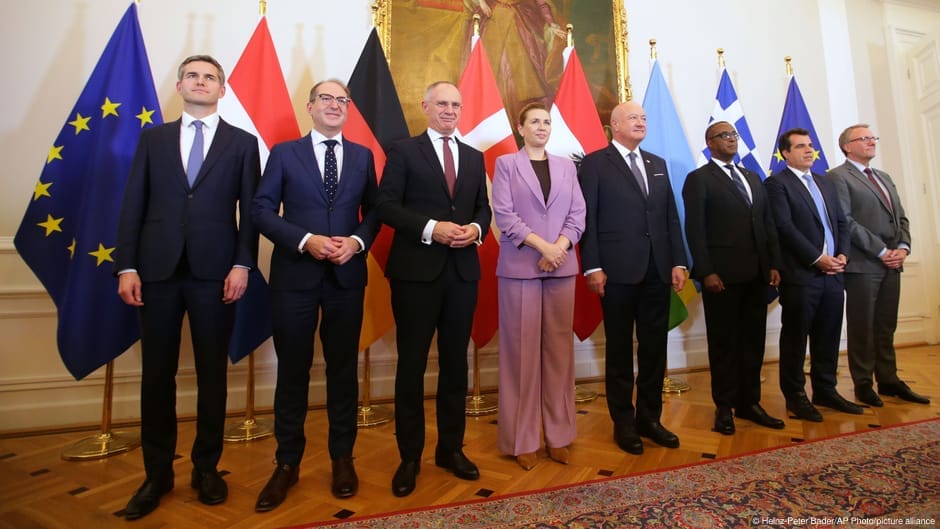
Germany, Denmark, Austria, Greece, and the Netherlands have announced plans to establish an extraterritorial deportation hub in Rwanda — the first such facility outside the EU. The pilot would process roughly 100 rejected asylum seekers, 20 from each nation, with a target opening date of 2027. The announcement follows EU migration reforms this year that granted broader detention powers and authorized the creation of return hubs. Interior Minister Alexander Dobrindt of Bavaria's CSU is the scheme's chief domestic champion, insisting it will comply with European and German law.
Extraction Map
The backlash has been immediate and cross-sectoral. Pro Asyl, Germany's leading refugee advocacy group, called the plan a coming "shipwreck." Managing director Karl Kopp noted that Rwanda is not a model democracy, citing arrests and torture of opposition figures. A joint statement from 45 NGOs across 15 countries condemned the policy for shifting people and responsibility "out of public sight and beyond scrutiny." The SPD, junior coalition partner, attacked the plan as "short-sighted" on foreign policy grounds, with foreign policy spokesman Adid Ahmetovic pointing to Rwanda's support for M23 rebels in eastern Congo. The coalition fracture is telling. Merz's CDU/CSU bloc needs migration enforcement optics; the SPD needs to signal it hasn't abandoned human rights norms. Dobrindt occupies the hardline position that the pilot's small scale — 100 people — is designed to normalize, not solve. The 20-per-country figure is not a migration policy; it is a political proof-of-concept, testing whether the EU's legal and normative infrastructure will absorb the precedent. Separately, the European Commission nearly doubled its 2026 growth forecast for Germany, from 0.6% to 1.3%, citing stable consumer demand and an export rebound — though the ongoing Iran war continues to drive inflation. The BVR reports 286,000 new businesses expected in 2026, up 3.4% year-on-year and the highest since 2015. AI is cited as a driver, alongside a difficult labor market pushing people toward self-employment. But the BVR's own caveats are more instructive than its headline. The start-up surge is "fragile," leaning on government support and exports rather than private investment. The 30-40 age cohort most likely to found companies is shrinking demographically. Europe's AI development still lags the US and China. This is a cyclical bump dressed as structural renewal — the kind of number that generates a press release but not a decade of compounding returns. Meanwhile, a massive leak of internal Deutsche Bank documents has exposed further cases of misconduct and incompetence, though details remain thin. The pattern is familiar: Germany's largest lender has cycled through scandals for years without structural reform reaching the culture that produces them. The through-line across these stories is a government reaching for visible gestures — a Rwanda pilot, a start-up strategy, a growth forecast revision — while the underlying structural problems (demographic decline, coalition fragility, institutional rot at major banks, dependence on external demand) remain unaddressed. The question is whether the gestures accumulate into real change or simply defer the reckoning.
Worth reading?
SKIP
Score
20
/100
Extractive — the Rwanda hub externalizes human and political costs to a third country with documented rights abuses, the start-up boom leans on public subsidy rather than private generativity, and Deutsche Bank's pattern persists without systemic correction.
What Is GRIN?
GRIN stands for Generativity, Resilience, Innovation efficiency, and Novelty openness. These four dimensions capture the essential characteristics of any memetic intelligence — whether a nation, a corporation, a religion, or a movement.
About GRINGenerativity
1/5
Resilience
1/5
Efficiency
1/5
Novelty
1/5
Extractive
4/5
Inverted
Does this create new capability or just redistribute existing value?
Near-zero generativity. A 100-person pilot creates no new capability — it establishes a legal and political precedent for cost-shifting. Start-up numbers are government-subsidized, not organically generative.
Verified Facts (10)
Germany, Denmark, Austria, Greece and the Netherlands announced plans to set up a hub for rejected migrants in Rwanda
Pro Asyl managing director Karl Kopp said plans would end in a 'shipwreck'
45 NGOs from 15 countries condemned the move in a joint statement
SPD foreign policy spokesman Adid Ahmetovic called Dobrindt's plans 'short-sighted with regard to foreign policy'
Rwanda hub will be initially run as a pilot with some 100 people, 20 from each of the five nations
European Commission raised Germany growth forecast from 0.6% to 1.3%
286,000 new businesses expected to be founded in 2026, a rise of 3.4% compared with last year
BVR warned the increase was fragile, largely driven by government support and exports rather than private investment
Interior Minister Alexander Dobrindt of the CSU is a main advocate of the Rwanda plan
Austrian Chancellor Christian Stocker said the aim is for the first center to be set up in Rwanda next year
More latest news
Read all