QATAR DEFENSE PLEDGE
€15B
IMPORT/EXPORT PRICE GAP
33%
DE-UA TRADE · 2025
€12B
WHITE PAPER ETA
2028
Friday in Berlin was a masterclass in the contradictions of a nation trying to rearm, decarbonize, and keep its youth on side — simultaneously. Chancellor Friedrich Merz stood beside Qatari Emir Sheikh Tamim bin Hamad Al Thani to announce €15 billion in new Qatari investment in German defense and technology, targeting AI, semiconductors, and aviation. The framing was mutual security; the subtext was Germany's desperate need for external capital to fund a rearmament program its own fiscal rules struggle to accommodate.
Extraction Map
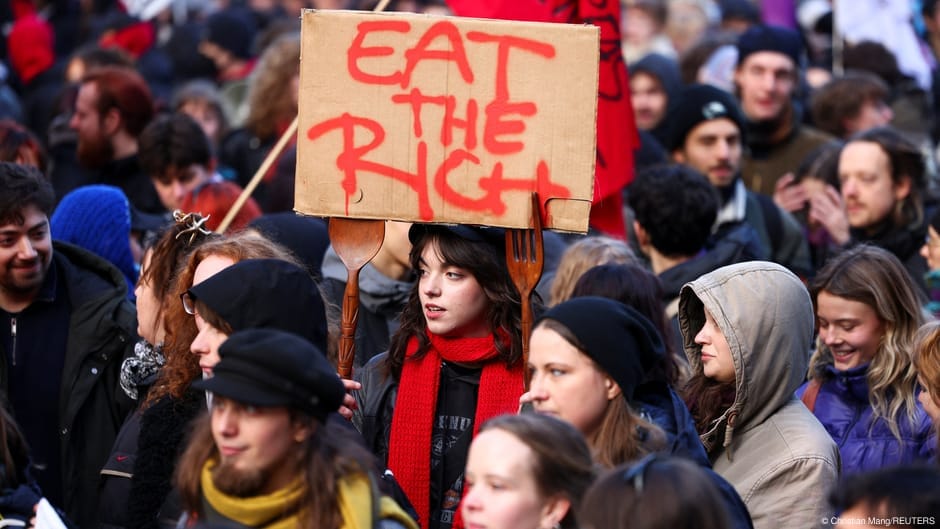
The Qatar deal underscores a dependency chain that now runs through the Gulf twice over. Merz was explicit: Germany wants Middle East peace because it needs affordable energy. The Strait of Hormuz shipping chokepoint hung over the press conference like a headline waiting to be written. Qatar gets defense-tech access and a European anchor; Germany gets investment it cannot generate domestically fast enough. Whether that constitutes genuine partnership or a financing arrangement with geopolitical strings is the question nobody on the podium answered. Meanwhile, in cities across Germany, the "Gen Z Takes Charge" movement returned to the streets. Co-organizer Akram Selo told RBB-Inforadio that talks would not stop demonstrations and that young people's demands were being sidelined. A parallel "School strike against conscription" targeted the Bundeswehr's surveys of teenage boys. The generational fault line is stark: Merz is building a conscription-era military with Gulf money while the generation slated to serve is protesting the premise. Merz also pressed Ukraine on rule-of-law reforms and anti-corruption measures as preconditions for continued investment, telling a Berlin business summit that bilateral trade already hit €12 billion in 2025. The message was blunt — "what we invest now, we will receive back many times over" — but the domestic politics are brutal, with anti-aid parties gaining ground in regional elections. On the energy front, official BDEW data revealed a paradox baked into Germany's grid architecture. Electricity exports rose 25.5% by volume in the first nine months of 2026, reaching 48.8 terawatt-hours worth €4.3 billion. But Germany still imported slightly more than it exported (49.2 TWh), and the price spread is punishing: exported power averaged €87/MWh, imported power €116/MWh — a 33% premium. Germany floods the market with cheap wind and solar when supply is abundant, then pays top euro for dispatchable power during shortfalls. The structural subsidy flows outward. The Finance Ministry's "Germany 2035" dialogue process, launching December 2 under Finance Minister Lars Klingbeil, is an implicit admission that none of these threads — defense spending, energy transition economics, youth disaffection, industrial competitiveness — currently connect into a coherent economic strategy. The process will consult economists, think tanks, and civil society through 2027, culminating in a 2028 white paper. That timeline tells you something: Berlin knows the architecture is broken but isn't pretending it can be fixed before the next election cycle. Sky TV's decision not to send staff to the Qatar F1 Grand Prix for security reasons adds an almost cinematic coda. Germany is simultaneously courting Qatar's billions and acknowledging the Gulf is too dangerous for its sports broadcasters. The contradiction is not lost on anyone paying attention.
Worth reading?
OPTIONAL
Score
40
/100
Mixed but tilting extractive — Qatari capital fills a gap Germany won't self-fund, the energy grid structurally subsidizes neighbors, and youth demands are being absorbed into dialogue processes designed to outlast the protesters' attention spans.
What Is GRIN?
GRIN stands for Generativity, Resilience, Innovation efficiency, and Novelty openness. These four dimensions capture the essential characteristics of any memetic intelligence — whether a nation, a corporation, a religion, or a movement.
About GRINGenerativity
2/5
Resilience
2/5
Efficiency
2/5
Novelty
2/5
Extractive
3/5
Inverted
Does this create new capability or just redistribute existing value?
Qatari defense investment and Ukraine trade create some new capability, but most value is redistributive — filling fiscal holes rather than expanding domestic productive capacity. Youth demands generate no policy output yet.
Verified Facts (11)
Qatar pledged €15 billion ($16.5 billion) in new German defense and technology investments
German electricity exports rose 25.5% to 48.8 terawatt-hours in first nine months of 2026
Exported electricity averaged €87/MWh; imported electricity averaged €116/MWh, 39% more than a year earlier
Electricity imports into Germany fell 13.3% in volume but remained at 49.2 TWh, slightly above exports
Germany-Ukraine bilateral trade worth around €12 billion ($13 billion) in 2025
Export value increased 51.3% to €4.3 billion ($4.7 billion)
Finance Minister Lars Klingbeil will begin the Germany 2035 dialogue process on December 2
White paper to be published in 2028
Sky TV will not send staff to Qatar F1 Grand Prix November 27-29
Co-organizer Akram Selo said: 'Talks won't make us stop demonstrating'
Bundeswehr surveys are currently non-binding and only obligatory for teenage boys
More latest news
Read all