VW TALKS · COLLAPSED
90 min
BREMEN · NO CHILDCARE
31%
BIRTH RATE DROP 2021-25
~20%
DE-AFRICA TRADE
€64B
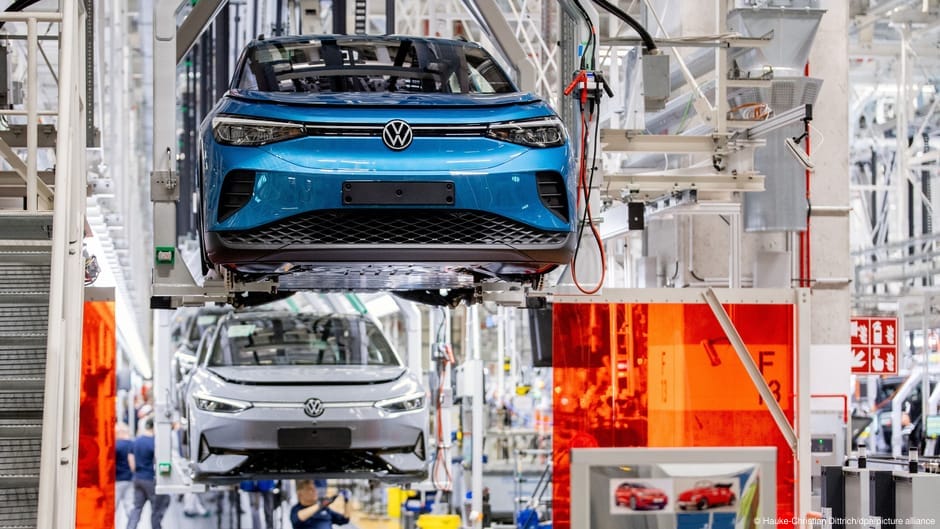
Volkswagen's opening wage negotiation with IG Metall lasted 90 minutes before collapsing. The union says VW management refused to answer basic questions about trust, existing contracts, and future labor prospects in Germany. Works Council Chair Daniela Cavallo warned of "some of the toughest industrial action ever seen at Volkswagen." The contractual no-strike clause expires December 31, meaning 2027 could open with work stoppages at Germany's most symbolically important manufacturer. IG Metall described VW's pre-negotiation demands as "a document of disrespect, unprecedented in Volkswagen's history." The next round is set for mid-December in Zwickau.
Extraction Map
Germany's childcare crisis is now arithmetically absurd. Birth rates fell roughly 20% between 2021 and 2025, yet the country still cannot provide enough spots for 1- and 2-year-olds. The gap is starkest in former West Germany — 18% of families locked out — and worst in Bremen at 31%. Former East German states manage with only 6% unmet demand. The families most likely to miss out are exactly those whose children would benefit most: households where little German is spoken and those at highest poverty risk. A shrinking population failing to serve its shrinking cohort of children is a system eating its own seed corn. Berlin's coalition politics took a sharp turn when the Left Party expelled representative Vanessa Emde over her fiercely anti-Israeli stance and her withdrawal from a party statement condemning antisemitism. Central Council of Jews President Josef Schuster called it "a first step" but warned Emde is "certainly not an isolated case," demanding that all parties in SPD-Green-Left coalition talks demonstrate willingness to protect Jewish life. The expulsion removed a specific impediment to coalition formation, but Schuster's framing makes clear the test is institutional, not personal. The Federation of German Consumer Organizations filed suit against Ray-Ban and plans the same against Meta over smart glasses that enable covert audio and video recording. The vzbv's chairwoman Ramona Pop dismissed the small blinking indicator light as insufficient notice to bystanders being filmed in public spaces. The organization wants the glasses banned from sale in Germany in their current configuration — a direct regulatory challenge to Meta's hardware ambitions in Europe's largest market. Business sentiment ticked up slightly, with the Ifo Business Climate Index reaching 90.6 in November from 90.1 in October — its highest in three years, though Ifo President Clemens Fuest cautioned that "the recovery lacks breadth," with services improving while manufacturing slipped after six consecutive gains. Meanwhile, President Steinmeier used the German-African Business Summit in Accra to push German firms toward Africa. German-African trade grew over 10% in 2025, dwarfing the 1% growth with Asia-Pacific, but the absolute gap remains vast: nearly €500 billion with Asia versus under €64 billion with Africa. Steinmeier framed the pivot explicitly in terms of reduced reliability of North American and Chinese markets. The through-line across these stories is a Germany stress-testing every load-bearing institution simultaneously: its industrial wage model, its demographic infrastructure, its coalition-building norms, its digital privacy regime, and its trade diversification strategy. Each individual pressure is manageable. The question is whether a system optimized for consensus and incrementalism can handle five structural adjustments at once without something breaking. One oddity rounds out the day: police in Rees, near the Dutch border, are searching for two people caught on camera throwing a human skull over the fence of a daycare center. Children initially thought it was a belated Halloween prank. Police suspect it may belong to a WWII soldier — skeletons regularly surface during excavation in the area. Even Germany's past refuses to stay buried.
Worth reading?
OPTIONAL
Score
44
/100
Mixed but tilting extractive — VW management seeks to extract concessions from workers under cost-cutting pressure, childcare failure extracts opportunity from the most vulnerable families, and Meta extracts privacy from bystanders. Generative signals exist in Africa trade growth and business sentiment, but they lack structural breadth.
What Is GRIN?
GRIN stands for Generativity, Resilience, Innovation efficiency, and Novelty openness. These four dimensions capture the essential characteristics of any memetic intelligence — whether a nation, a corporation, a religion, or a movement.
About GRINGenerativity
2/5
Resilience
2/5
Efficiency
2/5
Novelty
3/5
Extractive
3/5
Inverted
Does this create new capability or just redistribute existing value?
Weak generative signals. Ifo uptick and Africa trade growth are real but narrow. VW talks threaten to destroy industrial cooperation value rather than create it. Childcare failure blocks human capital formation at the root.
Verified Facts (11)
Round one of VW wage talks broke down after 90 minutes with no common ground found
IG Metall described VW's demands as 'a document of disrespect, unprecedented in Volkswagen's history'
December 31 is the last day workers are contractually prohibited from striking
Works Council Chair Daniela Cavallo warned of 'some of the toughest industrial action ever seen at Volkswagen'
Birth rate fell by around a fifth between 2021 and 2025
31% of families in Bremen left without childcare; 18% in former West Germany; 6% in former East Germany
Central Council of Jews President Josef Schuster said Emde is 'certainly not an isolated case'
vzbv chairwoman Ramona Pop said 'a blinking white light just a few millimeters in size is insufficient'
Ifo Business Climate Index rose to 90.6 in November from 90.1 in October
Germany's trade with Africa grew by more than 10% in 2025; Asia-Pacific growth was 1%
Germany trades almost €500 billion with Asia compared with just under €64 billion with Africa
More latest news
Read all