AFD SEATS · SAXONY-ANHALT
39
BSW SEATS
5
COMBINED MAJORITY
44/83
DELEGATES VOTING
~600
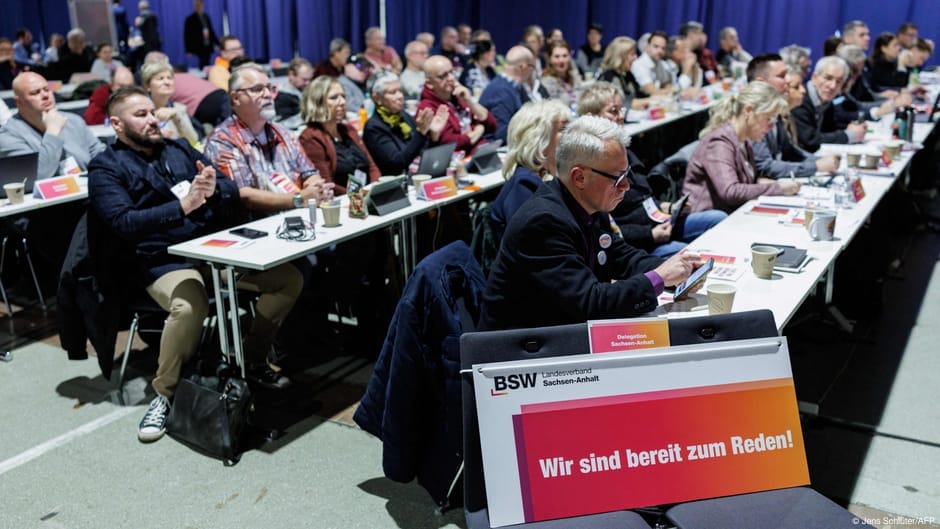
The Alliance for Social Justice and Economic Reason (BSW) voted down an internal motion at its Dresden party conference that would have drawn a hard line against cooperation with the Alternative for Germany (AfD). Approximately 600 delegates rejected the amendment proposed by several founding members, including executive board members Christian Leye, Amid Rabieh, and Klaus Ernst. The amendment sought to rule out not just coalitions but also any formal or de facto tolerance, support for an AfD-led government, and long-term cooperation agreements.
Extraction Map
The vote's context is Saxony-Anhalt. The AfD won the September state election there with 39 seats, and in October, the AfD's Tobias Rausch became Germany's first far-right state parliament speaker since World War II. The BSW holds 5 seats. Together, the two parties command a majority of the 83-seat chamber. The arithmetic is the argument. BSW founder Sahra Wagenknecht and party leader Fabio De Masi champion what they call the 'Magdeburg Model.' The framework rejects formal coalition with the AfD, refuses to support AfD candidates for state premier, and opposes tolerance for far-right platforms. But it explicitly envisions joint motions, joint voting, and potentially written agreements. The distinction between 'no coalition' and 'written cooperation agreements' is load-bearing — and fragile. Wagenknecht framed the approach as pragmatism: 'None of us wants to cozy up to the AfD,' she said, adding that BSW would engage where there is 'the possibility of reasonable majorities for peace, social improvement, and a reform of public broadcasting.' The two parties share pro-Russia positions on Ukraine, opposition to military support for Kyiv, and skepticism of sanctions they argue harm the German economy. These are not minor overlaps. The internal dissent was sharp. Co-founder Klaus Ernst threatened to leave the party if no clear line was drawn. Christian Leye stated flatly after the vote: 'This party can only be an opponent. In my view, it is a racist party, a nationalist party that also has its issues with democracy.' Germany's Office for the Protection of the Constitution — the domestic intelligence agency — has formally classified the AfD as right-wing extremist. What the BSW has constructed is a permission structure. The 'Magdeburg Model' lets the party cooperate on a case-by-case basis while maintaining rhetorical distance. The danger is well-documented in democratic systems: once the first joint votes pass, the political cost of the next one drops. Each agreement normalizes the relationship. The firewall erodes not through a single breach but through accumulated precedent. The broader German political landscape adds weight. The job market is stalled — Federal Employment Agency head Andrea Nahles warns no recovery before summer, with 34 million employees subject to social insurance contributions and 13 unemployed people per open unskilled position. The EV market is growing toward a predicted 1 million sales in 2027. The 2027 budget just passed. These are the material conditions in which populist cooperation flourishes: economic stagnation creating demand for outsider politics, with traditional parties unable to deliver visible improvement fast enough.
Worth reading?
SKIP
Score
24
/100
Extractive — this arrangement concentrates legitimation power in two fringe parties while eroding the democratic firewall norms that protect broader civic institutions, with no new generative capacity created.
What Is GRIN?
GRIN stands for Generativity, Resilience, Innovation efficiency, and Novelty openness. These four dimensions capture the essential characteristics of any memetic intelligence — whether a nation, a corporation, a religion, or a movement.
About GRINGenerativity
1/5
Resilience
1/5
Efficiency
2/5
Novelty
1/5
Extractive
4/5
Inverted
Does this create new capability or just redistribute existing value?
Zero new capability. Joint voting on existing legislation creates no economic or institutional value — it redistributes political legitimacy from the democratic center to classified extremists.
Verified Facts (11)
BSW voted against a motion limiting cooperation with the AfD at a party conference in Dresden with approximately 600 delegates
AfD won 39 seats in September's Saxony-Anhalt state election
BSW holds 5 seats in Saxony-Anhalt; combined 44 seats form a majority of 83
AfD's Tobias Rausch became Germany's first far-right state parliament speaker since World War II in October
The Magdeburg Model rejects formal coalition, support for AfD premier candidates, and tolerance for far-right platforms, but envisions joint motions, joint voting, and possibly written agreements
Germany's Office for the Protection of the Constitution has classified the AfD as right-wing extremist
BSW co-founder Klaus Ernst threatened to leave the party if it didn't draw a clear line from the far right
Federal Employment Agency head Andrea Nahles said there would be little change in the job market between spring and early summer, with 34 million employees subject to social insurance contributions
13 unemployed people for every open position for unskilled workers
ZDK predicts over 1 million EV sales in Germany in 2027, based on estimated 840,000 in 2026
Some €16.5 million paid out to victims of terrorist and extremist attacks since the 2016 Berlin Christmas market attack, affecting almost 3,000 people
More latest news
Read all