LOAN COVER LINE
1.00×
GPU INSTALL COST
$37K–$77K
HOURLY RENT RANGE
$2.46–$3.69
UTILIZATION BAND
59–82%
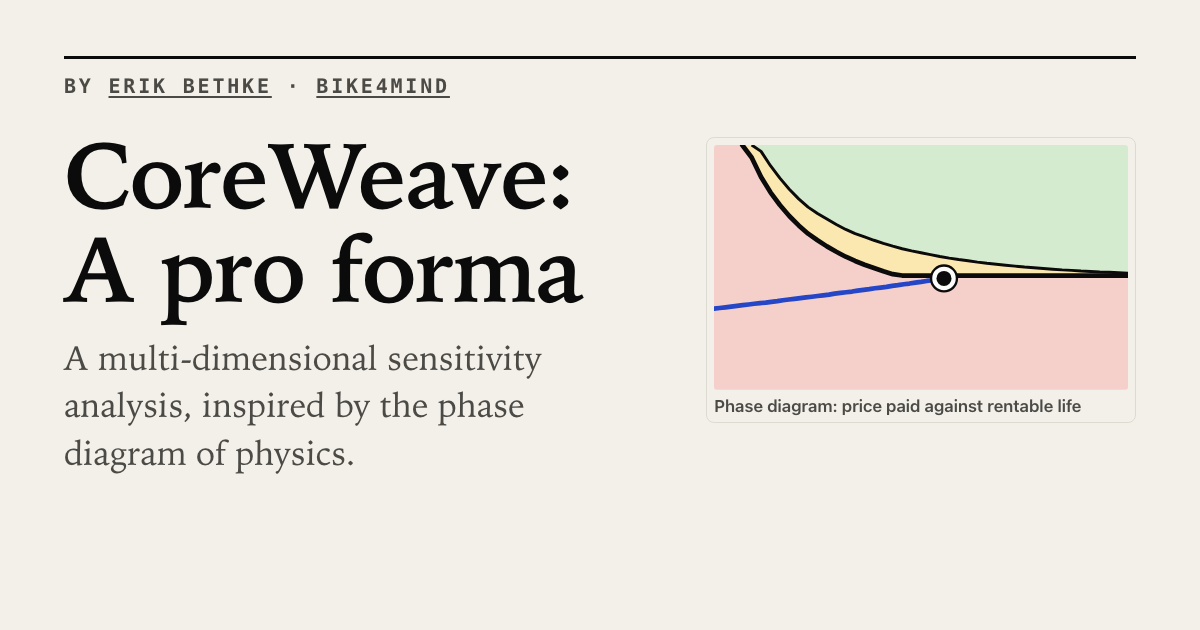
Erik Bethke's interactive pro forma does something rare in AI infrastructure coverage: it ignores the hype and models a single GPU as a financed, rented asset. The result is a phase diagram — literally borrowed from physics — showing where CoreWeave's business model is solid, liquid, or anxious. The states are defined by whether rental income covers the loan, and whether owners clear their target return above the lender's margin.
Extraction Map
The mechanics are straightforward. CoreWeave borrows to buy GPUs (H100s at ~$37,000, Blackwells at $60,000–$77,000), installs them, and rents them by the hour. The loan rate is the Fed rate plus a lender's margin. Owners demand a premium on top of that. Rent per GPU-hour, averaged over the GPU's rentable life, must cover debt service, running costs, and return. When it doesn't, the model enters what the pro forma labels the "anxious" state — requiring new capital or refinancing to fill the gap. The sensitivity analysis is the sharpest part. Three levers dominate: rental price ($2.46–$3.69 per GPU-hour on the H100 contract sheet), fleet utilization (59%–82%), and rentable life (3–6 years). These are risks, not choices. The breaking-point table shows where each lever, moved alone, pushes loan cover below 1.00× or causes owners to miss their target return. Price and utilization are the most powerful levers; a 15% annual price decline can melt the model from solid to anxious within a year. The "melt path" visualization — the same deal signed one, two, or three years later — is where the structural risk becomes vivid. GPU prices fall. Newer hardware arrives. A deal that was profitable in Year 1 may be underwater by Year 3, not because demand disappeared but because the asset depreciates faster than the loan amortizes. This is the core tension: CoreWeave is financing rapidly depreciating assets with debt structures that assume stable cash flows. What the 10-Q does not disclose — and the pro forma flags explicitly — is how much of new build capacity is already contracted. This is the single most important unknown. If pre-leasing is high, the anxious zone shrinks. If CoreWeave is building speculatively, counting on spot demand to fill racks, the refinancing treadmill accelerates. The extractive structure is layered. Nvidia captures value at the hardware layer regardless of CoreWeave's rental success. Lenders are senior to equity and extract through the spread over the Fed rate. CoreWeave's equity holders are residual claimants — last in line — bearing the full depreciation and utilization risk. The customers (AI companies renting GPU-hours) pay the rental rate that funds the entire stack. If the model works, value flows upward to Nvidia and lenders first, with equity getting what's left. If it doesn't, equity is wiped out while Nvidia and lenders have already been paid. This pro forma is a tool, not a verdict. But the phase diagram makes the structural fragility visible: CoreWeave's model occupies a narrow band of conditions where all three states coexist, and small moves in price, utilization, or interest rates push the entire fleet from profitable to anxious. The 20-year question is whether GPU rental economics look more like commercial real estate (stable, long-lived assets) or more like semiconductor fabs (brutal depreciation cycles with periodic wipeouts). The melt path suggests the latter.
Worth reading?
SKIP
Score
36
/100
Extractive — Nvidia and senior lenders capture value regardless of rental outcomes; equity holders and eventually customers bear the depreciation and refinancing risk in a structure that requires continuous capital infusion to avoid the 'anxious' state.
What Is GRIN?
GRIN stands for Generativity, Resilience, Innovation efficiency, and Novelty openness. These four dimensions capture the essential characteristics of any memetic intelligence — whether a nation, a corporation, a religion, or a movement.
About GRINGenerativity
2/5
Resilience
1/5
Efficiency
2/5
Novelty
3/5
Extractive
4/5
Inverted
Does this create new capability or just redistribute existing value?
Enables GPU access without upfront capex, expanding who can run AI workloads. But the value created is narrow — renting compute, not building durable capability. Generativity accrues mostly to Nvidia's hardware monopoly.
Verified Facts (8)
H100 GPU costs approximately $37,000; Blackwell GPUs $60,000 to $77,000
Rental price range $2.46 to $3.69 per GPU-hour based on H100 contract price sheet
Fleet utilization band 59% to 82%
Rentable life range 3 to 6 years
Yearly price fall range 0% to 15%
Fed rate and lender's margin ±1.5 points as assumption range
Running costs ±25% as assumption range
Loan cover below 1.00× means rent alone does not cover the loan
More latest news
Read all