REACTOR CAPACITY
300 MW
U.S. BWRX-300 PERMIT
1st
NA PROJECTS ACTIVE
3
APP TO PERMIT
~17 mo
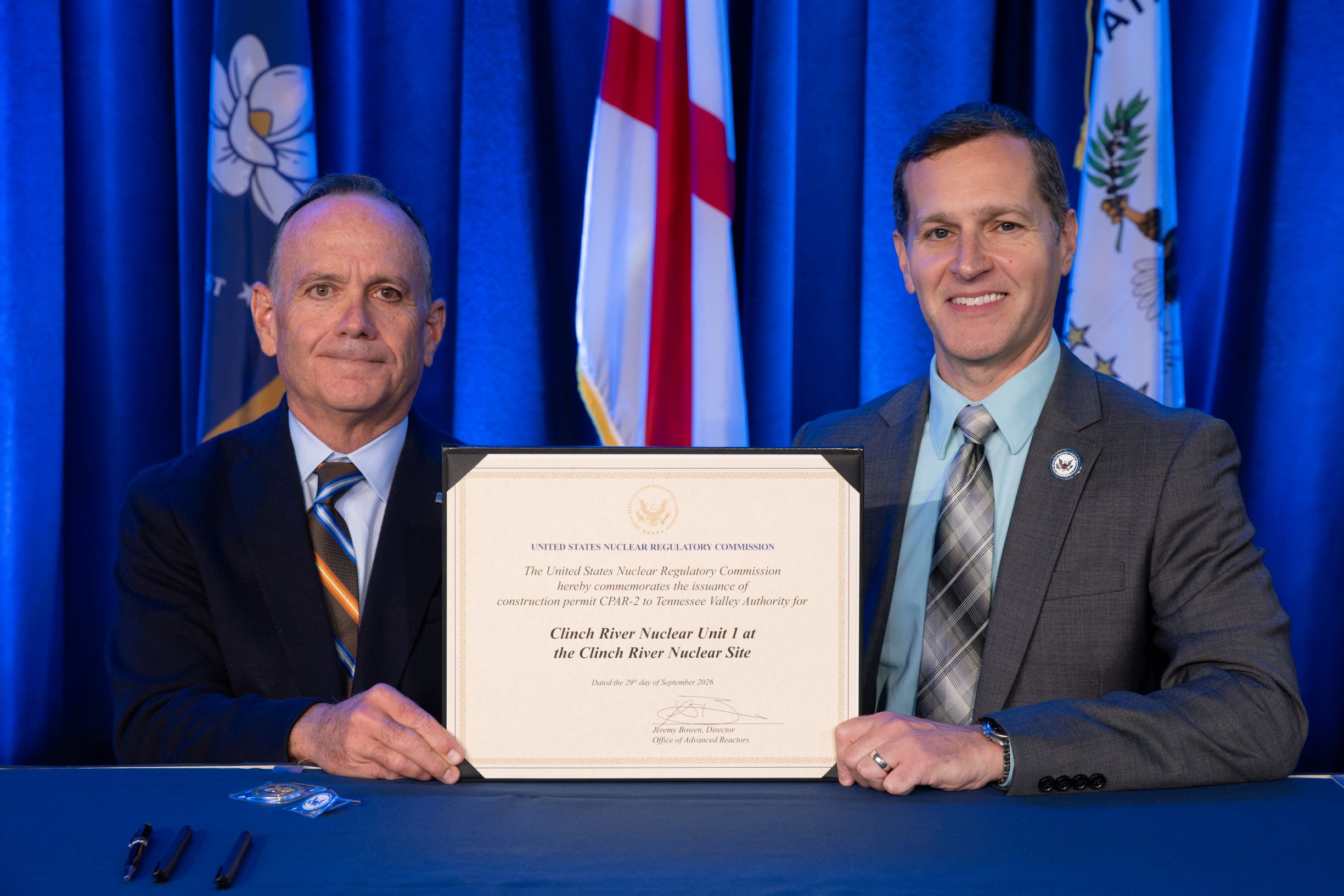
The U.S. Nuclear Regulatory Commission has issued a construction permit to the Tennessee Valley Authority for a BWRX-300 small modular reactor at the Clinch River site in Oak Ridge, Tennessee. This is the first construction permit issued in the United States for the BWRX-300 design, a 300-MW boiling water reactor built by GE Vernova Hitachi Nuclear Energy. TVA submitted its application in April 2025; the permit arrived September 2026 — roughly 17 months from application to approval.
Extraction Map
The permit matters less for what it authorizes at one site than for what it implies about a licensing pipeline. GVH is explicitly pursuing a fleet deployment model: a single standardized reactor design where each successive project inherits the licensing documentation, supply chain relationships, and construction lessons of the previous one. The Clinch River permit is the second BWRX-300 construction authorization in North America, following Ontario Power Generation's License to Construct at Darlington in April 2025, where construction is already underway. A third application — from Blue Energy for a gas-plus-nuclear project in Texas — landed at the NRC in September 2026. The fleet logic is straightforward: nuclear energy's cost problem has historically been a bespoke-engineering problem. Every plant was a unique build, with unique regulatory filings, unique construction sequences, and unique cost overruns. The BWRX-300's pitch is that a simplified boiling water reactor configuration, built from decades of operating experience, can be stamped out in series. If Clinch River's construction validates the design, the Texas and future projects inherit a regulatory precedent and a supply chain already tooled for the job. TVA's choice of Clinch River is not accidental. The site already held an Early Site Permit, reducing regulatory friction, and it sits within the Oak Ridge nuclear ecosystem adjacent to the Department of Energy's Oak Ridge National Laboratory. The federal alignment is explicit: GVH's statement references Executive Orders aimed at accelerating advanced reactor deployment, and the DOE's proximity provides institutional support infrastructure that a greenfield site would lack. The Canadian parallel is instructive. OPG's Darlington project is roughly 18 months ahead of Clinch River in the licensing timeline — OPG submitted its License to Operate application in March 2026 for a reactor whose construction license arrived in April 2025. If Darlington hits its construction milestones on time and on budget, Clinch River's case for federal and utility investment strengthens considerably. If Darlington slips — as nuclear megaprojects historically do — the fleet model faces an early credibility test. The 300-MW capacity positions the BWRX-300 in the gap between utility-scale renewables and traditional gigawatt-class nuclear plants. At 300 MW, a single unit can serve a data center campus, an industrial complex, or supplement a regional grid without requiring the decade-long, multi-billion-dollar commitment of a conventional reactor. The design's viability as a commercial product depends on whether construction costs actually decline with repetition — the central, unproven promise of the SMR concept. Three BWRX-300 projects are now in active licensing or construction across North America: Darlington (under construction), Clinch River (permitted), and Blue Energy Texas (application filed). The pipeline is real. The question that remains is whether the cost curve bends the way the fleet model requires, or whether each site discovers its own set of expensive surprises.
Worth reading?
RECOMMENDED
Score
72
/100
Generative — a standardized reactor design that successfully deploys as a fleet would create new low-carbon baseload capacity, reduce per-unit regulatory and construction costs, and expand the nuclear supply chain. The extractive risk is low at this stage; no ratepayer costs are being imposed yet.
What Is GRIN?
GRIN stands for Generativity, Resilience, Innovation efficiency, and Novelty openness. These four dimensions capture the essential characteristics of any memetic intelligence — whether a nation, a corporation, a religion, or a movement.
About GRINGenerativity
4/5
Resilience
3/5
Efficiency
3/5
Novelty
4/5
Extractive
1/5
Inverted
Does this create new capability or just redistribute existing value?
Genuine new capacity if the fleet model works. 300 MW per unit fills a real gap between renewables and gigawatt plants. The standardization bet is the generative engine — without it, this is just another one-off nuclear build.
Verified Facts (8)
NRC issued construction permit to TVA for BWRX-300 at Clinch River site in Oak Ridge, Tennessee on September 29, 2026
TVA submitted its construction permit application in April 2025
CNSC issued OPG a License to Construct the first BWRX-300 at Darlington in April 2025
OPG submitted its License to Operate application in March 2026
Blue Energy submitted the first part of its construction permit application to the NRC in September 2026 for a BWRX-300 in Texas
The BWRX-300 is a 300-MW small modular reactor
Eric Gray is CEO of GE Vernova Power Segment
Jason Cooper is CEO of GE Vernova Hitachi Nuclear Energy
More latest news
Read all