WEBSITES EXPOSED
225M+
CVSS SCORE
9.2
BUG LATENCY
11 yrs
INDEPENDENT TEAMS
5
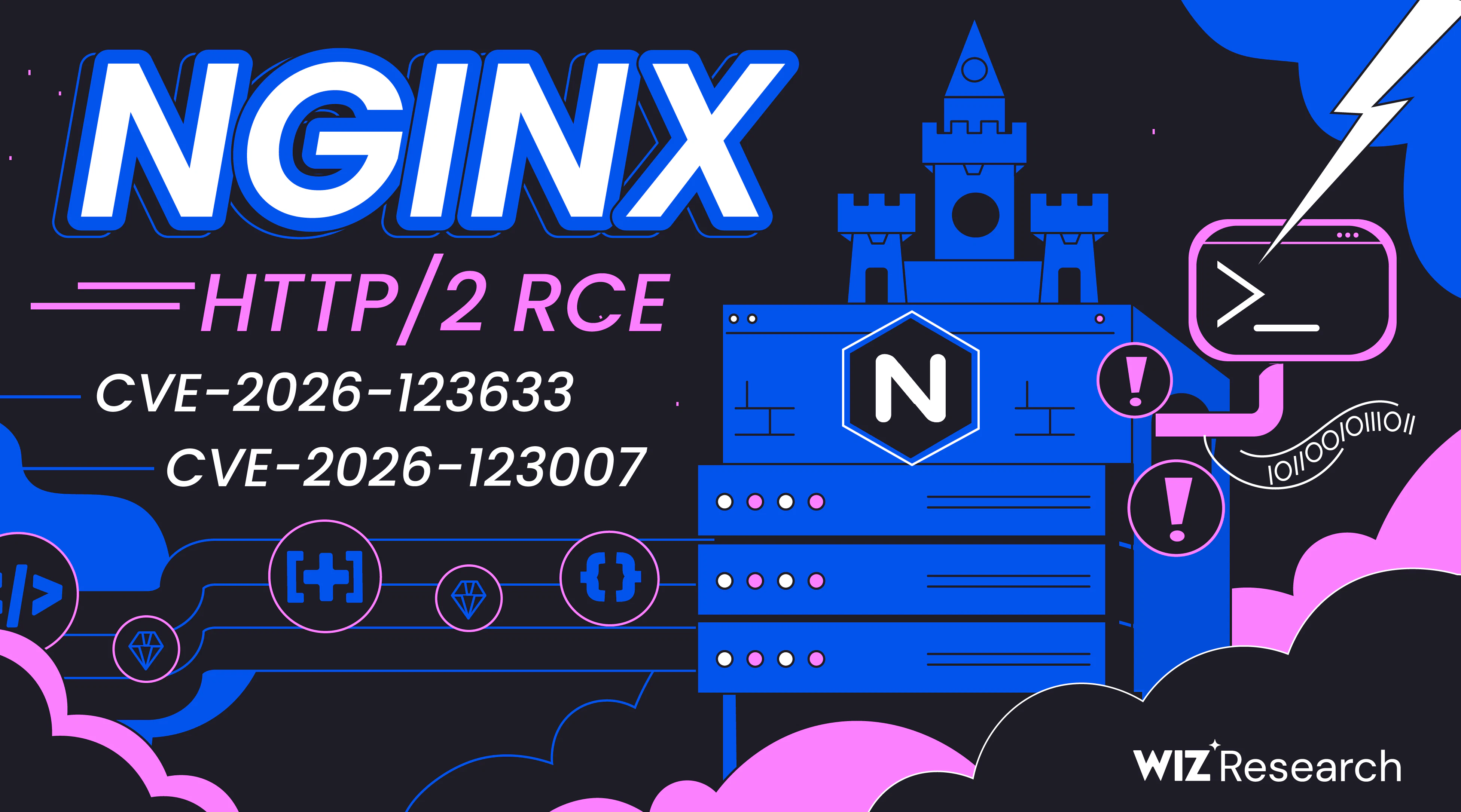
Two critical remote code execution vulnerabilities in NGINX — CVE-2026-123633 and CVE-2026-123007, both scoring CVSS 9.2 — allow unauthenticated attackers to fully compromise servers handling traffic for over 225 million websites. The flaws are memory-safety bugs in HTTP/2 processing: a use-after-free and an integer underflow. Neither requires a vulnerable backend application. One was demonstrated on a server serving static files with no third-party modules.
Extraction Map
The integer underflow (CVE-2026-123007) has existed since NGINX 1.9.5, released in 2015 — more than eleven years undetected. The use-after-free dates back nearly six years. Both bypass ASLR, the standard memory-safety mitigation, because attackers can use the vulnerabilities themselves for memory read access before achieving code execution. F5's November 18 security release patches both, alongside seven additional CVEs including HTTP/3 use-after-free, DNS resolver RCE, and mail proxy RCE — all rated critical or high. The discovery mechanism is the real structural story. Wiz Research, Ikotas Labs, Metnir, Rapid7, and Xint independently found the same vulnerabilities. Wiz used Gemini 4 Carbon and ChatGPT 5.6 Sol to validate exploitability. This follows last month's PHP2Shell and yesterday's Java4Shell disclosures — all memory-safety flaws in foundational internet infrastructure, all found by AI-assisted research, all hidden for years. Five independent teams converging on the same bugs is not coincidence; it is a signal that AI has crossed a capability threshold for vulnerability discovery in complex C codebases. The operational exposure is enormous. NGINX commonly sits as a reverse proxy in front of multiple applications and APIs, meaning a single compromised deployment cascades across every service behind it. HTTP/2 is the default protocol for modern web traffic. The mitigation for organizations that cannot immediately patch is to disable HTTP/2, which degrades performance and may break integrations. The window between disclosure and widespread exploitation is compressing, and security teams face substantial manual work to validate patches and coordinate rollouts across production environments. F5's coordinated release addresses nine CVEs total, spanning NGINX versions from 0.5.33 through 1.31.8. The breadth of affected versions — some stretching back to 2006 — underscores a systemic problem with memory-unsafe languages in critical infrastructure. The bugs span HTTP/2, HTTP/3, DNS resolution, mail proxying, and stream handling. This is not a single oversight; it is the accumulated technical debt of a C codebase that processes untrusted input at internet scale. The deeper implication is a permanent shift in the economics of vulnerability discovery. Complexity was the practical barrier — tracing subtle interactions between memory operations across multiple code paths required expertise and time that limited the attack surface practically accessible to researchers and adversaries alike. AI models are dissolving that barrier on both sides simultaneously. Defenders and researchers find bugs faster, but so do attackers. The net effect is a compression of the window between a vulnerability existing and being exploited, which transfers risk directly onto security operations teams who must patch faster with the same resources. The Wiz team frames this correctly: each new generation of AI models will uncover more complex vulnerabilities that were previously beyond practical reach. The question is no longer whether critical infrastructure has undiscovered memory-safety flaws — it does — but whether patch deployment can keep pace with AI-accelerated discovery. For NGINX specifically, organizations should identify all deployments, verify HTTP/2 configuration, and apply the November 18 patches immediately. For the ecosystem broadly, this is an argument for memory-safe rewrites of foundational internet infrastructure that grows harder to ignore with each disclosure cycle.
Worth reading?
OPTIONAL
Score
48
/100
Mixed — AI-accelerated discovery is generative long-term (hardening foundational software) but extractive short-term (compressing patch windows faster than defenders can respond, transferring costs to under-resourced security teams).
What Is GRIN?
GRIN stands for Generativity, Resilience, Innovation efficiency, and Novelty openness. These four dimensions capture the essential characteristics of any memetic intelligence — whether a nation, a corporation, a religion, or a movement.
About GRINGenerativity
3/5
Resilience
1/5
Efficiency
2/5
Novelty
4/5
Extractive
3/5
Inverted
Does this create new capability or just redistribute existing value?
Net generative over decades: AI hardens code that was practically unauditable. But short-term, the same capability arms attackers. Five independent teams finding the same bugs signals a capability unlock, not a one-off.
Verified Facts (9)
NGINX powers more than 225 million websites.
CVE-2026-123633 and CVE-2026-123007 are both rated Critical with CVSS 4.0 score of 9.2.
CVE-2026-123007 affects versions dating back to NGINX 1.9.5 in 2015.
Both vulnerabilities require HTTP/2 to be enabled on the affected NGINX server.
Wiz Research used Gemini 4 Carbon and ChatGPT 5.6 Sol to validate the impact of both vulnerabilities.
Five teams independently discovered the vulnerabilities: Wiz Research, Ikotas Labs, Metnir, Rapid7, and Xint.
F5's security release on November 18 addresses nine CVEs total.
Testing of CVE-2026-123007 demonstrated code execution on NGINX serving ordinary static files, without a backend application or third-party modules.
Typical memory safety mitigations such as ASLR do not protect against these issues.
More latest news
Read all